
Meta's VR Glasses puck takes DisplayPort in, for use as a Mac, Windows or console display

The puck that carries the Meta VR Glasses battery and processors has a DisplayPort input, and Meta’s own developer documentation lists it for use “as a Mac, Windows, or console display”. The connectivity rows for the glasses give the puck “1x USB-C” and “DisplayPort DP-In”, on a headset Meta says goes on sale in spring 2027 for $1,299.99 in the US.
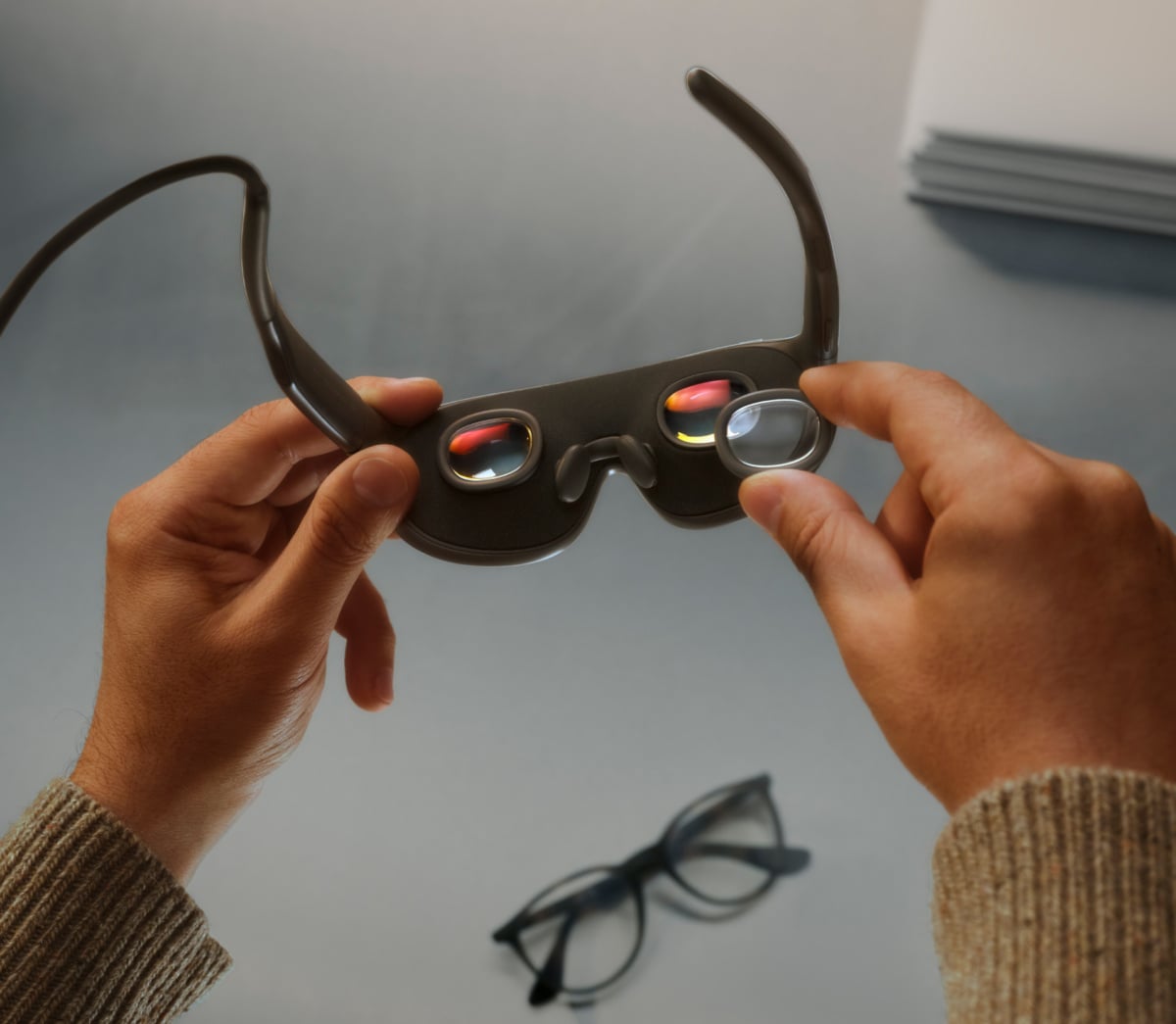
Meta puts the battery and the processors in a separate puck, which is where both ports live. Image: Meta
That is a video input rather than an output, so the glasses are the screen and something else does the rendering. None of the consumer material spells it out: Meta’s announcement post offers only the option to “connect your Mac or Windows PC wirelessly or over USB-C”, and to “connect to your handheld gaming device wirelessly or via USB-C to play on a big screen”.
Meta lists the processor two different ways
The comparison table names the chip “Snapdragon XR2 Gen 3”. Meta’s announcement post says the glasses are “powered by Qualcomm’s new Snapdragon Reality Elite processor”, and both pages are Meta’s own, so the documentation contradicts itself and the company has not said which entry is right.
Both chips exist. Qualcomm announced the Snapdragon Reality Elite as its new XR part in June 2026, while the XR2 Gen 3 is the generation above the chip in a Quest 3.
The spec sheet stops short of the useful details
Meta does not name a console, a resolution, a refresh rate or a cable requirement for the DisplayPort input, and does not say whether a handheld needs DisplayPort alt mode of its own to use it. Documentation describing a capability on a device that does not go on sale for another six months or more is a long way from a tested feature, and nothing here says how the glasses handle a desktop at their own panel resolution.
What the table does state, for the glasses themselves:
- Micro-OLED at 2412 x 2288 per eye, 37 PPD, 120Hz, with Dolby Vision, HDR10 and HLG support
- Colour stereoscopic passthrough at 26 PPD, with autofocus and depth sensing
- Head, hand and eye tracking, and manual per-eye IPD from 56 to 70mm
- 12GB of RAM, Wi-Fi 7 and Bluetooth 5.4
- Two speakers with Dolby Atmos, and battery life of “up to ~3 hours for media playback”
The field of view is 70 degrees horizontal and 66 degrees vertical, which is a good deal narrower than the 110 degrees a Quest 3 shows. For a wired external display that is less of a problem than it is for room-scale VR, because a virtual monitor does not have to fill the edges of your vision.
Nothing ships before spring 2027
Meta’s glasses weigh about 100 grams, put everything heavy in the puck, and do not go on sale until spring 2027 at $1,299.99. Until then the DisplayPort line is a spec on a developer page, and Meta has kept it out of the consumer pitch entirely.

