
Anthropic scores Opus 5.5 at 66.4% on Terminal-Bench, but ran the test itself
Anthropic says Claude Opus 5.5 scores 66.4% on Terminal-Bench 4.0, an agentic coding test it ran itself and published with the model on September 22. The public Terminal-Bench leaderboard, checked the same day, carries no Opus 5.5 result at all, and its top entry is GPT-6 Astra (max) on 58.2%.

GPT-6 Astra tops the public Terminal-Bench 4.0 board on 58.2%, run through OpenAI's Codex harness. Image: OpenAI
The two numbers come from different places and do not line up. Anthropic ran Opus 5.5 on its own setup at xhigh effort and took GPT-6 Astra's 57.9% from OpenAI's reporting rather than running that model. The Terminal-Bench board, hosted by Stanford, Harbor and the Laude Institute, lists runs submitted to it, and the 58.2% at the top of it was scored through OpenAI's Codex harness.
The public board has no Opus 5.5 row yet
Behind GPT-6 Astra sit Anthropic's own Fable 5.1 (max) on 57.9% through Claude Code, then Opus 5 (xhigh) on 53.9%, each with a 95% confidence interval of roughly three points. Opus 5.5 came out on September 22, so its absence from the board is a question of timing rather than a verdict on the model.
Anthropic is unusually open about how it reached its figure. It gives the effort setting, a standard error of ±2.6 points, and a check on its own harness: the public board scores Opus 5 at 51.8%, and Anthropic's setup puts the same model at 52.3%, which it calls within noise.
A vendor's own run is still a vendor's own run. Until Terminal-Bench takes in an Opus 5.5 submission, the 66.4% is Anthropic measuring Anthropic, and it cannot be set against the 58.2% on the public board as though both came out of the same harness.
GPT-6 Astra wins two rows of Anthropic's own comparison
Anthropic lines up nine benchmarks, and Opus 5.5 loses two of them to GPT-6 Astra, the OpenAI model that cracked a 1941 Enigma message unsolved since 2005. Astra takes AutomationBench at 41.4% against 40.0%, and Terminal-Bench-Science 0.1 at 64.6% against 58.7%.
Anthropic says Zapier ran and reported the AutomationBench figures without fallback models, so every time Opus 5.5's safeguards intervened the task counted as a failure. Only GPT-6 Astra and GPT-5.6 Sol appear as rivals in the comparison, and no Google model appears in it at all.
One independent board has already posted a score
Artificial Analysis now puts Claude Opus 5.5 (max with fallback) at the top of its Intelligence Index on 58, with the xhigh and high settings on 56 and 54, ahead of Claude Fable 5.1 and GPT-6 Astra on 53. The cost per task and output speed columns are empty for every Opus 5.5 entry, and Artificial Analysis labels each current Claude model, Fable 5.1 included, "with fallback".
Artificial Analysis also owns GDPval-AA v2.1, the knowledge-work test Anthropic claims 1846 Elo on against 1735 for Fable 5.1. That score is Anthropic's run of someone else's benchmark, not a result Artificial Analysis has published.
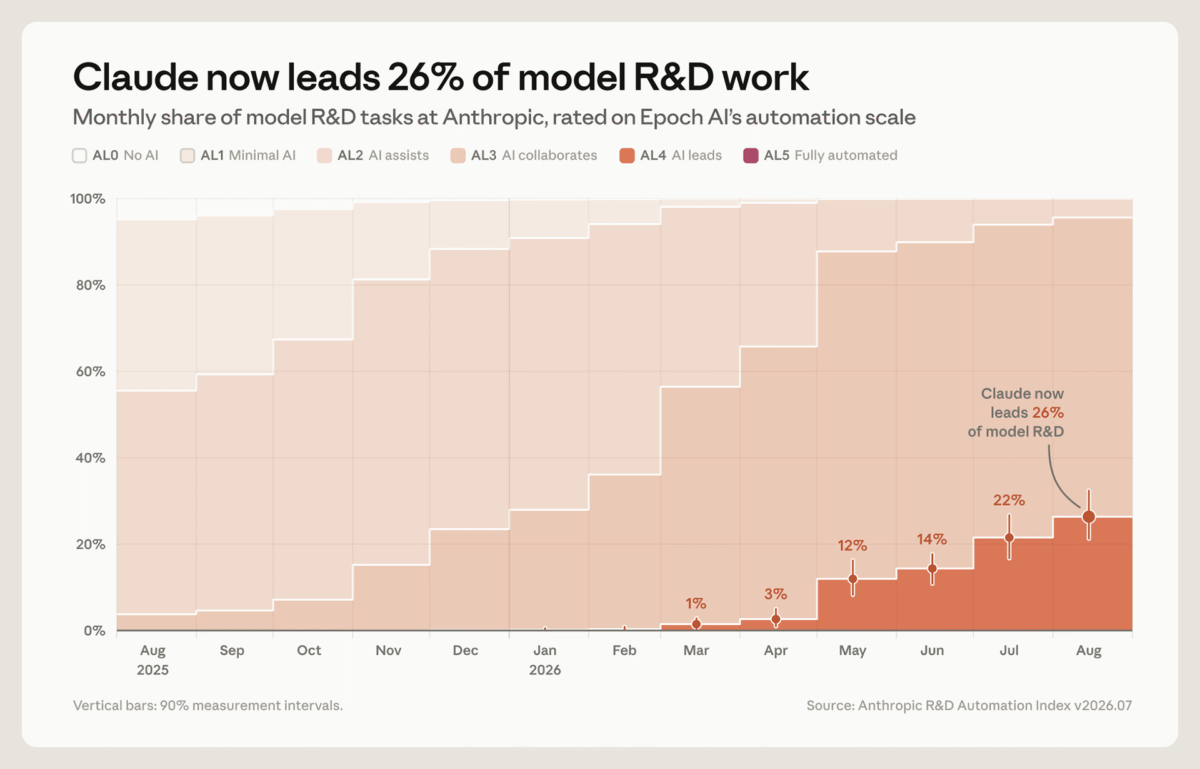
Anthropic has a habit of publishing its own measurements of its own work, including the claim that Claude led 26% of its AI research work in August. This time it pairs the numbers with a caution of its own: at these levels of capability, the company says, benchmark margins "have become a less reliable guide to real-world differences", and in its own use the gap between Opus 5.5 and Fable 5.1 is narrower than the scores suggest.

