
Anthropic says Claude led 26% of its own AI research work in August
Anthropic says Claude "leads" 26% of the company's own AI research and development work as of August 2026, but the figure is self-reported and has not been independently verified. It comes from a report Anthropic published on September 17, which also says about 30,000 AI agents were at work on its most-used internal platform at any one time in August.
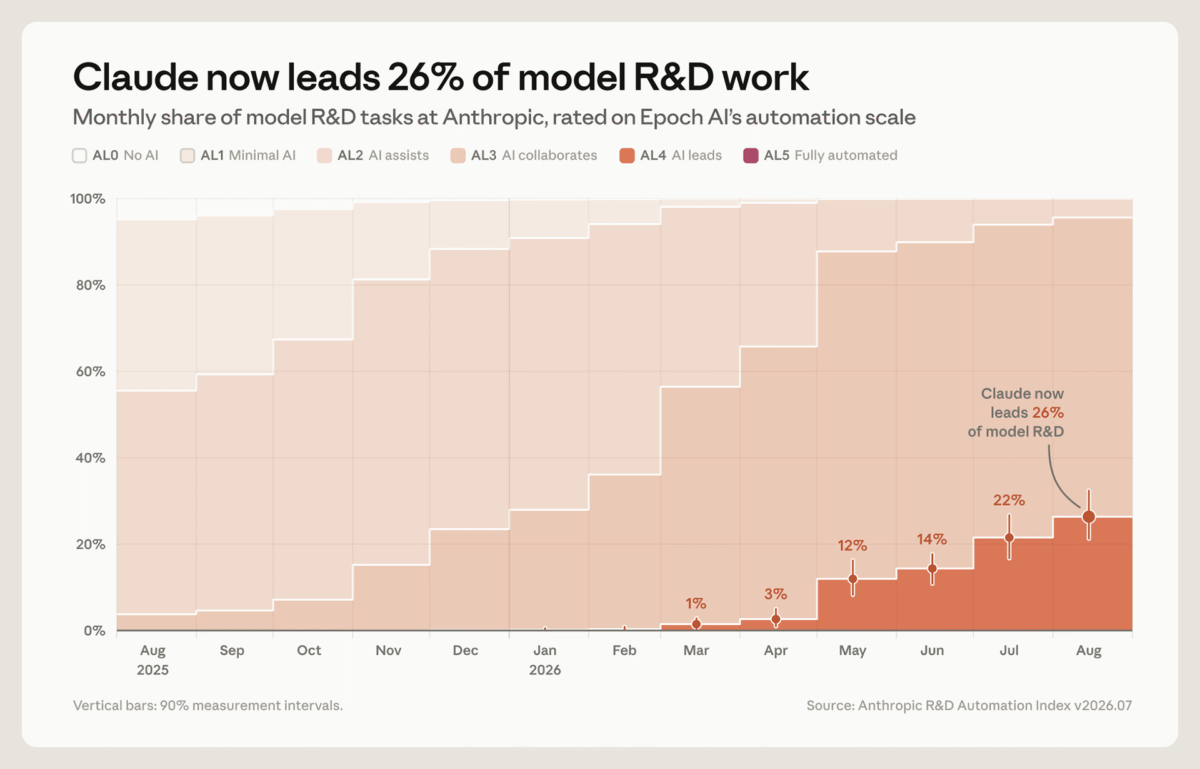
Anthropic's own chart: the share of its model R&D work that Claude 'leads' rose from under 1% in February 2026 to 26% in August. Image: Anthropic
The report proposes three measures that any frontier lab could publish: how much AI research is done by AI, how closely AI agents are watched, and how much computing power goes to safety. Anthropic then gives its own numbers for each.
Anthropic defines what "leads" means
The 26% does not mean Claude does a quarter of the research on its own. Anthropic uses an automation scale developed by Epoch AI that runs from AL0, no AI involvement, to AL5, where AI works fully autonomously with no human in the loop.
At AL4, "leads", the AI "can complete most of the task end-to-end from a high-level prompt, while the human supervises". Anthropic's example is a broken nightly data pipeline: Claude finds and fixes the fault and writes it up, but an engineer still decides whether the fix ships.
Anthropic says 26% of its AI research work sits at that level, more than 90% is at or above AL3, "AI collaborates", and no measured area is fully autonomous. A chart in the report shows the "leads" share rising from under 1% in February 2026 to 26% in August.
The method leans heavily on Claude itself. Anthropic sampled 20% of staff in each relevant department every week in July, had a Claude agent list their tasks from Slack and internal documents, then had a separate Claude "judge" rate how automated each kind of work is.
Anthropic concedes the weak spot. Using its own models to evaluate its own systems means the judge "could make the same kinds of errors as the model it is checking", although it says the judge agreed exactly with staff ratings 59% of the time, while staff agreed with each other only 35% of the time.
Anthropic's monitor blocked one in 47,000 agent decisions in August
As of August 2026, Anthropic says about 30,000 agents were doing research and engineering work at any one time on its most-used internal platform, and its figures cover that platform only. An automated monitor reviews their actions before they run.
Across more than a billion agent decisions in August, Anthropic says 0.002% were blocked, or about one in 47,000. Humans review blocked actions within a week, and a second, after-the-fact monitor flags roughly 100,000 transcripts a week, of which about 50 reach a human.
That is a small rate on a very large number. Anthropic's own point is that individual agents rarely misbehave, but at millions or billions of agents "even rare events can happen regularly."
Safety got about 6% of research compute in one July week
The compute figure comes from a single week, July 13 to July 20. In that week, Anthropic says about 6% of the compute used for AI research went to safety work, and about 12% of the compute used for AI-driven research.
Anthropic calls these deliberately conservative numbers. Work that helped capabilities as much as safety counted as general research, and Anthropic's safeguard classifiers, which it says use a separate and comparable amount of compute, are left out entirely.
Anthropic also notes that one week is enough to show the measurement can be made, not enough to show a trend. The pool being divided is large: SemiAnalysis estimates that cumulative AI capital spending could reach about $11.1 trillion from 2024 to 2029.
So every headline number here is a self-reported snapshot, measured by Anthropic with Claude's help: the compute share covers July 13 to July 20, and the research share and agent figures cover August. Anthropic says it plans to embed independent third-party evaluators with access to its internal systems and to publish the measures regularly, and it argues that "any frontier developer could publish these measures regularly, using a public methodology."
Until another lab publishes the same measures, the 26% is a figure with nothing to compare it against.

