
GPT-6 Astra cracks a 1941 Enigma message that had resisted solution since 2005

OpenAI's GPT-6 Astra has broken a German Army Enigma message from July 10, 1941 that nobody had managed to read, and the Enigma researcher who publishes it has confirmed the result. Carter Leffen, who ran the model, wrote in a post on X on September 17 that GPT-6 Astra had broken the message two days earlier, and his case study dates the investigation to September 14 and 15.
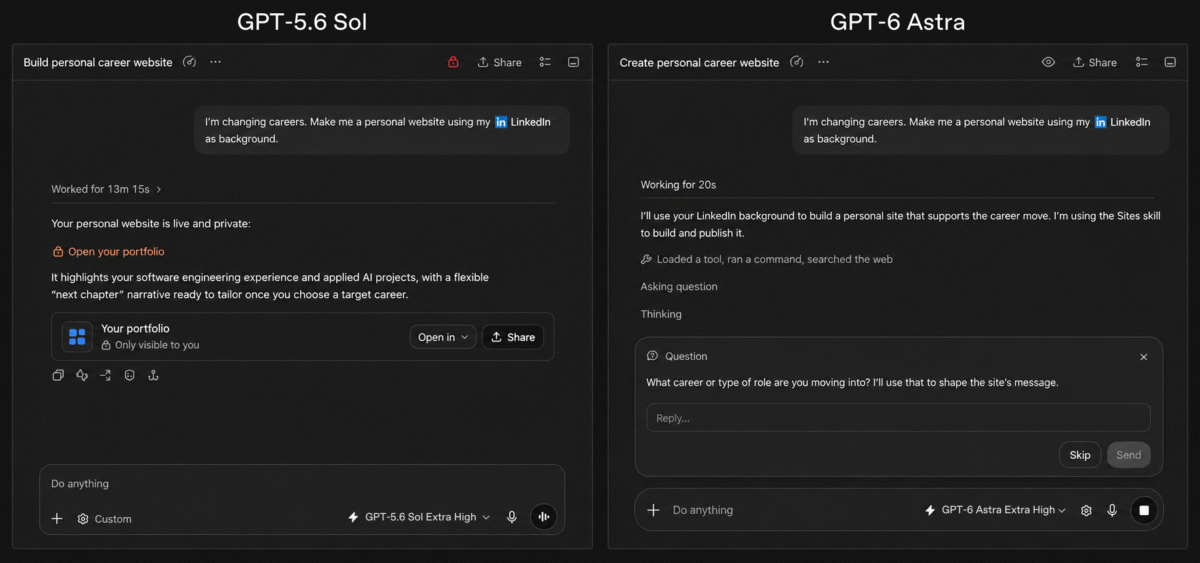
OpenAI's launch post shows GPT-6 Astra in ChatGPT at its Extra High setting. Image: OpenAI
The 82-letter message, known by its indicator MVUEH, was listed among the unbroken messages on Frode Weierud's CryptoCellar research site. Weierud writes that "since 2005, the message has resisted all attempts to break it."
A request for directions in Rosenow
The plaintext is short and unglamorous. According to Leffen's case study, it reads "Please specify the route of march. I am in Rosenow, Rosenow. Immediate reply by radio," signed by a sender tentatively read as Waschbusch.
The key turned out to use Enigma I with reflector B, rotor order II-V-III, ring settings H-M-F and ten plugboard pairs. Weierud says it is "completely different from the other keys from 10 July 1941", down to the wheel order, which helps explain why the known daily key never opened it.
Two other problems stood in the way. Weierud says the published transcription of the ciphertext contained several errors, and the machine's left-hand rotor turns over at the 72nd letter, a rare event that complicates a break.
Two accounts differ on how much the model did alone
The breakthrough came from a guess. A related message from the same day, SIPVX, had been broken in 2017 and contained the repeated town name ROSENOWROSENOW, so the search used those 14 letters as a crib, a suspected piece of plaintext, to narrow down the possible settings. The case study is candid that the known SIPVX text "helped motivate the crib; it was not a blind prediction."
Who made that call depends on which account you read. Leffen's case study describes "a researcher-led investigation with GPT-6 Astra and parallel specialist agents", in which "the researcher set the goal and pushed the investigation forward." Weierud's account gives the model far more credit. He says Leffen only asked the model to try the unbroken messages on his site, and that GPT-6 Astra picked MVUEH, spotted the link to SIPVX, chose the crib and wrote its own Enigma simulator and Bombe software in Python and C++. To Weierud, "the most astonishing thing about this break" is that GPT-6 Astra "did it entirely on its own".
Leffen's own post on X is closer to Weierud's version. It lists searching historical archives, comparing uncertain letters, building an Enigma simulator and recovering the plaintext among the things the model did "autonomously".
The result checks out, with limits
Verification is the strongest part of the case. Weierud, who received the details on September 15, says "it was immediately clear he had found the correct key and plaintext", and his site now lists the break under "Breaking news".
The case study says separate implementations reproduced the full message body and its header, and that all 43,016 batches of the Rosenow search were accounted for. It is also careful about what it claims: "This is not the original breaking of Enigma, and no first-ever or corpus-wide breakthrough is claimed."
The work was done by a user, not announced by OpenAI. OpenAI's GPT-6 Astra launch post pitches the model on computer use, science and cybersecurity, and says it is coming to ChatGPT Plus, Pro, Business and Enterprise users as well as the API.
In July, Sam Altman was defending language models against critics who called them a dead end. Weierud, who says he spent several weeks on the archive files the model cited, sums up his reaction: "as an old cryptanalyst, I am still in awe."

