
Tencent's Gander talks while it thinks, and hands the hard work to Codex or Claude Code
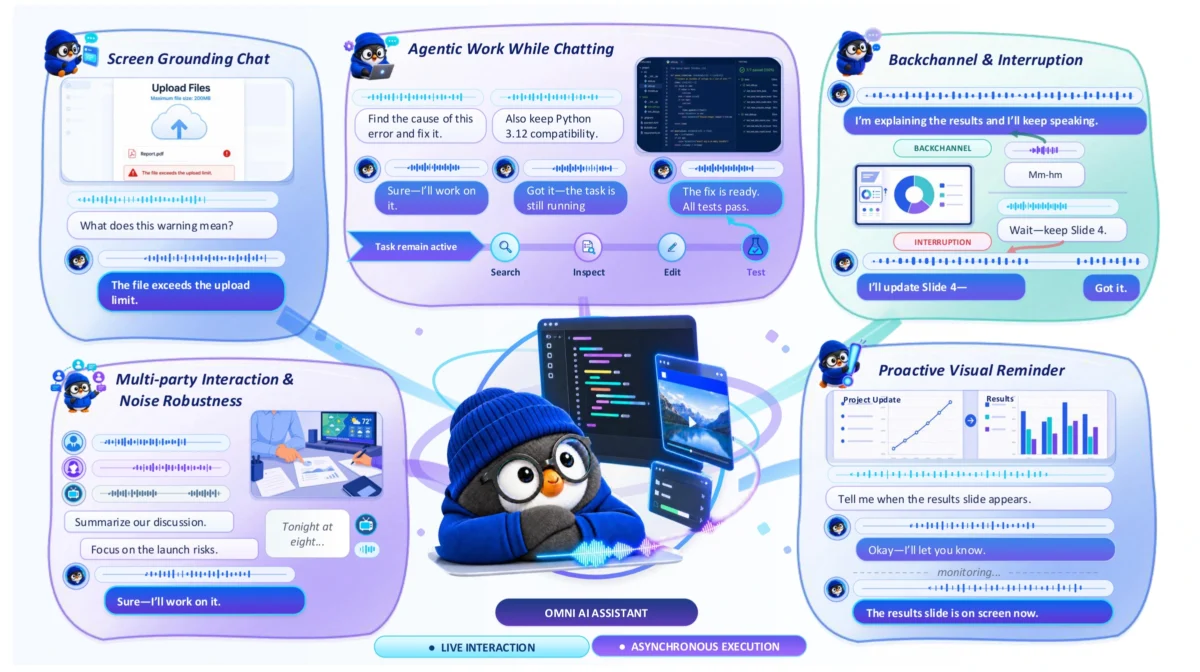
A research team led by Tencent's Hunyuan Speech group has published Gander, a voice model that keeps a conversation running while a separate coding agent grinds away on the actual task in the background. The paper, posted to arXiv on September 8 and revised on September 12, names Codex and Claude Code as the agents that can sit in that background slot, swapped in without any retraining.
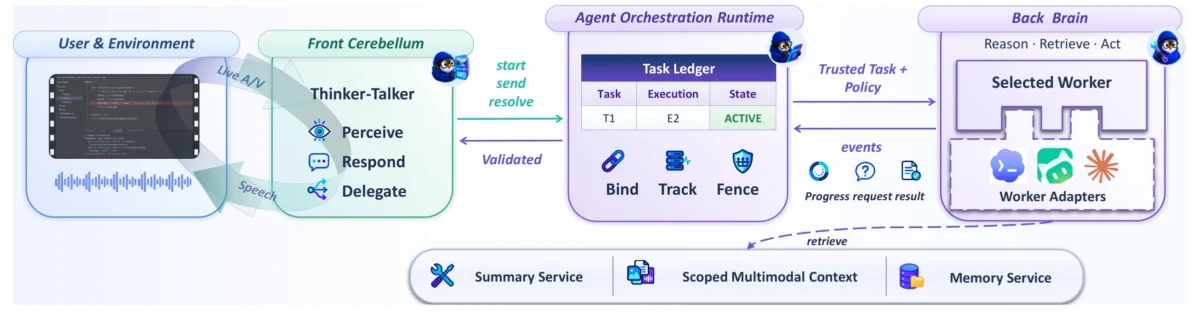
The front cerebellum handles live conversation while the back brain, by default Codex, runs the task through the orchestration runtime. Image: Tencent Hunyuan Speech Team and academic collaborators
What matters here is the interaction design rather than the model itself. A pair of glasses has no screen to fill a silence with, so an assistant that goes quiet for 30 seconds while it thinks is the wrong shape for the hardware, and Gander is a public, inspectable attempt at the right one.
A small model talks, a big agent works
Gander splits the job in two. The "cerebellum" is a 9B model built on MiniCPM-o 4.5 that handles live speech, vision and text, cutting the incoming stream into fixed one-second windows. It predicts one control token per window, choosing to listen, to speak or to interrupt itself, which is how it can be cut off mid-sentence, ask a follow-up question or drop in an acknowledgement while something else runs.
The "brain" is an ordinary general-purpose agent that gets no extra training. In the authors' own runs it is the Codex app server driven by GPT-5.6, and the code repository builds its provider layer as a registry so another agent can be plugged in without touching the conversational side. Codex is the only provider shipped in the repository so far, so Claude Code is named in the paper rather than included in the code. The cerebellum decides for itself which requests it can answer and which need handing over.
The turn-taking numbers are the strongest part
On Full-Duplex-Bench v3, a 100-scenario suite for tool-using spoken assistants, Gander takes the floor at an appropriate moment in all 100 scenarios, matched only by a cascaded Whisper to GPT-4o to text-to-speech pipeline, and starts speaking over the user in 8.0% of turns. The paper puts that against 13.5% for GPT-Realtime and 47.9% for the weakest system in its table, which manages 96.0% on turn-taking by interrupting constantly.
That is the part a glasses assistant would notice. Cutting the user off is the failure people remember, and Meta has said its own Muse assistant is heading to its glasses, so the bar for conversational manners is about to be set in public.
The accuracy is the price, and so is the waffle
On the same benchmark Gander comes last on all four task-accuracy metrics. Its strict Pass@1, which requires exactly the right tools with every argument correct, is 0.400 against 0.410 for the next worst system and 0.600 for GPT-Realtime at the top. Tool selection lands at 0.759 against that same system's 0.794, argument accuracy at 0.503 against 0.513, and response quality at 0.490 against 0.510 at the bottom and 0.792 at the top.
The talking has its own cost. Gander prefaces 51.6% of its turns with a conversational placeholder, the one interaction metric where it does not lead, and the authors say brief acknowledgements keep the conversation alive while a delegated task runs but concede there is room to cut unnecessary filler. An assistant that says "let me look at that" every other turn is a different kind of annoying from one that talks over you.
The authors point at the speech path and the routing decision rather than the agent. When they run the same back-end agent straight from a text transcript, with the conversational model and the audio channel removed, Pass@1 rises to 0.520 and response quality to 0.740, and tool selection reaches 0.934, higher than any other system in the table including GPT-Realtime's 0.876. Pass@1 still sits below GPT-Realtime there, and the paper says its runs do not separate the two effects. On the team's own figures, the two-tier design currently costs accuracy to buy responsiveness.
What is actually released
The code is on GitHub under Apache 2.0 and the model weights are on Hugging Face. The paper's abstract says the data is released too, but the repository lists the dataset as coming soon and says it is still going through the open-source release process. The benchmark figures are the team's own, run with the suite's released scoring scripts and the GPT-4o judge the baseline protocol uses, and nobody outside the project has reproduced them.
Gander is also a paper, not a product. The project page and the paper describe it as an academic research project, with authors from Tencent's Hunyuan Speech team, Zhejiang University, Shanghai Jiao Tong University, the Chinese University of Hong Kong and Nanyang Technological University. No Tencent device is attached to it, and nothing in the work says any of this is heading for a pair of glasses. It arrives in a week when Alibaba cut its audio input prices by 98%, which is the other half of the same problem: the interaction model has to be good, and the audio has to be cheap enough to leave running.

