
Alibaba says its new Qwen model can locate targets by sound, and cuts audio prices by 98%
Alibaba's Qwen team released Qwen3.8-Omni-Flash on September 18, an omnimodal model that takes text, image, audio and video in and holds a 1M-token context window. The claim buried in the middle of the post is the one that matters to anyone building an assistant into glasses or a headset.
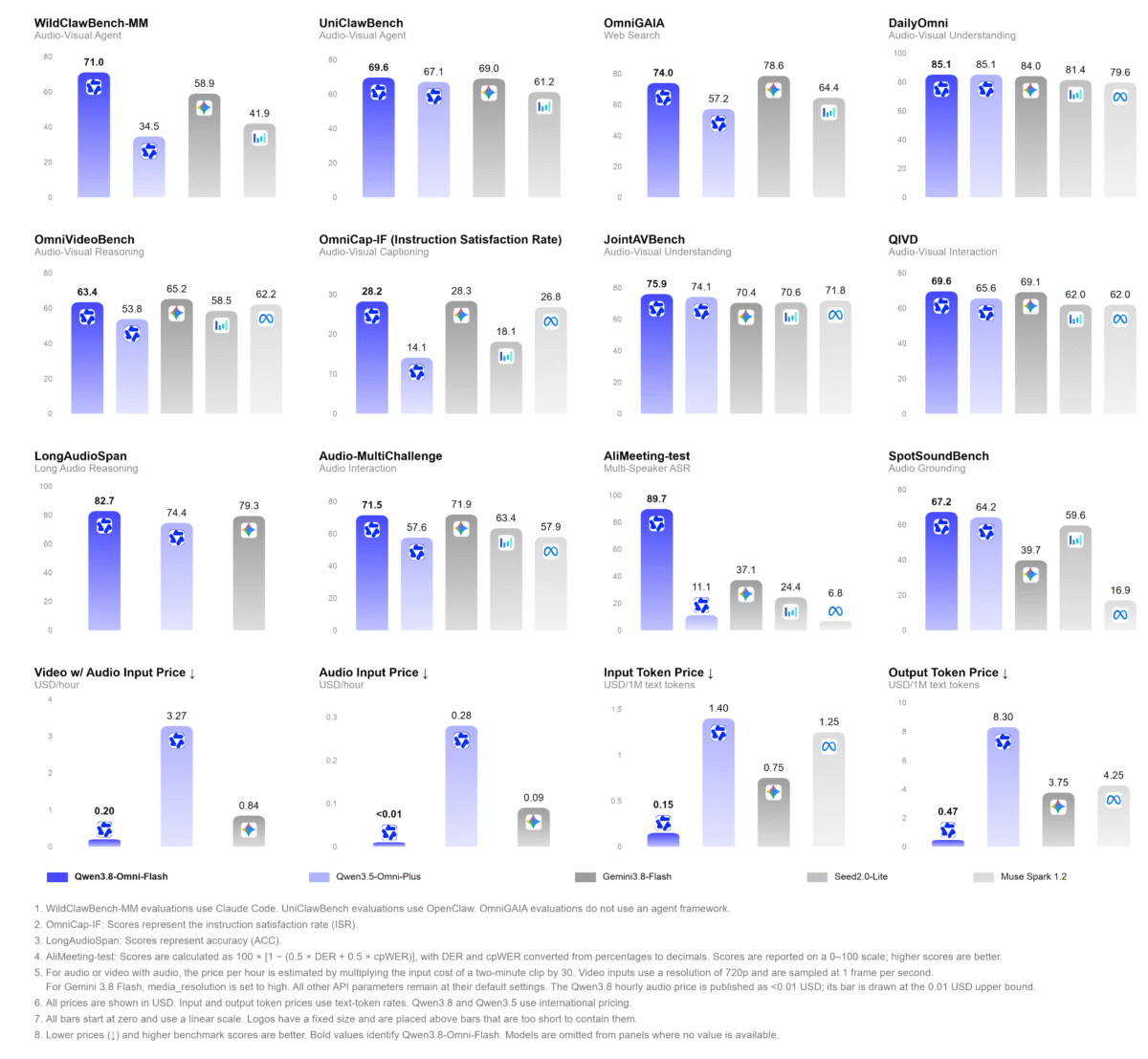
Qwen's own overview chart, setting Qwen3.8-Omni-Flash against Gemini 3.8 Flash and three other models on 12 benchmarks and four price measures. Image: Qwen Team, Alibaba
Qwen says the real-time version of the model "combines spatial sound with visual information to continuously determine the direction and distance of sound sources while perceiving obstacles, navigable areas, and changes in the scene, making it the first omnimodal model capable of locating targets by sound". That is Qwen's own claim, and nobody outside the company has checked it.
Locating a sound is exactly what a wearable assistant has to do
The example Qwen gives is the one a glasses owner would recognise. For instructions such as "come over here" or "go see what is making that sound", Qwen says the model can isolate voices and target sounds from environmental noise, work out where in the room they are coming from, and then call tools to perform localisation, search, path planning and navigation.
The number behind it is SpotSoundBench, an audio grounding test, where Qwen scores its model at 67.2 against 39.7 for Gemini 3.8 Flash. That figure sits in Qwen's own results table alongside every other score in this article, so read it as a vendor claim rather than a result.
The spatial work runs on a separate model, Qwen3.8-Omni-Flash-Realtime, which handles live streams over WebSocket and WebRTC. Qwen names no glasses or headset partner in the post, and lists no shipping product built on any of it.
The price cut is the other half of the announcement
Qwen says the API price per hour of audio input falls by more than 98% against Qwen3.5-Omni-Plus, and the price per hour of audio-visual input by more than 93%. Its chart puts the old model at $0.28 per hour of audio input and the new one at under $0.01, with Gemini 3.8 Flash at $0.09. For video with audio, the same chart shows $3.27 against $0.20. Across 29 evaluations, Qwen puts the average score more than 25% above the older model.
The methodology is Qwen's, and it is footnoted on the page: hourly prices are estimated as 30 times the input cost of two minutes of source material, video is counted at 720p and one frame per second, and the Gemini and Muse prices are converted from dollars at 1 USD to 6.7191 CNY. It is a drop against Qwen's own previous model on Qwen's own accounting, not a like-for-like tariff comparison with anyone else.
Where it lands against Gemini 3.8 Flash
Qwen published a full comparison table, and it does not win everything. It puts Qwen3.8-Omni-Flash ahead on WildClawBench-MM at 71.0 against 58.9, on StreamingBench at 80.8 against 79.9 and on UniClawBench at 69.6 against 69.0, while Gemini 3.8 Flash leads on several, including AgenticVBench at 45.0 against 36.8 and OmniVideoBench at 65.2 against 63.4.
Qwen's own summary is measured: "audio-visual performance close to Gemini 3.8 Flash and overall audio performance that exceeds Gemini 3.8 Flash". The agentic rows carry a further caveat, since Qwen ran WildClawBench-MM and AgenticVBench through the Claude Code harness and UniClawBench through OpenClaw.
The latency figures are published too, and they are the ones a voice assistant lives or dies by. On a six-second audio input, Qwen measures 591ms to first token and 978ms to the first audio packet. On a 20-second audio-visual input, those rise to 981ms and 1,350ms.
The weights are not open
Speech recognition covers 74 languages plus 39 Chinese dialects, and speech generation 29 languages plus seven dialects. The model natively supports up to one hour of audio-visual input and recognises speakers jointly across audio and video, which is how Qwen gets its multi-speaker meeting scores on AliMeeting down from 88.11 and 89.61 to 3.35 and 17.18 on diarisation error rate and cpWER.
Despite Qwen's open-source reputation, the weights are not published. The model runs on Alibaba's Qianwen AI Platform through an OpenAI-compatible API, with Beijing and Singapore endpoints. What Alibaba did open-source alongside it are two tools: Qwen-MM-Plugins, a plugin suite that installs into agent harnesses including Codex, Claude Code, Qwen Code and Gemini CLI, and Qwen-Live Harness, a runtime for continuous audio-visual interaction.
Chinese labs have spent the year undercutting OpenAI and Anthropic on API price, and an assistant that can hear where you are pointing it is a more interesting thing to sell cheaply than another chatbot. The nearest thing actually on the market is Meta's Muse agent, which the company says is coming to its AI glasses.

