
Google will release Gemini 4 Argon without cyber guardrails to trusted defenders

Google says it will be “releasing Argon without cyber guardrails” to trusted defenders and to its own internal teams at Google, so they can use what it calls the model’s “full frontier-level cybersecurity defense capabilities”. Those are the only two groups the company names.
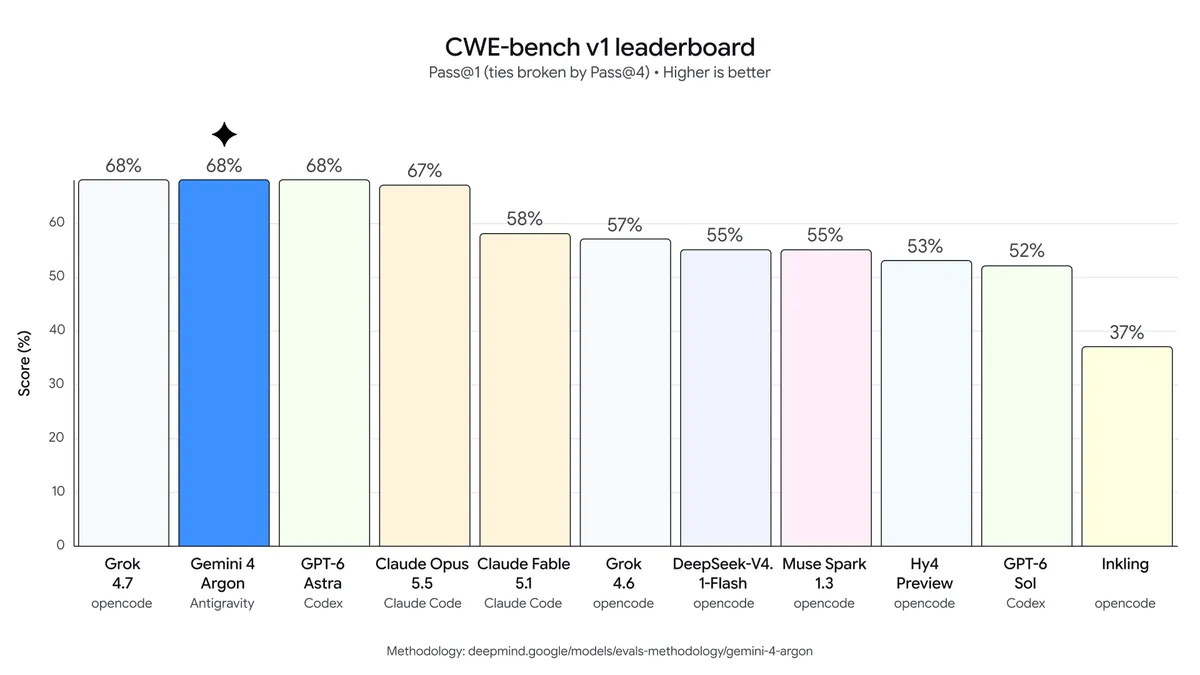
Google’s bar chart of the CWE-bench v1 leaderboard, published with the Gemini 4 Argon announcement, with 11 models ranked by score. Image: Google
Google does not say which restrictions come off, or what the guardrails stop Gemini 4 Argon doing while they are on.
Access runs through a programme with its own vetting
Defenders reach the model through the Fairwind Program, which Google describes as giving “high-priority defenders (like governments, healthcare providers, and telecommunications services) early access to advanced models that help them build better defenses, before new threats arrive”. Partners can run Argon on its own or inside CodeMender, Google’s code security agent.
Google prioritises three kinds of partner: governments and national cyber authorities, critical infrastructure operators across healthcare, telecommunications, energy and financial networks, and core technology platforms. It adds that it welcomes applications from academic labs working on defensive benchmarking.
“We vet all applicants to make sure they have a proven track record of ethical operations and research,” the programme page says. Google also says it runs background checks on the organisations that apply, “to verify security history and analyze their record of ethical operations”, and that partners may not share, redistribute or sell access.
Google also sets out what partners may do with the model. They “are only permitted to carry out dual-use tasks, including authorized threat simulation, reverse engineering, and malware analysis for defensive and academic research purposes”, and Google says malicious tasks such as creating malware are not permitted.
Google is in the US government’s pre-release access process
“Safely releasing frontier capabilities at this level requires a phased approach,” Google says, and it states its own position: “We are actively engaged in the U.S. government’s voluntary process for pre-release model access while we gradually expand access.” Developers, enterprises and consumers come after that, and no date is attached.
The published cyber figure for Argon is CWE-bench v1, where Google says the model “ties for first place with a top score of 68%” on remediating security vulnerabilities. In September the company also described a May security test in which Gemini broke into three real companies.
The broad release keeps four sets of safeguards
For the wider launch, Google lists four areas it says it is strengthening: refusals for cyber and chemical, biological, radiological and nuclear requests under its Frontier Safety Framework, resilience against indirect prompt injection, monitoring for misalignment, and hardening the sandboxes it trains and evaluates in.
The misalignment work is the part Google describes in most detail. It says it monitors Argon’s chain of thought and its actions and stops execution when necessary, and that it ran a similar system over its training runs while “taking careful precautions against feeding the findings back into training so as to not risk shaping Argon’s reasoning to evade our monitoring”.
None of it can be inspected from outside. Argon is going out to that cohort and nobody else for now, so the only account of what the model does without its cyber guardrails is Google’s.

