
Gemini 4 Argon lifts Google's output limit to 1M tokens, but only cyber defenders have it
Google announced a new frontier model, Gemini 4 Argon, on September 30, and the first people to get it are neither developers nor subscribers. Google says Argon is rolling out to "a set of trusted cyber defenders" through its existing Fairwind Program, and that the model's output token limit rises to 1M tokens, up from the previous 64K.
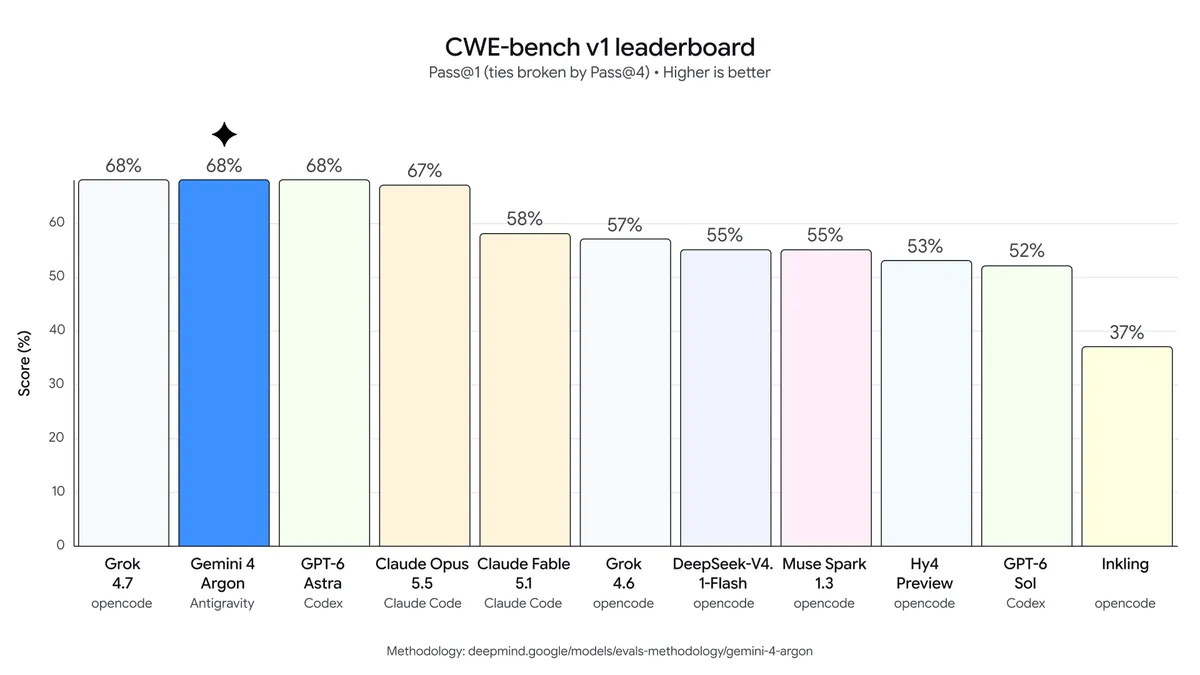
Google's CWE-bench v1 chart puts Gemini 4 Argon at 68%, level with Grok 4.7 and GPT-6 Astra, and a point above Claude Opus 5.5. Image: Google
The 1M figure is an output ceiling, not an input context window, and Google publishes no context length for Argon at all. It frames the extra headroom as room for the model to "generate hundreds of thousands of tokens in a single trajectory".
The $2 and $10 prices are introductory ones
Google says Argon "will launch at an introductory price of $2 per million input tokens and $10 per million output tokens, with cached input tokens priced at 95% off input token price". Those are launch prices rather than standing ones: Google puts the post-introductory rate at $4 per 1M input tokens and $20 per 1M output tokens, and gives no date for when the introductory period ends.
For scale, OpenAI's GPT-6.1 Sol runs at the same $2 and $10 per million tokens. Argon starts level with it and then doubles, and nobody outside Google's chosen testers can pay either Argon price yet.
Four benchmark scores, all of them Google's own
Google gives four numbers for Argon. It "sets a new state of the art" on DeepSWE v1.1, which measures long-horizon software engineering, with 77.9%; it "ranks #1 with a score of 51.3%" on AutomationBench, Zapier's test of end-to-end execution across business functions; and it is "state of the art with a score of 91.7%" on LVBench, which measures long video understanding.
On CWE-bench v1, which scores a model on remediating security vulnerabilities, Argon ties for first place at 68%. Google's own leaderboard chart puts Grok 4.7 and GPT-6 Astra on that same 68%, with Claude Opus 5.5 a point behind.
Google names no thinking or effort setting for any of the four scores, and none of them has been replicated outside the company. Four benchmarks are also four benchmarks, not a verdict on what the model can do.
Defenders get Argon without its cyber guardrails
Google says Argon can autonomously find, validate and patch critical software vulnerabilities, and that "for trusted defenders and our own internal teams at Google, we'll be releasing Argon without cyber guardrails". Security vendor Wiz is using it through its Scan for Good initiative, where Google says the model "uncovered a critical vulnerability exposing sensitive personal information across healthcare software used by hospitals worldwide".
Google does not name the affected software and gives no CVE number for it. The company has published results from an earlier Gemini security exercise against three real companies, so the defensive framing here is a continuation rather than a new direction.
Everyone else waits. Google says it will release Argon "to developers, enterprises, and consumers, starting with paid API customers and Google AI Ultra subscribers", gives no date for that, and says it is "actively engaged in the U.S. government's voluntary process for pre-release model access" while access expands.
Argon is running inside Google in the meantime, where the company says a team of its agents found memory optimisations that will free more than 300 TiB across its data centres once rolled out, and a Rust rewrite of the libgav1 video decoder came out 2.7x faster than the existing port with identical output. For now, the only people who can test any of that are the defenders Google picked.

