
Gemini 4 Argon cut its own pick-and-place time from 58.9 to 17.4 seconds, says Google
Google says Gemini 4 Argon cut its own time on a pick-and-place task from 58.9 seconds to 17.4 across three attempts on a 6-DoF robot arm, working out what went wrong from its own logs and camera footage in between. The figures come from a post published on October 13 by Kanishka Rao, a principal software engineer at Google, and every one of them is Google's own measurement.
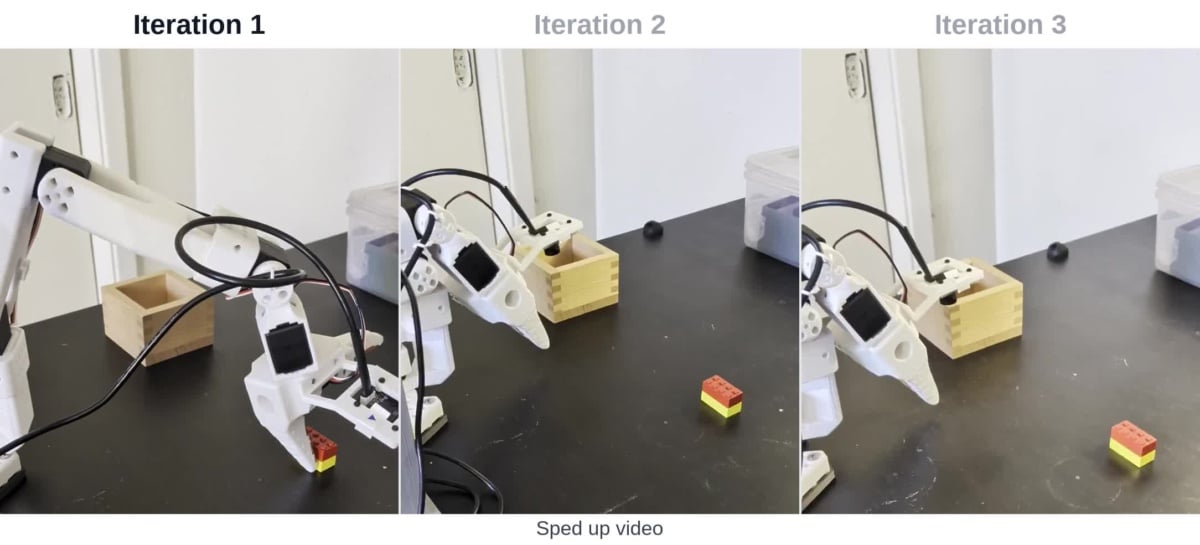
Google's recording of the three SO-101 pick-and-place iterations, timed at 58.9, 22.9 and 17.4 seconds. Image: Google
The arm is an SO-101, and Google times the three runs at 58.9 seconds, then 22.9, where the gripper "grazed box rim on drop", and 17.4, which it describes as a dead-centre drop. The improvement was asked for: Google's published prompt tells Argon to diagnose its own failures from its logs and its wrist and overhead footage, check the fix in a dry run, and once the task succeeds make it at least twice as fast within its safety limits.
Practice in simulation took a real robot from 56% to 75%
A second result starts from a single photograph. From "a single RGB photo of the real tabletop", Google says, Argon "autonomously builds a calibrated MuJoCo simulation twin, defines new tasks, and synthesizes a closed-loop motion generator to collect 4,500+ domain-randomized episodes in simulation", and training on that data took a real robot's success rate from 56% to 75% while completion time fell from 35 seconds to 24.
The rig there is a pair of 7-DoF Franka FR3 arms with four cameras, and the randomisation covers 10 centimetres of pose either way. The prompt also makes Argon verify a reward of 1.0 in MuJoCo physics before the episodes are exported for fine-tuning.
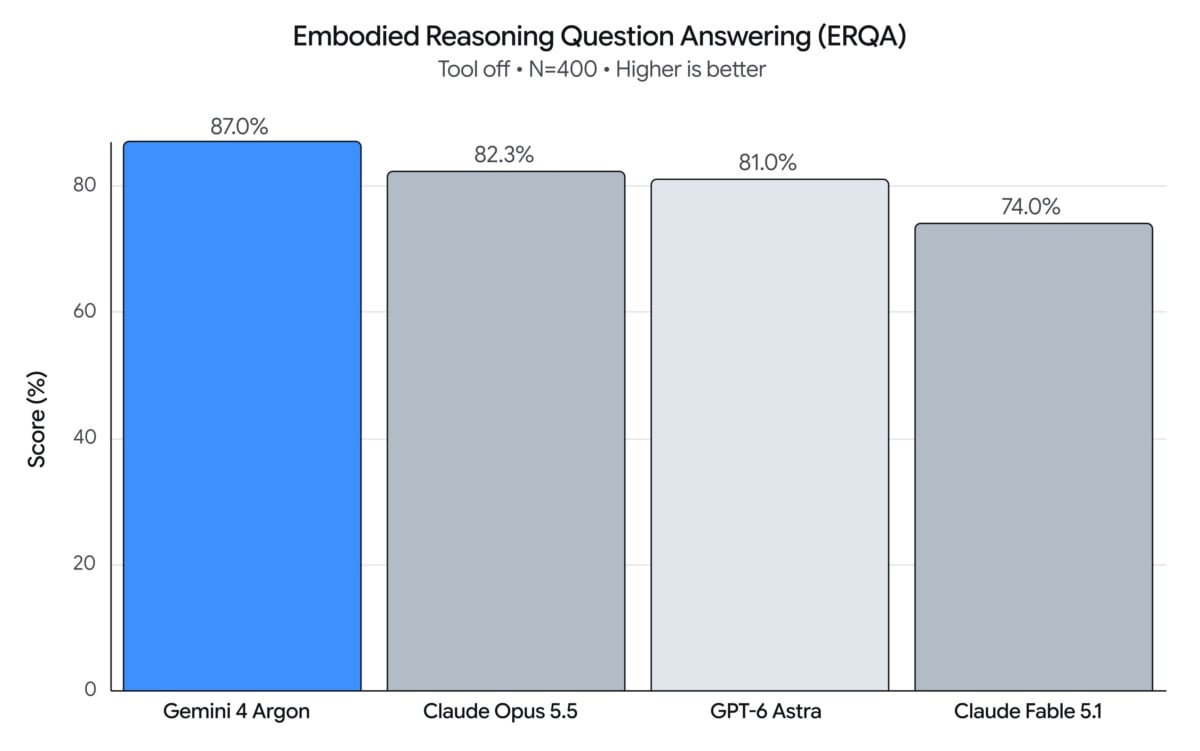
Google's own benchmark image for Gemini 4 Argon, which it scores at 87% on Embodied Reasoning. Image: Google
The scaffolding is written into the prompts
These demonstrations are not a model handed a robot and left to it. The quadruped run uses a Boston Dynamics Spot, the same platform whose thermal camera has turned up on Ray-Ban Display, and Argon practises a three-leg tripod balance in MuJoCo before stepping on a foot-pedal bin to drop soda cans in it. Google's prompt tells it to confirm the foot target in the front cameras and to run "a 2-agent verification swarm" before releasing.
The same pattern runs through the rest. A mug-and-napkin task is driven through a wrist camera with a 2 centimetre world grid and a jaw-closing reticle drawn on it, plus named motion primitives to call. A dual-arm Franka FR3 pair solves the classic 12-ball balance puzzle in three weighings by reading the scale's tilt from stereo cameras. In each one the coordinate frames, the primitives and the verifying agents are supplied in the prompt rather than invented by the model.
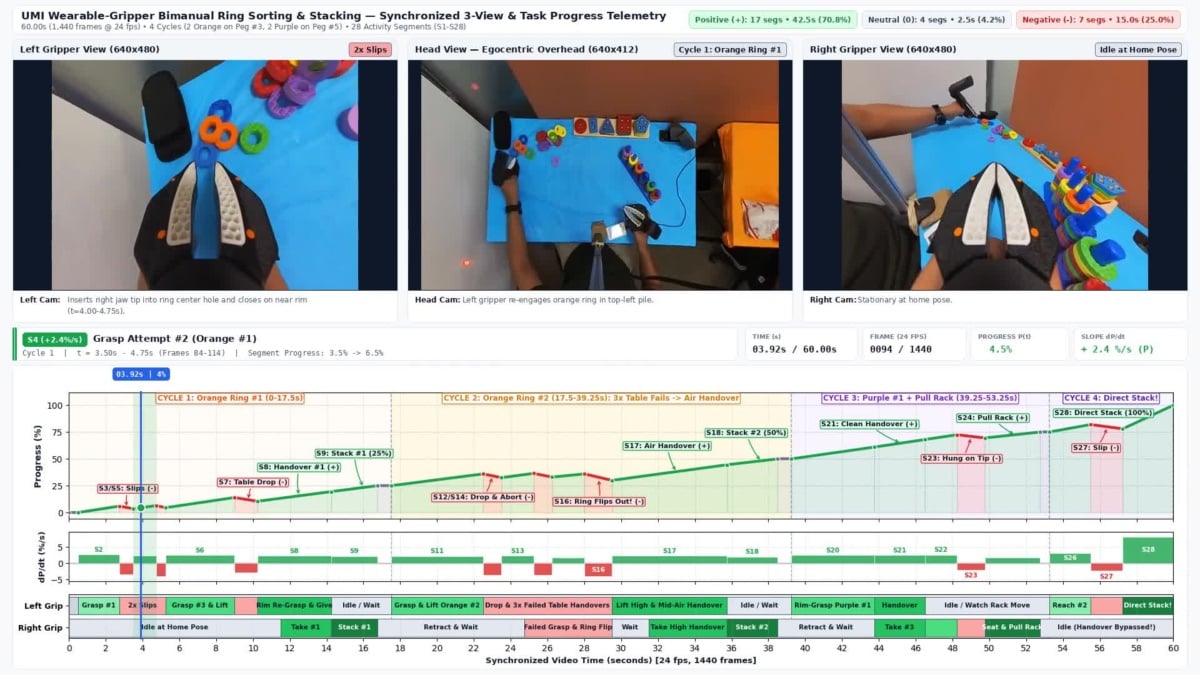
Argon is also used as a scorer rather than a driver. On a 60-second two-handed ring-sorting clip recorded from a human wearing grippers, Google says it inspected the synchronised head and gripper camera feeds around each contact and split the run into 28 segments of positive, neutral and negative progress.
Argon runs on three Google platforms
Argon is available in Google AI Studio to Google AI Ultra subscribers, on the paid tier of the Gemini API as gemini-4-argon in the Interactions API with day-one support across the google-genai SDKs, and in Google Antigravity to AI Ultra subscribers. It went on general release on October 13 with an introductory price that runs out on November 30, and its 87% Embodied Reasoning score was published then too.
One of the results needs no robot at all. Google says that with one prompt per paper, Argon ported five legged and humanoid robotics papers into self-contained MuJoCo WebAssembly browser labs and verified them in headless Chromium, out of 68 interactive browser sandboxes it reproduced.
Google's own framing is that Argon "marks an important milestone accelerating the path toward physical AGI". What it has published is three runs of one task on one arm, an 87% on a benchmark Google DeepMind open-sourced itself, and prompts long enough to read as engineering.

