
Google prices Gemini 4 Argon at $2 and $10 per million tokens, but it is not on sale

Gemini 4 Argon will launch at $2 per million input tokens and $10 per million output tokens, Google says, rising to $4 and $20 once the introductory period ends. Nobody can pay either price yet, because Argon is not on sale.
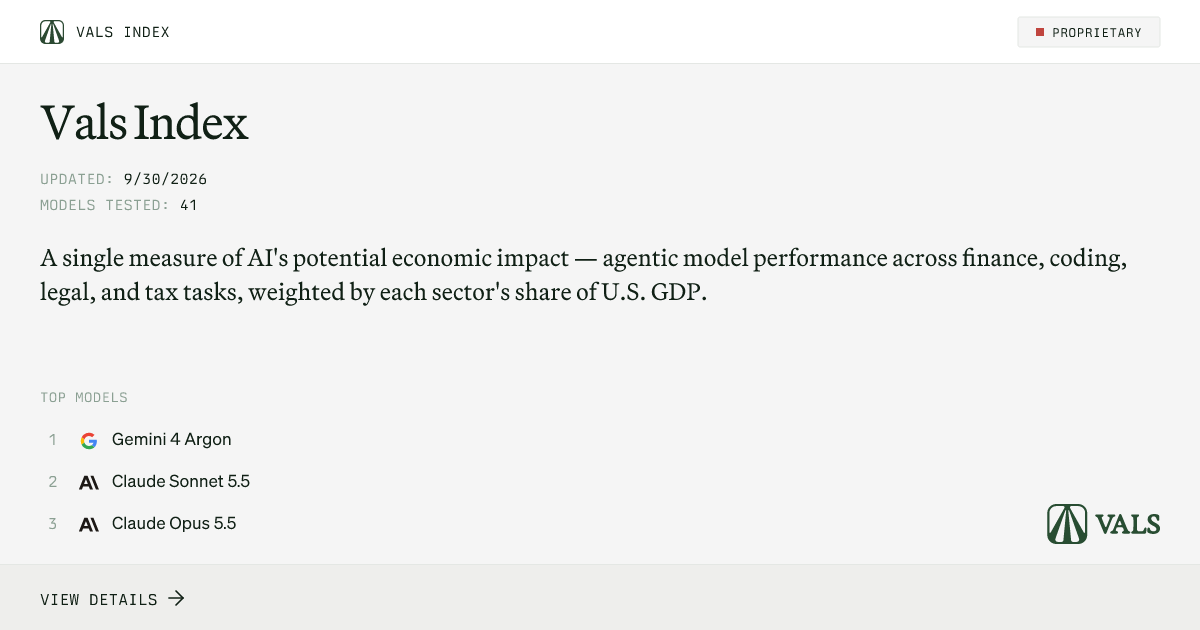
Vals’ card for its own index, updated September 30, with Gemini 4 Argon first of the 41 models tested. Image: Vals
The introductory rate comes with cached input tokens “priced at 95% off input token price”. On the introductory rate that works out at $0.10 per million cached input tokens, and on the later one at $0.20. The higher $4 and $20 rate is carried in a footnote, and Google gives no date for when the introductory period starts or stops.
Argon is missing from every Google developer page that would sell it
Google’s Gemini API model list carries no Gemini 4 model of any kind, and neither does the Gemini API pricing page. The newest generation documented on both is Gemini 3.8, and Google has published no model ID for Argon.
That pricing page does put dates on the same kind of discount elsewhere. Gemini 3.8 Flash runs at $0.75 per million input tokens and $3.75 per million output tokens through December 31, 2026, then $1.50 and $7.50 from January 1, 2027, while Argon’s step up from $2 and $10 to $4 and $20 is tied to no date at all.
The documented Pro tier also prices by prompt length, which Argon’s two rates do not. Gemini 3.1 Pro Preview, the newest Pro model on that page, runs at $2.00 per million input tokens and $12.00 per million output tokens for prompts up to 200,000 tokens, then $4.00 and $18.00 above that, with cached input at $0.20 and $0.40. Argon’s $2 and $10 is a single pair of numbers with no such split, and its $10 output rate sits below the $12 Google charges for its current Pro model.
The Gemini API changelog has nothing newer than September 22, more than a week before the announcement, and the Vertex AI release notes for generative AI have nothing newer than May 26.
Only vetted cyber defenders have the model
Argon is going out through Google DeepMind’s Fairwind Program, which the company describes as giving “high-priority defenders (like governments, healthcare providers, and telecommunications services) early access to advanced models”.
Broader access comes later, and Google puts it in that order: it will “release to developers, enterprises, and consumers, starting with paid API customers and Google AI Ultra subscribers”. No date is attached to any of those tiers. We covered the launch itself, and the jump to a 1M-token output limit, on September 30.
A benchmark operator already lists the higher rate
Vals, which ranks Argon first of 41 models on its Vals Index, lists the model’s input and output cost as $4 and $20, the rate that applies after the introductory period rather than during it. Its run of the full index cost $15.68 per test, against $21.34 for Claude Sonnet 5.5 and $32.14 for Claude Opus 5.5, the two models behind Argon on that index.
Pricing a product before shipping it is ordinary enough in software. What is unusual here is the order: Google has set out two rates, a cache discount and a rollout sequence for a model it has not put in its own documentation, and has not said when any of that starts.

