
Claude Sonnet 5.5 scores 70.6% on Terminal-Bench, above Opus 5.5 at half the price
Anthropic released Claude Sonnet 5.5 on September 28, and the company's own benchmark table puts the cheaper model above its Opus flagship on agentic coding. Anthropic reports 70.6% for Sonnet 5.5 on Terminal-Bench 4.0 against Opus 5.5's 66.4%, at $2 per million input tokens and $10 per million output tokens, half of Opus 5.5's $4 and $20.

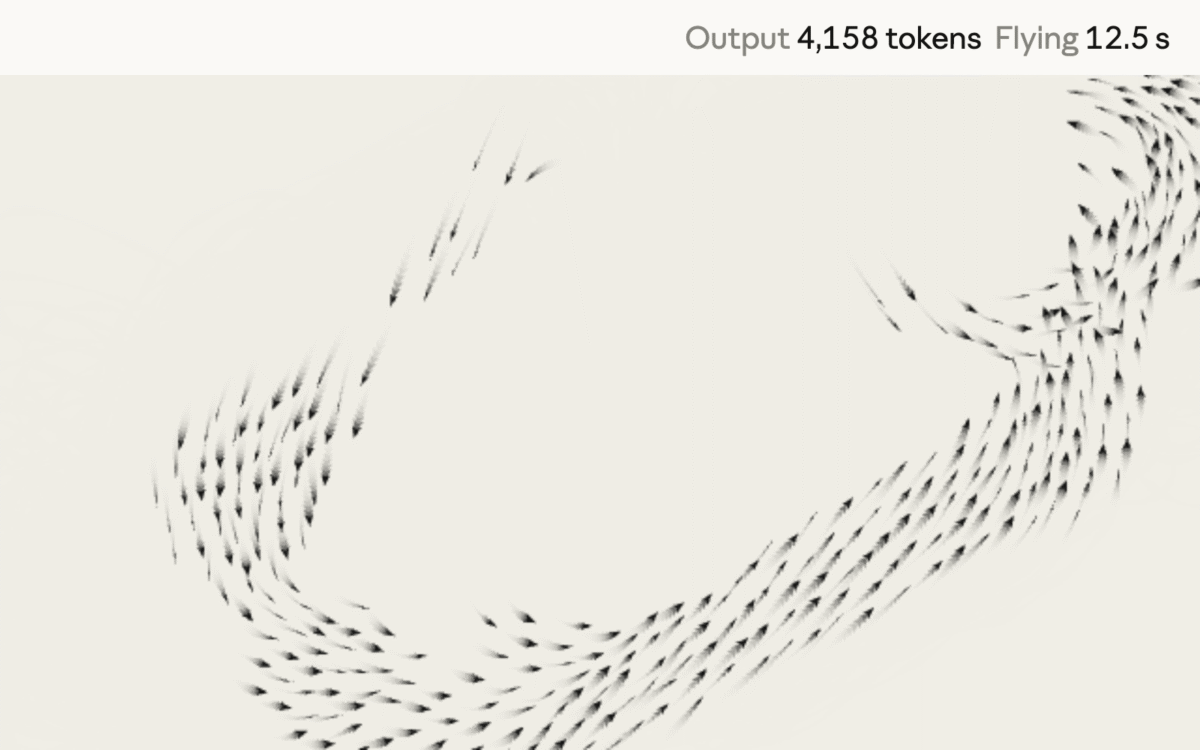
Anthropic ran the same prompt on both models on its launch page. Sonnet 5.5's clock of clocks, four grids of clock faces whose hands form the digits 10:00, took 14,386 output tokens. Image: Anthropic
The two scores were not measured at the same setting. Anthropic says the Opus 5.5 result is reported "at Xhigh effort which represents the model's highest score", while the Sonnet 5.5 figure carries no effort label, so this is not a like-for-like win.
Opus 5.5 stays ahead on every other score Anthropic published. It takes 57.8% to Sonnet 5.5's 55.5% on CursorBench 4.0, 54.4% on FrontierCode 1.1 against Sonnet 5.5's best of 52.1% at Xhigh effort, and 1846 to 1844 on the GDPval-AA v2.1 Elo scale.
Anthropic says Opus still wins open-ended work
Anthropic puts the caveat in its own words: "benchmark scores capture only one facet of a model's capabilities; in our own testing, and in that of external testers, Opus 5.5 remains clearly stronger at complex, open-ended work requiring sustained judgment."
All of these numbers come from Anthropic's own page rather than an independent public leaderboard, the same limitation that applied when Anthropic scored Opus 5.5 at 66.4% on a Terminal-Bench run it conducted itself. Artificial Analysis ran the GDPval-AA and AA-Briefcase tests on a pre-release deployment that Anthropic says carried a bug affecting structured outputs, since fixed.
One comparison is easy to misread. Anthropic publishes no GPT-6 Sol score for Terminal-Bench 4.0 or CursorBench 4.0, and where a GPT number appears in its cost charts for those two tests it is GPT-5.6 Sol. For Terminal-Bench, Anthropic gives the reason: "Terminal-Bench and OpenAI did not report GPT-6 Sol performance publicly".
FrontierCode is the test where Anthropic does compare the two directly, and it is where the cheapest-sounding claim of the launch comes from: at High effort, the default on the Claude Platform, Sonnet 5.5 matches GPT-6 Sol's best score "for about a fifth of the cost per task". That is a cost-per-task comparison with OpenAI's model, not a comparison with what Opus 5.5 charges.
Pricing holds at Sonnet 5 levels
Sonnet 5.5 keeps the Sonnet 5 price list: $2 per million input tokens, $10 per million output, and $0.20 per million for cache reads. Anthropic says it runs "30%+ faster" than Sonnet 5 and costs up to 30% less per task, both figures from its own testing.
The model ID is claude-sonnet-5-5, with a 1M token context window and a 128K maximum output. Anthropic's model page gives a June 2026 knowledge cutoff and says the model will not retire sooner than September 28, 2027.
It reached the Claude API, Amazon Bedrock, Claude Platform on AWS, Google Cloud and Microsoft Foundry on the same day, according to Anthropic's platform release notes.
A Sonnet model ships with cyber safeguards
Anthropic says Sonnet 5.5 is "the first Sonnet model to launch with cyber safeguards and fallbacks like those we've developed for our most capable models", because its cybersecurity capabilities are comparable to Opus 5's. Higher-risk cybersecurity requests visibly fall back to Sonnet 5, which echoes the routing Opus 5.5 uses when it sends cybersecurity work to Opus 4.8.
Biology safeguards are unchanged from Sonnet 5, and Anthropic says both sets target a narrow band of high-risk requests. Claude Haiku 5.5 is promised "in the coming weeks", with no date attached.

