
Xiaomi's MiMo-V2.6-Pro tops the open models after a $2.62m reinforcement-learning run
Xiaomi’s MiMo-V2.6-Pro is the top-ranked open weights model on the Artificial Analysis Intelligence Index, which scores it 46 and ranks it first of the 114 open weights models it tracks. Xiaomi says the reinforcement-learning run behind it took under six days and cost about $2.62 million, and it published the weights on Hugging Face on September 22 under an MIT licence, alongside a cheaper sibling, MiMo-V2.6-Flash, whose run cost about $0.85 million.
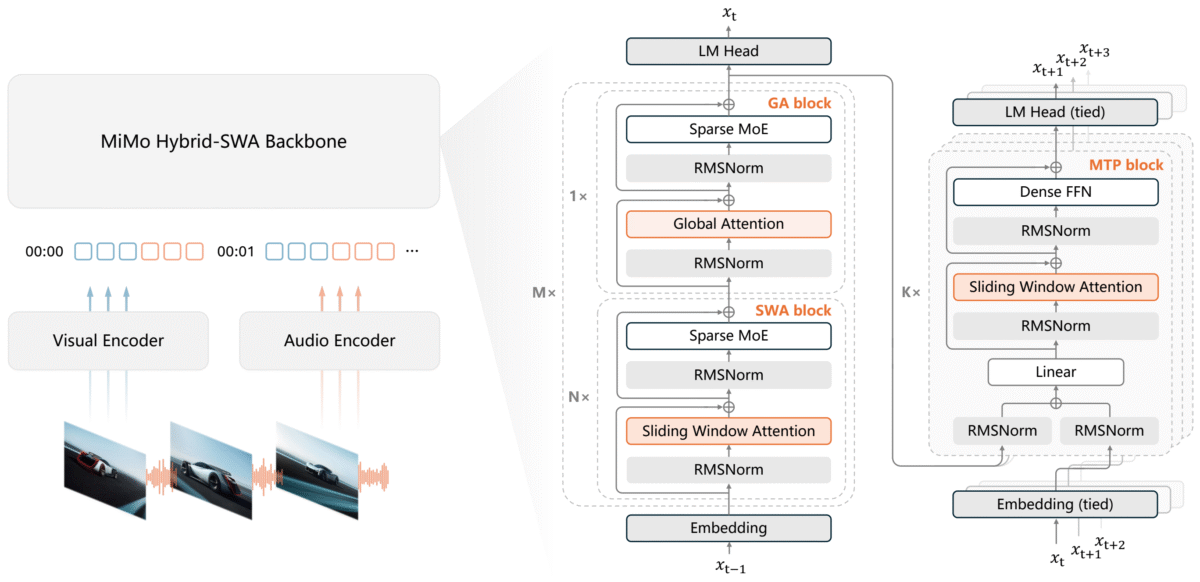
Xiaomi's diagram of the MiMo-V2.6 architecture, with the visual and audio encoders, the hybrid SWA backbone and the multi-token prediction blocks. Image: Xiaomi
Price is the other half of the pitch. Pro costs $0.435 per million input tokens and $0.87 per million output tokens on Xiaomi’s own API platform, with cache hits at $0.0036 per million, and Flash costs $0.14 and $0.28.
Xiaomi says the V2.6 series keeps V2.5 pricing, so the score moved and the bill did not. Undercutting on rates is the strategy that has Chinese models eating into OpenAI and Anthropic’s API business.
Xiaomi is releasing the training environments, not only the weights
Xiaomi says each model completed 30 reinforcement-learning steps over roughly 750,000 trajectories in that six-day window, with batches of 1,568 prompts and 16 rollouts per step. On DeepSWE v1.1, a held-out software engineering benchmark, it puts Pro’s score rising from 58.4 to 72.57 across the run.
The company says it is releasing the training environments and the RL code as well, so that researchers can reproduce the results. Its technical report puts the four released task sets at roughly 7,000 tasks covering coding, cybersecurity, knowledge work and visual work, each with an automatic verifier: executable tests, rule checks, rubric-based judging and visual grading, plus about 1,000 music-generation tasks.
The model card and the file listing disagree on size
The model card describes MiMo-V2.6-Pro-RL as a sparse mixture-of-experts model with “1.02T total / 42B activated parameters”, a one-million-token context, and native text, image, video and audio input. It lists 70 layers, 384 routed experts with eight active, and an MIT licence.
Hugging Face’s own listing for the same checkpoint totals 524B parameters, and 159B for Flash-RL, and Xiaomi has not published an explanation for the gap. The MIT licence on the card allows commercial use. Alibaba went the other way on September 21, publishing Qwen-Image-2.1 with open weights but a research-only licence.
Anthropic accuses Xiaomi of replaying user sessions into Claude
Anthropic’s threat report of September 10 names Xiaomi among the Chinese labs it accuses of illicit distillation. Anthropic says it observed more than 400,000 requests to Claude across more than 1,500 accounts over 20 days in March and April 2026, routed through proxy services.
The method it describes is replay. Anthropic says Xiaomi saved the full request and response from its own users, then pushed those sessions through Claude, often through the OpenClaw and OpenCode coding harnesses, to generate data for supervised fine-tuning and reinforcement learning.
The traffic Anthropic describes involves MiMo-V2-Pro, an earlier model. Anthropic says its investigation suggests Xiaomi may have launched that model with a free trial period, later extended, intending to use the surge in international developer use to distil Claude, and that the bulk of the distillation began as the trial was ending. The allegation is Anthropic’s own, and no court or regulator has tested it.
MiMo-V2.6-Pro and Flash are available through Xiaomi’s API platform, MiMo Desktop, MiMo Code and OpenRouter. There is also an UltraSpeed mode that Xiaomi says runs at up to 20 times Pro’s output speed at the same quality, priced at $4.35 and $8.70 per million tokens, or 10 times the standard Pro rate.

