
Vuzix ships a 3,000-nit waveguide display for defence, but only as evaluation units

Vuzix introduced the Shrike Defense Display Platform on September 29, a configurable waveguide display aimed at defence, security and first responder customers, and says it has begun shipping initial units to customers for evaluation and integration. Those are evaluation units rather than general availability, and Vuzix announced no price and named no customer.
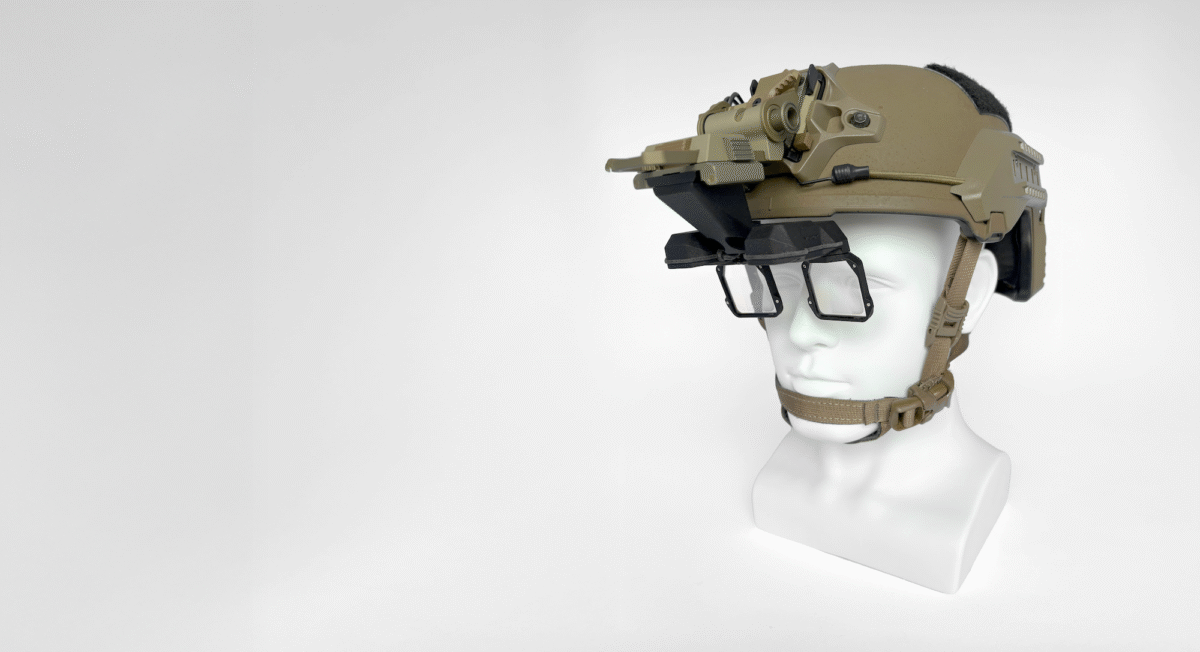
Shrike in its binocular configuration on a helmet. Vuzix also offers it as a monocular unit. Image: Vuzix
The specification it did give: a 40-degree field of view, full-colour 1280 x 720 at 16:9, a rated brightness of 3,000 nits to the eye, 25 mm eye relief and a 14.3 x 14 mm eye box. Optional electrochromic tinting adjusts the view, and Vuzix Incognito cuts the outward-visible light the display throws forwards.
Brightness to the eye is not a panel figure
3,000 nits to the eye is what reaches the wearer after the light has crossed the waveguide, and that is not how a phone or a headset panel's brightness is usually quoted. Vuzix does not give the output of the display engine behind the waveguide, so the figure cannot be lined up against the panel numbers quoted for consumer hardware without knowing how each was taken.
The rest of the numbers are the ones an integrator asks about. A 14.3 x 14 mm eye box is the window in which the image stays visible as the unit shifts on a head, and 25 mm of eye relief is the distance it can sit from the eye, which is what decides whether it clears spectacles or a respirator.
Shrike is sold to integrators, not to people
Vuzix describes Shrike as a working platform a customer can use to assess display performance, fit and system integration before defining a purpose-built product. It is configurable as a monocular or a binocular unit and connects over Micro HDMI and Mini USB.
The uses Vuzix lists are situational awareness, drone and unmanned ground vehicle operation, mission support, human-machine interface development and OEM integration programmes. "Shrike provides defense customers a platform they can work with now, while giving them room to tailor the display to their application," said Paul Travers, president and chief executive of Vuzix. "Our goal is to help customers move from evaluating a wearable display to developing a system that meets their program requirements."
Vuzix will demonstrate Shrike at the AUSA Annual Meeting and Exposition in Washington DC from October 12 to 14, and at Modern Warfare Week at Fort Bragg, North Carolina, from November 16 to 19.
The waveguides come off Vuzix's own lines
Vuzix makes its diffractive waveguides at its Rochester, New York plant on custom-assembled nanoimprint lithography lines, the same replication technique the EU's bank backed with a loan to a Dutch waveguide stamper in September. Founded in 1997, the company organises its business around enterprise smart glasses, OEM customer programmes and waveguide design and manufacturing, and says it holds more than 500 patents and patents pending.
Incognito is not new either: Vuzix has been fitting it since it first showed the eye-glow suppression in 2023. What is new here is the combination offered as a defence building block rather than a finished pair of glasses.
There is no price, no volume order and no delivery schedule beyond those first evaluation units. The next dated thing on the calendar is a trade show stand in Washington on October 12.

