
A VR scene generator that remembers your edits cut corrective fixes from 8.52 to 5.62

Ask a model to lay out a virtual living room and it forgets everything you moved last time. Six researchers say a system that carries those corrections forward cut the average number of fixes a user had to make from 8.52 to 5.62, measured across a 42-person study, and they published the result as an arXiv preprint submitted on October 1.
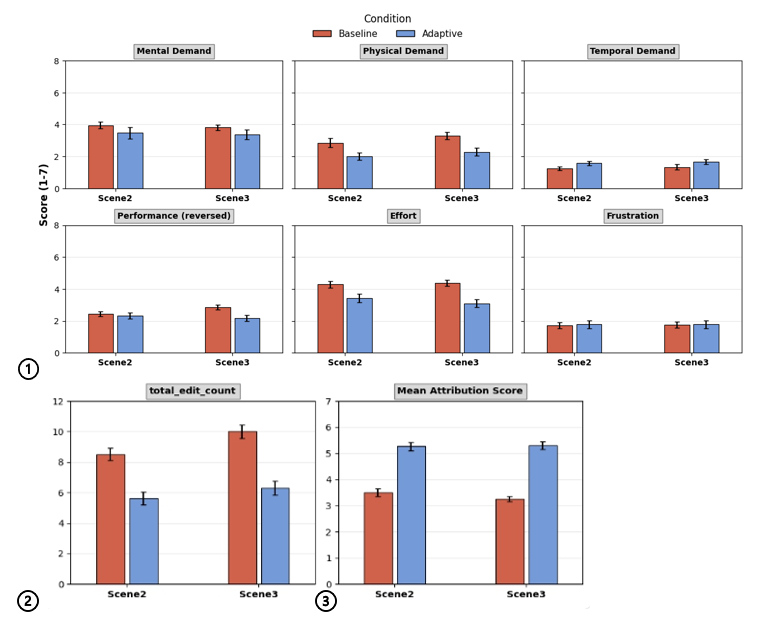
The paper's own charts. Physical demand and effort fall in the adaptive condition, while mental demand, temporal demand and frustration barely move. Image: Lee et al.
The system is called SPHERE, by Hyeonmin Lee, Zheng Wei, Kyungmin Kwon, Jumin Seo, Jiwon Park and Hayoung Oh, and the complaint it starts from is familiar to anyone who has built anything in a headset. Current pipelines "fail to retain user-specific preferences across sessions, making immersive authoring a repetitive and physically fatiguing process", the authors write.
Three rooms, each one deliberately harder
The study ran 42 participants, 23 women and 19 men, aged 20 to 40 with a mean of 27.3 years, through roughly 60 to 75 minutes each on a Meta Quest 3 with handheld controllers, editing by voice and by grabbing objects. Anyone with professional expertise in 3D modelling or spatial design was excluded, because the question was whether novices benefit.
Half were put in an adaptive condition, where preferences inferred from the first room shaped the next two, and half in a baseline condition that generated each room from default heuristics with no memory of what came before. The rooms changed shape between rounds on purpose: a near-cubic space first, then a severe contraction or expansion, then a narrow asymmetric layout chosen to force trade-offs. Participants were assigned one of three fixed preference profiles rather than their own taste, which keeps the test reproducible but means nothing here measures real personal preference.
The editing dropped, the overall workload did not
On edit counts the gap was large and the authors report it as significant on a Welch's t-test, t = 4.86 with p below .001. Perceived usability moved too, with mean System Usability Scale scores of 73.2 for the baseline against 78.3 for the adaptive condition, t(40) = -2.20, p = .034. Participants also recognised that something had been personalised, rating attribution at 3.51 against 5.27 in the second room and 3.27 against 5.30 in the third on a seven-point scale.
Overall workload is where the claim narrows. The abstract says SPHERE "significantly reduces corrective edits and physical demand", and the full text gives the number behind the second half: mean NASA-TLX scores were 3.10 and 2.89, and "the difference was not statistically significant", at t(39.3) = 1.349 and p = .185. What did fall significantly were the physical demand and effort subscales, so the honest reading is that the task felt less physically punishing rather than less demanding in general.
The authors name their own weak spot
Fine positional edits did not correlate with how satisfied people said they were, and the paper blames its own interface: "because object manipulation was not always precise, participants may have repeatedly adjusted placements, inflating spatial edit counts regardless of their actual spatial satisfaction".
An offline test on the same logs stripped out the stage that abstracts a room into functional clusters and a connectivity graph before the model sees it. Without it, the constraints the model inferred collapsed towards simple object attributes, 0.75 of all constraints against 0.35 with the stage in place, and profile alignment fell from 0.511 to 0.422. Profile alignment was scored by a GPT-4-based evaluator and the constraint categories by two human raters, both softer measures than a count of edits.
SPHERE is a preprint, not peer-reviewed work, and the code and project page are promised rather than published. It sits beside another recent preprint in which eleven vision-language models graded AR scenes instead of generating them, and both arrive at the same practical argument: a model in the loop is cheaper than a test panel on every iteration.

