
Snap reportedly wants Robert Downey Jr. for $100M to make its $2,195 AR glasses look cool

Snap has a big problem with its new $2,195 AR glasses: they may be technologically impressive, but a lot of people think they look ridiculous.
Now, Snap may have a very expensive solution.
According to a new report from Alex Heath’s Sources newsletter, Snap is reportedly in talks to pay Robert Downey Jr. about $100 million in stock to become an ambassador for Specs, the company’s new augmented reality glasses.
The deal has not been confirmed by Snap or Robert Downey Jr., so it should be treated as a report for now. But if it happens, it would be one of the most aggressive celebrity pushes yet for smart glasses.
And honestly, it is easy to see why Snap would want him.
Robert Downey Jr. spent more than a decade playing Tony Stark in the Marvel Cinematic Universe. For millions of people, Tony Stark is the guy who made holograms, AI assistants, wearable computers, and futuristic glasses look cool.
Snap’s $2,195 Specs are not normal smart glasses
Snap unveiled Specs at the Augmented World Expo on June 16, with CEO Evan Spiegel describing them as a new kind of computer built into see-through augmented reality glasses.
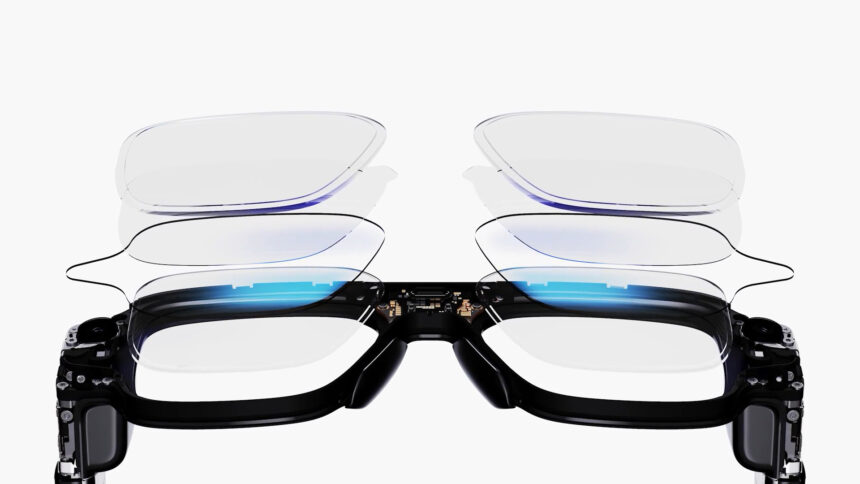
These are not like Ray-Ban Meta glasses, which are mostly camera and AI glasses without a display. Snap’s Specs are proper AR glasses, with displays that can place digital objects, apps, games, web pages, and AI assistance into the world around you.
Snap says Specs are fully standalone, which means they do not require a phone, puck, or external battery to work.
The glasses use two Snapdragon processors. One is dedicated to computer vision, while the other runs AR Lenses. Snap says this allows fast hand tracking, responsive interactions, and 7-millisecond motion-to-photon latency, which is meant to make digital content feel anchored in the real world.
Specs also include a 51-degree field of view, 16 million colors, electrochromic lenses that can shift from clear to tinted in about 10 seconds, Bluetooth notifications, AI assistance, and a charging case.
Battery life is rated at up to four hours of mixed use. The included case provides four additional charges, bringing total mixed-use battery life to up to 20 hours.
But they cost $2,195
Specs are available for pre-order at $2,195, with a $200 refundable deposit. Snap says they are expected to ship this fall in the United States, United Kingdom, and France.
That makes them far more expensive than most smart glasses, including Meta’s new AI glasses, which start at $299.
To be clear, Snap’s Specs and Meta Glasses are not the same product. Snap is selling a standalone AR computer with see-through displays. Meta is selling displayless AI glasses with speakers, cameras, microphones, and Meta AI.
But to regular people, that difference may not matter much. One pair starts at $299 and looks like normal eyewear. The other costs $2,195 and looks like something only early adopters, developers, or people paid by Snap would wear in public.
Robert Downey Jr. would be the perfect face for this product
If Snap really wants to change the story around Specs, Robert Downey Jr. is probably the most obvious celebrity it could choose.

He is strongly associated with futuristic technology because of Tony Stark. The character made AR interfaces, smart glasses, AI assistants, and wearable machines feel aspirational instead of awkward.
Snap can explain the processors, the field of view, the hand tracking, the developer platform, and the AI features. But it also needs people to look at Specs and think, “I want that.”
Right now, a lot of people are looking at Specs and thinking the opposite.
That is why a Robert Downey Jr. campaign could make sense from a marketing perspective. He is probably one of the few people who could wear bulky AR glasses and make them feel like a Tony Stark product instead of a strange developer kit.
The rumored $100 million price tag is the wild part
The reported deal is also controversial because of Snap’s current financial position.
Snap’s market value is now around $7.6 billion, and its stock is down sharply from its pandemic-era highs. A $100 million stock package would equal roughly 1.3% of the company’s current market cap.
At $2,195 per pair, Snap would need to sell about 45,558 pairs of Specs just to generate $100 million in gross revenue. That is before manufacturing costs, software development, marketing, shipping, customer support, returns, R&D, and the cost of actually building the platform.
That does not automatically mean the deal would be bad. A celebrity campaign is not supposed to pay for itself only through direct unit sales. It can also make the product famous, attract developers, help with brand positioning, and make investors believe Snap has a real shot in AR.
But the number is still huge for a company that has already spent years trying to convince investors that its hardware bets will eventually matter.
I mean, if you've been following the glasses industry, you know that Snap has been trying to make glasses happen for nearly a decade.
The first Spectacles launched in 2016 as camera sunglasses, sold through Snapbot vending machines. They created a lot of hype at first, but they never became a mainstream product.
Later versions improved the hardware, and Snap eventually moved toward developer-focused AR glasses. Specs are the next step: a consumer-facing version of the product that Snap wants people to actually buy and use.
Snap says it has spent more than a decade investing across the AR stack, including developer tools, its operating system, displays, optics, computer vision, and hardware. The company also says it has filed more than 7,000 patents during Specs development.
The problem is that investors have become less patient with long-term hardware bets.
Activist investor Irenic Capital has pushed Snap to rethink the Specs business, arguing that the company should either seek outside funding, spin it off, or consider other alternatives. Snap has already separated Specs into a wholly owned subsidiary, which could make it easier to bring in partners or outside investment.
Snap needs more than Tony Stark energy
A Robert Downey Jr. campaign could help Snap make Specs look more desirable, but it will not solve every problem.
Specs still need a strong app ecosystem. They need real use cases beyond demos. They need to be comfortable enough to wear. They need to avoid privacy backlash. And most importantly, they need to convince people that $2,195 is a reasonable price for a new category of wearable computer.
That is a difficult pitch, even with one of the most recognizable tech-adjacent celebrities in the world.
Still, if Snap is going to spend big on a celebrity, Robert Downey Jr. is probably the best possible choice. He made fictional AR glasses look cool for more than a decade.
Now Snap reportedly wants him to do the same thing for a very real, very expensive pair of glasses.

