
Two Samsung devices described as Smart Glasses cleared the FCC on September 27

Two Samsung devices whose filings describe them only as "Smart Glasses" were granted FCC equipment authorisation on September 27, under the identifiers A3LSMO200P and A3LSMO200J. Both grants cover Wi-Fi and Bluetooth radios and nothing else, and every photograph of the hardware is held back under a confidentiality request until March 26, 2027.
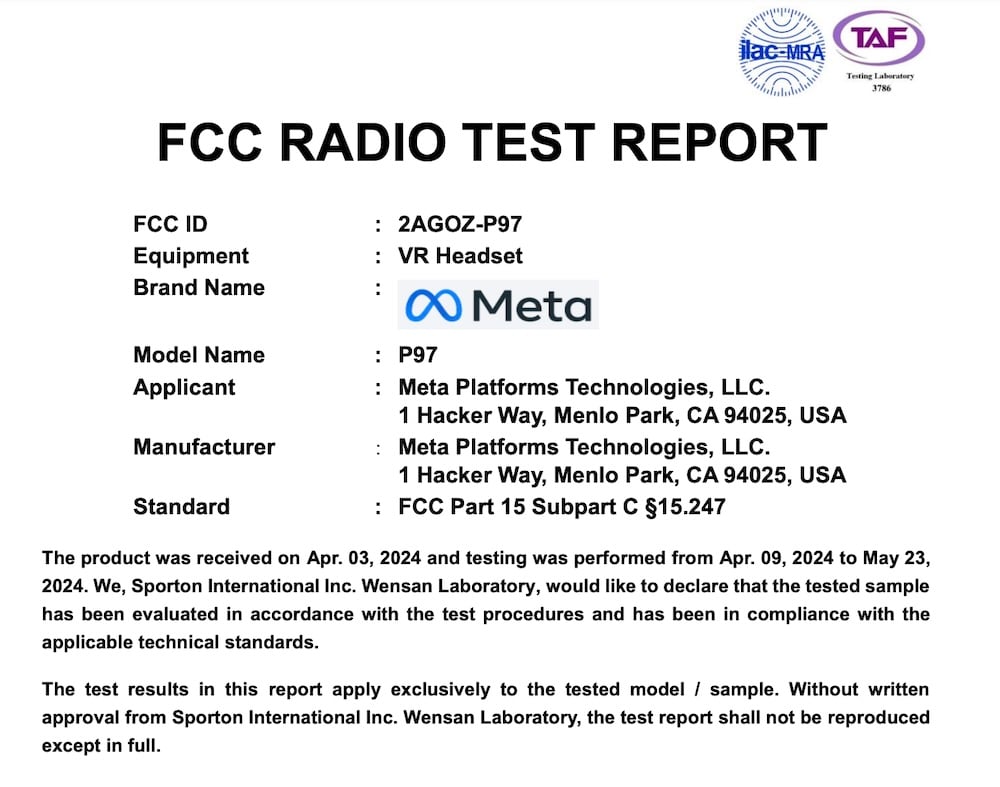
Not Samsung’s paperwork: this is the cover of the FCC radio test report Meta filed for the Quest 3S in 2024, named on it as a VR headset. Samsung’s test reports are public too, but every photograph of its two devices is sealed until March 26, 2027, so no picture of them exists outside the FCC.
The applications are dated July 22, and the grants were issued by Element Materials Technology Washington DC LLC, formerly PCTEST, of Columbia, Maryland, one of the private bodies that certify equipment on the FCC's behalf. The grantee is Samsung Electronics Co Ltd under its A3L grantee code, the models are SMO200P and SMO200J, and the responsible party named on both is Jenni Chun, a general manager at Samsung's Pine Brook, New Jersey address. "Notes: Smart Glasses" is the entire product description on the grant sheets.
Wi-Fi and Bluetooth, and no mobile radio
Between them the two grants authorise 2402 to 2480 MHz and 2412 to 2462 MHz for Bluetooth and 2.4GHz Wi-Fi; the 5180 to 5240, 5260 to 5320, 5500 to 5720 and 5745 to 5825 MHz blocks for 5GHz Wi-Fi; a 5845 to 5885 MHz block and single points at 5815, 5835, 5845 and 5855 MHz; and 5935 to 7115 MHz, which is Wi-Fi 6E. No LTE or 5G NR band appears in either document, so neither device is authorised to connect to a mobile network in the United States.
The power figures are small: a maximum of 0.382 watts on 2412 to 2462 MHz, 0.019 watts across most of the 5GHz blocks, and 0.0044 watts EIRP on 6GHz for A3LSMO200P against 0.0045 for A3LSMO200J. Both identifiers carry a "15E 6 GHz Low Power Indoor Client" grant, which adds that "this device supports 20, 40, 80, and 160 MHz BW modes".
The exposure testing is the closest the paperwork comes to describing the object. Each identifier was authorised under several Part 15 rules and every grant issued to it carries its own specific absorption rate line, so the numbers vary. One grant for A3LSMO200P reads: "The highest reported SAR for head, body, and simultaneous transmission use conditions are 0.13 W/kg, 0.34 W/kg, and 1.56 W/kg, respectively. Head use was evaluated in the intended wearing position. Body use was evaluated at a 5 mm separation." Across its other grants the head figure runs up to 0.84 W/kg and the body figure up to 0.90 W/kg, and the simultaneous-transmission figure stays at 1.56 W/kg throughout. A3LSMO200J carries the same wording, with head figures from 0.13 to 0.59 W/kg, body figures from 0.35 to 0.78 W/kg, and 1.49 W/kg for simultaneous transmission. "Head use was evaluated in the intended wearing position" is the only phrase in either file that says anything about how the thing is worn.
What the filings do not establish
They do not name a product, quote a price, give a release date, name a retailer, or say anything about a display, cameras, microphones or battery, and nothing in either document identifies the software the devices run. "Smart Glasses" is the applicant's own wording in the device description field, not a marketing name.
Both are marked as composite devices with short-term and long-term confidentiality requested. The user manual, the internal photographs, the external photographs and the test setup photographs are all listed with an availability date of March 26, 2027, and the block diagrams, schematics, operational description and tune-up procedure are withheld permanently. No photograph of either device has been published, by Samsung or by anyone else. Until next March, the phrase "Smart Glasses" and a list of frequencies is the whole public record.
An equipment authorisation is permission to sell a radio device in the United States, which makes it a genuine step towards a launch rather than a rumour about one. It is not a launch. FCC paperwork has run ahead of hardware before on this beat, including Meta's Quest 3 and the Quest 3S, but a grant fixes only what was tested, and what was tested here is two radios and a set of SAR numbers.

