
Pimax says DIY Spation buyers bring their own GPU, and its FAQ adds a motherboard
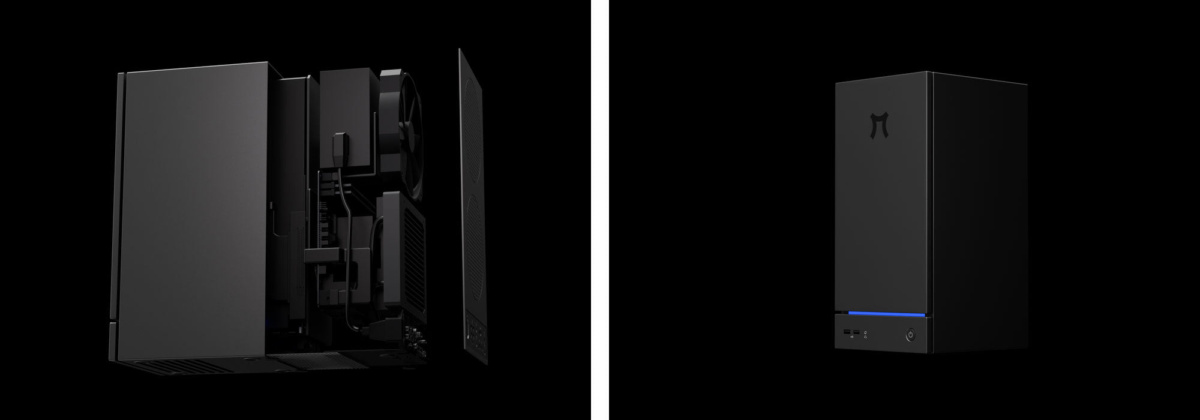
Pimax has announced a mini-PC called the Spation, built around a desktop Ryzen 7 9800X3D and a desktop graphics card, and the two documents it published about it on October 6 do not agree on what a DIY buyer has to supply. One names storage, memory and a GPU. The other names a motherboard and a GPU.

Valve's Steam Controller, Steam Machine and Steam Frame. Image: Valve
Pimax's announcement of the machine, read at 23:07 UTC on October 6, says: "A DIY configuration is also available, allowing customers to supply their own storage memory and GPU." Its Frontier 2026 FAQ, read in the same minute, answers the question "What is the DIY option?" with "We supply the Spation, and you bring your own motherboard and GPU."
Those describe two different purchases. One is a near-complete computer missing its drive, its memory and its card; the other is a chassis and a power supply waiting for a board. Pimax has not said which is right.
The standard machine is a desktop squeezed into a small box
Both documents agree on the configuration Pimax will assemble itself. It pairs an AMD Ryzen 7 9800X3D, with Pimax's own hedge of "or equivalent" attached, to either an AMD RX 9070 XT or an Nvidia RTX 5070 Ti, alongside 32GB of DDR5-6000, a 1TB M.2 NVMe SSD and a 1000W SFX power supply.
Connectivity runs to Wi-Fi 7, Bluetooth 5.4 and 2.5G Ethernet, with two DisplayPort 2.1 outputs, one HDMI 2.1, one USB-C DisplayPort 1.4a, one USB4 port and six USB 3.2 Gen 2 ports. Pimax says the Spation supports both Windows and SteamOS, which puts it on the same operating system as Valve's Steam Machine, which cannot yet stream VR games to a Steam Frame.
The target Pimax sets for it is a flight simulator. "Will it run Microsoft Flight Simulator 2024 in VR? That is the bar it was built for: a long flight sim session at VR resolution, held smooth", the FAQ says. Nothing about performance has been demonstrated.
The chassis gets two descriptions as well
The announcement calls the Spation a machine using desktop-class parts "in a chassis smaller than a typical tower PC". The FAQ is tighter: "It uses a desktop CPU and GPU and fits in a blade-sized chassis no thicker than a dual-slot graphics card." A tower and a dual-slot card are a long way apart as size comparisons, and the renders Pimax has published show a narrow upright box rather than a slab.
A third answer in the FAQ returns to parts. "Storage, memory and graphics are upgradeable with standard parts", it says of the assembled machine, which names the same three components as the announcement's DIY list and leaves the motherboard out of it. Pimax has published no correction to either wording, and both pages still carry the date October 6.
Nothing has been priced or dated
"Pricing and availability will be announced later", the FAQ says, so there is no cost and no ship date for the Spation in either document. The 60G AirLink wireless kit works with the machine, the FAQ adds, but is not built into it.
Pimax has sold PC VR headsets for a decade, most recently a Crystal Super with ultrawide optics reaching 140 degrees, and the Spation is the first computer it has put its name to. Both pages were live, and still disagreeing, when they were read at 23:07 UTC on October 6.

