
OpenAI discounts GPT-6 cached input up to 90%, if you reuse it inside 30 minutes
OpenAI has given the GPT-6 family a prompt caching system that discounts cached input tokens by up to 90%, for shared prefixes reused inside a 30-minute window. OpenAI said on September 22 that the discount applies to eligible shared prefixes, and that it comes with a caching dashboard and a diagnostics tool that says why a cache missed.
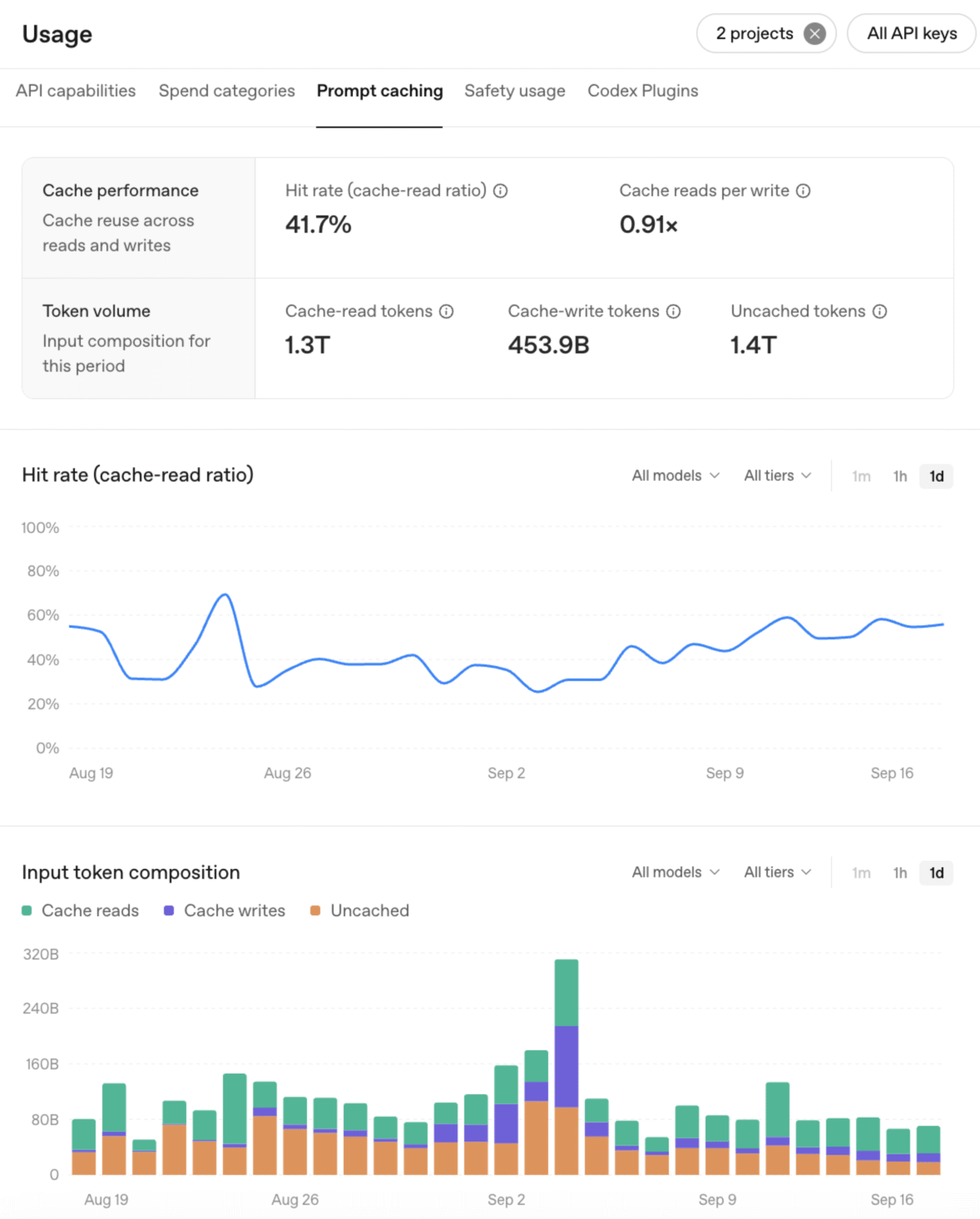
The Prompt Caching Dashboard charts hit rate over time and splits input into cache reads, cache writes and uncached tokens. Image: OpenAI
This is a separate change from the list prices, which OpenAI cut when it halved the API price of GPT-6 Sol and Luna. Caching is about reusing computation across requests that carry the same instructions, tool definitions and earlier context, so the two stack rather than replace each other.
GPT-6 is built for agents that work for hours at a time, from refactoring codebases to producing researched documents, and OpenAI says the applications behind them make a series of API requests that build on one another. Higher hit rates by default are the stated goal, and faster responses are the other half of the benefit.
A dashboard now shows how much came out of cache
The new Prompt Caching Dashboard shows how much of an application's input is served from cache, with hit rates over time and an input composition chart that compares cached and uncached tokens. OpenAI's example dashboard shows a 41.7% hit rate, with 1.3 trillion cache-read tokens against 1.4 trillion uncached.
A separate diagnostics tool handles the misses. It compares a request with a recent response to identify changes to the model, tools, settings or input that prevented reuse, and returns a reason and a token count, for example a cache_miss with the reason tools_changed and 5,629 tokens that could have been reused.
Developers report hit rates in the high 80s and 90s
Four customers are quoted in the announcement, and the figures they give are their own. Mario Rodriguez, GitHub's chief product officer, says prompt caching plays a critical role in helping GitHub Copilot deliver fast, efficient experiences at scale: "Over the past several months, we've reduced by more than 50% the share of prompt tokens requiring fresh processing across billions of requests to OpenAI models, relative to our previous baseline."
Bin Fan, agent team lead on the Manus agent, describes a move to a mix of explicit and automatic caching: "In less than a week, our OpenAI model cache hit rate went from roughly 85% to consistently above 90%, further lowering inference costs in production."
The other two quotes are the most specific. Eugene Mikhantyev, an AI engineer, says cache hit rates on his team's evaluations rose from 83% to 91% in under a week, cache writes fell by roughly two-thirds and inference costs by 36%, while chief technology officer Arian Hanifi says the dashboard and diagnostics improved hit rates by a few percentage points, reducing costs by 20%.
Four controls decide what stays in the cache
Explicit cache breakpoints let a developer choose which prompt prefixes get reused. On GPT-6 models, reasoning effort can now be changed between responses without breaking the cache, by appending a configuration_update while leaving request-level reasoning effort unchanged.
The other two are about discipline. OpenAI advises keeping tool definitions, schemas and ordering stable and using allowed_tools, or tool_choice set to none, instead of removing tool definitions, and it suggests prewarming shared instructions and reference material at startup so the work happens before the first question arrives.
OpenAI puts no per-token price on any of this, and every saving quoted belongs to the customer who reported it.

