
Google’s new Gemini model can score 1,000 questions at once without writing an answer
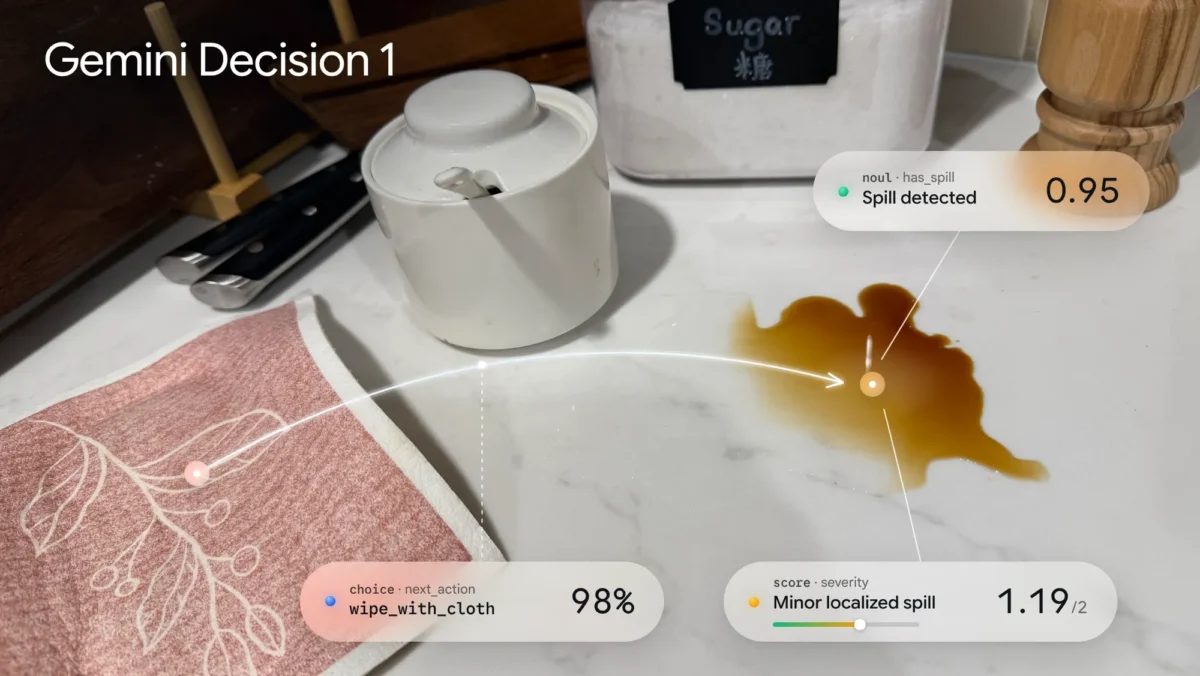
Google has introduced a Gemini model designed to assess up to 1,000 questions about the same input in one request. Gemini Decision 1 can work with text, images, audio, video and PDFs, returning confidence scores for bounded choices rather than writing a conversational answer.
The new Gemini Decisions API is aimed at developers building applications, not a new mode in the consumer Gemini chatbot. Google says it is available through the Gemini API in Google AI Studio.
For example, an application could submit an image and a text note, then ask whether a spill is present, choose a response from a supplied list and score its severity. The model provides probabilities that software can use to decide when to pass an uncertain result to a person.
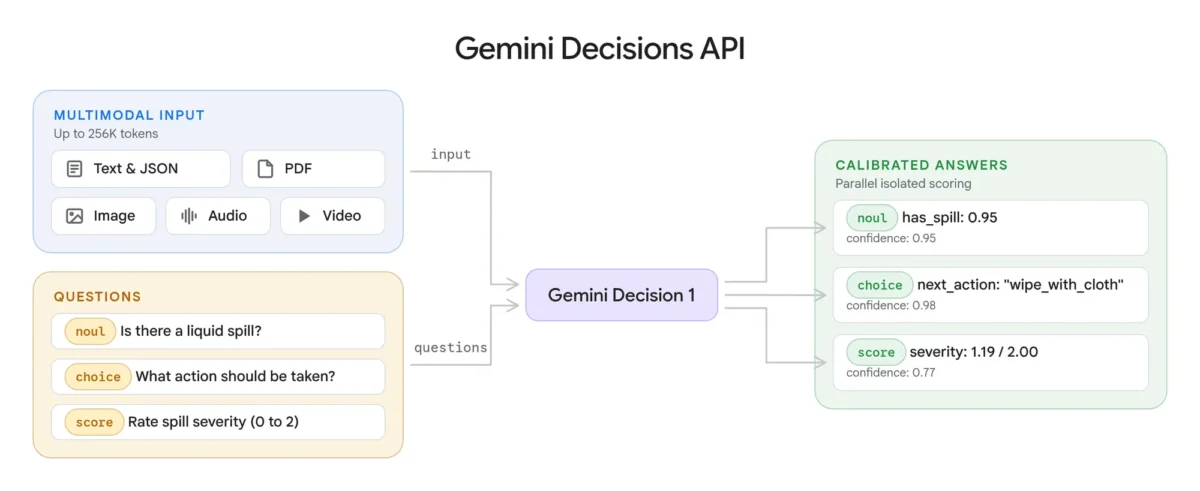
Google’s diagram describes how the Decisions API scores options rather than generating a free-form answer. Image: Google
One input, multiple decisions
In its announcement, Google says a request can include a shared multimodal input of up to 256,000 tokens and as many as 1,000 independent questions. It supports yes/no assessments, multiple-choice questions and scores against an ordered rubric.
For multiple-choice questions, Google says developers can supply between two and 255 choices. The API returns a selected option and probabilities for the candidates. A confidence score is a signal for handling a result, not proof that the selected answer is correct.
That distinction matters for uses such as screening content or routing a customer request. A developer still needs to test the system on the material it will encounter and decide when a person or another system should check the result.
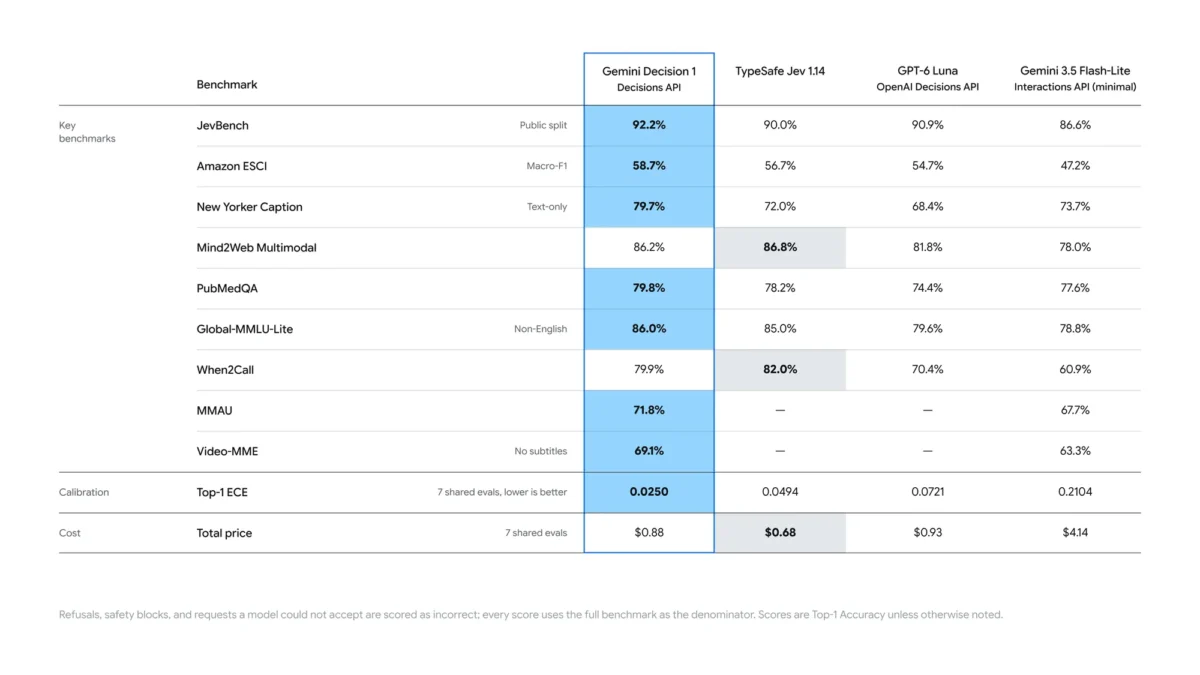
Google’s published comparisons are company measurements and are not a guarantee of real-world performance. Image: Google
Speed and cost come with conditions
Google lists a price of $0.10 per million input tokens, with no output tokens billed. That is an input-token rate, not a flat price for 1,000 questions or for every document. The cost of a request depends on the amount and type of input processed.
The company reports 150 to 250 milliseconds of end-to-end median latency for contexts up to 16,000 tokens in the conditions it describes. Its maximum supported input is larger, but the announcement does not promise that same latency for every request at the maximum size.
Google also publishes comparisons with other models on its chosen benchmarks. Those results are its own measurements, so developers considering a switch should test accuracy, speed and cost with representative tasks rather than treat the charts as a guarantee.
The announcement provides examples and links to Google’s developer documentation. Anyone building a workflow can combine question types against one input; people using the regular Gemini app should not assume this developer endpoint changes their chatbot experience.

