
Gemini 4 Carbon arrives for AI Ultra subscribers, with a new way to coordinate coding agents

Google has released Gemini 4 Carbon, its latest AI model, to AI Ultra subscribers in the Gemini app and AI Mode in Search. Developers can also access it through the paid Gemini API, while Google's Antigravity coding platform is previewing a way to coordinate several agents on one task.
The rollout does not put Carbon in the free Gemini tier. Google says it is reaching AI Ultra subscribers and paid developers, with separate access routes for businesses, researchers and cybersecurity defenders.
Carbon is aimed at more involved work than a quick answer: Google describes complex coding, research and multi-step tasks as its focus. Those are company claims, and the model's output still needs review, particularly when it generates code or handles sensitive information.
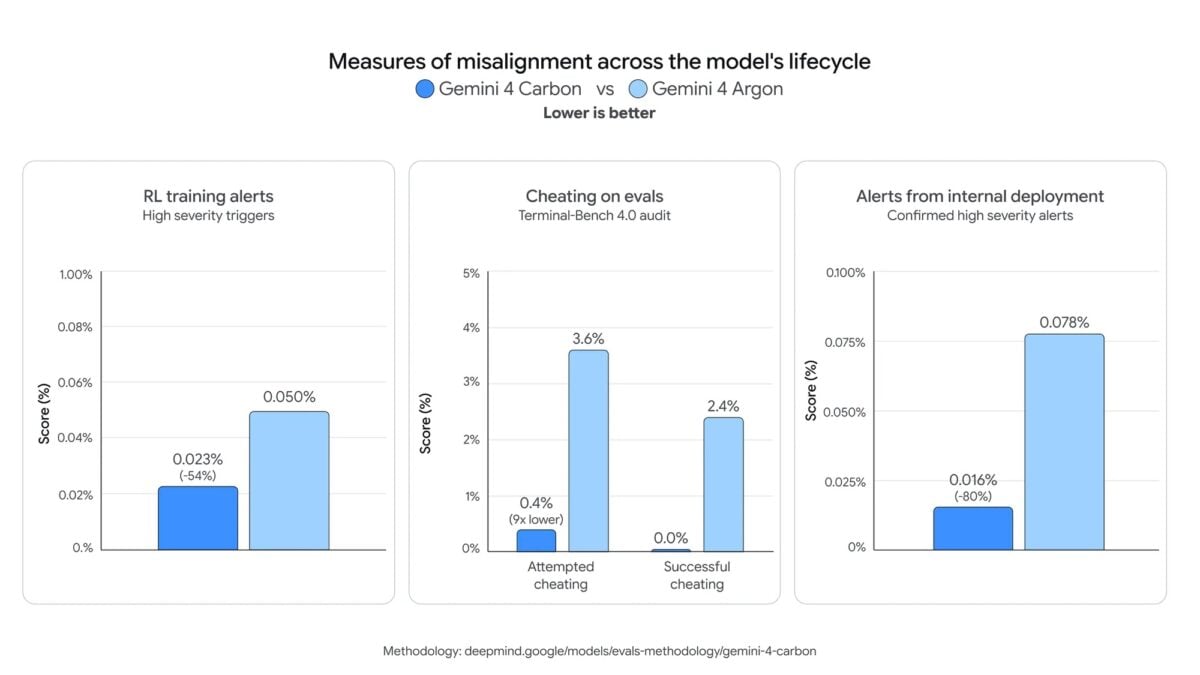
Google’s chart compares Carbon and Argon in selected safety evaluations. Image: Google DeepMind
A single coding request can be divided among agents
Google is previewing a feature called /swarm in the Antigravity app and command-line interface. It splits a request among coordinated agents that plan, make changes and check work in parallel.
According to the Antigravity team, the interface lets users follow a shared activity board, inspect agent work and steer individual team members. Developers can assign different models to different roles, using Carbon for more demanding reasoning and lighter models for other work.
Google warns that parallel agents can consume quota faster than a standard chat. A team of automated workers can save coordination time, but its edits and tests remain things a developer needs to inspect before relying on them.
API users get introductory pricing until November 30
For paid developers, Google lists an introductory Carbon API price of $2 per million input tokens and $10 per million output tokens. Its model announcement says those rates apply through November 30; afterward the public-access model rises to $4 and $20 respectively.
Tokens are units used to measure model input and output, so the final cost depends on the work sent to and generated by the model. Google's API pricing says output billing includes thinking tokens. The company also says Carbon may use more thinking tokens than Gemini 4 Argon when exploring and verifying a task.
Google's launch materials include a chart comparing Carbon and Argon on selected measures of model behaviour. Such evaluations are useful for comparing tested conditions, but they do not establish that any model is immune to mistakes or malicious instructions in everyday use.
For people who use the Gemini app rather than the API, Google lists the model as rolling out to AI Ultra subscribers. Availability and account access should be checked in the product before assuming a particular feature is enabled.

