
Microsoft’s new ray-tracing preview supports all RTX GPUs, with AMD starting at RX 9000
Microsoft's ray-tracing preview supports every Nvidia RTX GPU, while AMD support starts with Radeon RX 9000 cards. The aim is to make detailed, animated worlds cheaper to prepare for ray tracing, leaving more room in each frame for the scene itself.
The changes arrive in Agility SDK 1.722-preview, released October 28. Clustered geometry, partitioned scene structures and GPU-driven builds give engine developers new ways to avoid repeating work. They require game integration; this is not a driver switch that accelerates an existing library.
Microsoft demonstrates the difference in a deliberately demanding procedural test. Its sample documentation says the workload stresses building separate structures for many objects. Real games can use optimisations that this stress test deliberately avoids, so its enormous gain needs that context.
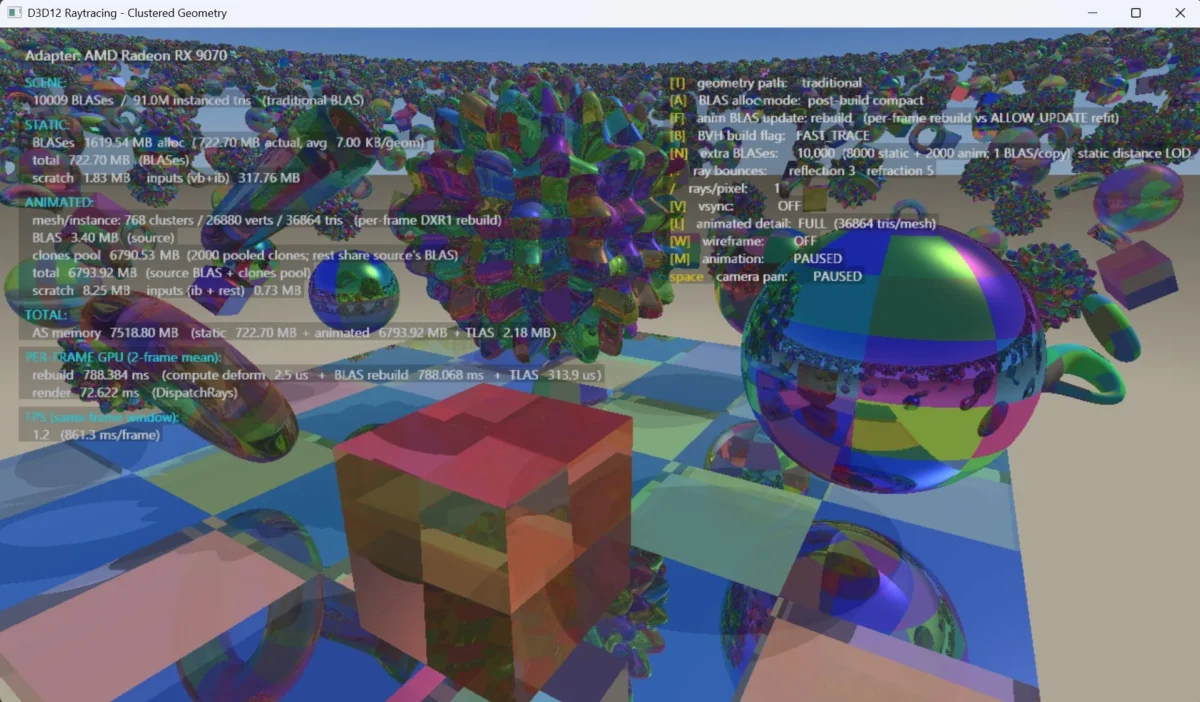
Traditional geometry mode in Microsoft’s RX 9070 sample. Image: Microsoft
Microsoft’s RX 9070 test jumps from 1.2 to 79fps
In Microsoft's published example, clustered geometry raises performance from 1.2 to 79fps on a Radeon RX 9070. This is one synthetic configuration, not a game benchmark.
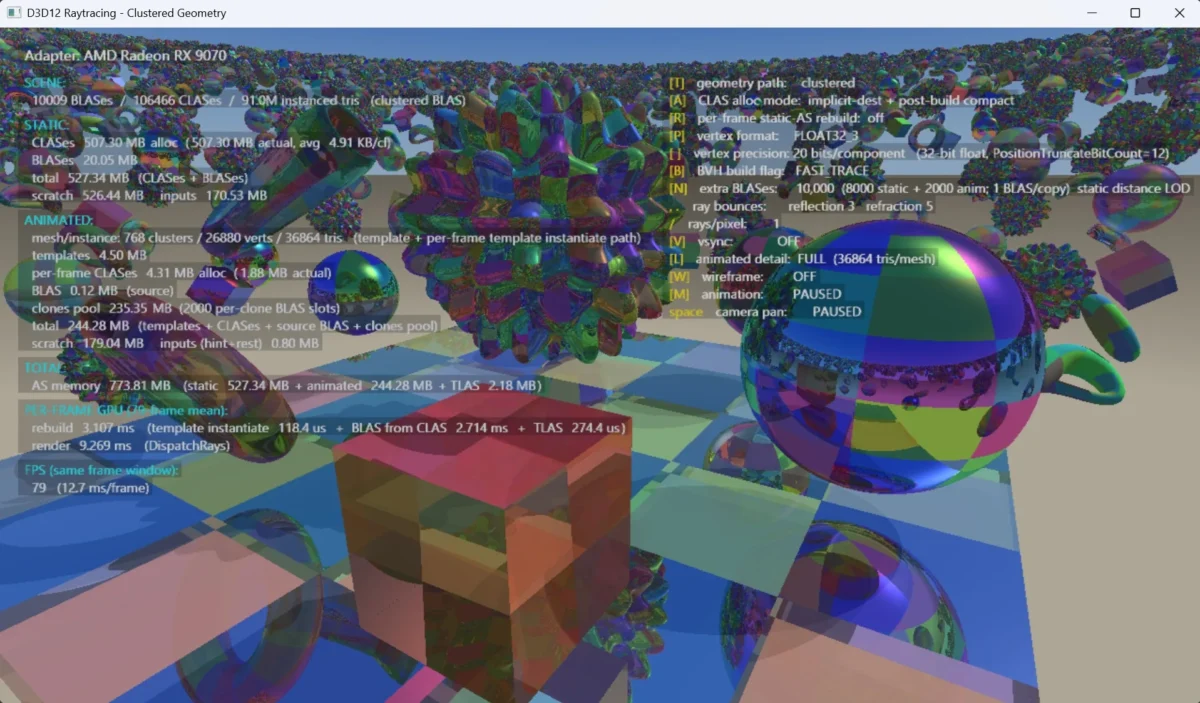
Clustered geometry mode in the same Microsoft sample. Image: Microsoft
| RX 9070 sample metric | Traditional rebuild | Clustered geometry |
|---|---|---|
| Frame rate | 1.2fps | 79fps |
| GPU structure preparation/build per frame | 788ms | 3.11ms |
| GPU ray tracing per frame | 72.6ms | 9.27ms |
| Static structure memory | 723MiB | 527MiB |
| Animated structure memory | 6,794MiB | 244MiB |
| Total structure memory, including TLAS | 7,519MiB | 774MiB |
| Static build scratch memory | 1.83MiB | 526MiB |
| Animated build scratch memory | 8.25MiB | 179MiB |
The memory total covers acceleration structures: the data the GPU uses to find what a ray hits. It excludes scratch buffers and source inputs, so it is not total game VRAM usage. Scratch is temporary working space for construction, and both scratch figures increase sharply here.
The sample also gives each animated copy a separate structure. Its documentation notes that a real application can share one traditional structure between identically deformed objects. Comparing those approaches in a shipping game could produce a very different result.
Microsoft cautions that results change with settings, workload and GPU.
What clustered geometry actually changes
Nvidia's technical explanation describes clusters as nearby triangles grouped before the GPU builds its ray-tracing structures. Supplying that organisation saves work compared with handing over an unordered collection of triangles.
Templates help with animation. A character can bend and move while its triangles remain connected in the same pattern; the engine can reuse work tied to that pattern instead of starting from scratch each frame.
Partitioned top-level acceleration structures tackle the larger world. If only one region changes, the engine can update that partition and retain the others. Games can use this alongside clusters to manage changing objects and large environments.
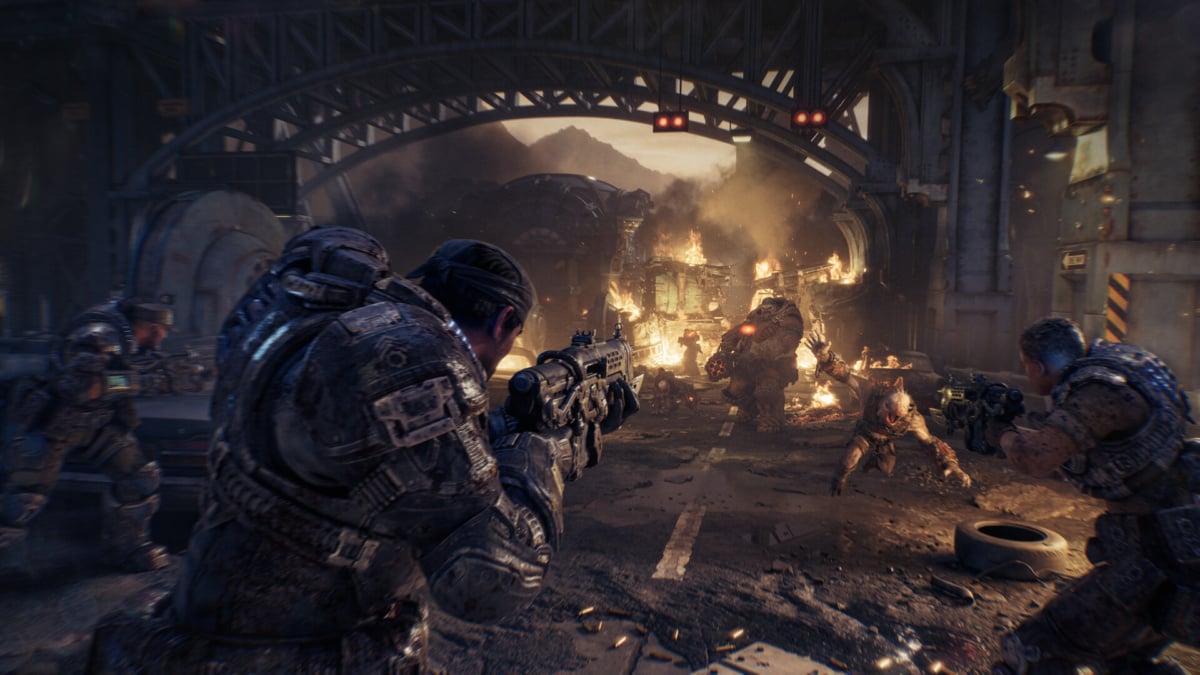
Gears of War: E-Day already uses Nvidia’s vendor-specific RTX Mega Geometry to ray-trace detailed Nanite geometry instead of simpler proxies. The DirectX work creates a common route for supporting vendors.
Which GPUs and drivers support the preview?
The feature support list is narrower than the list of GPUs on which a driver package can install.
| Hardware | Driver or availability |
|---|---|
| All Nvidia RTX GPUs | Game Ready 621.01 introduces support |
| AMD Radeon RX 9000 series | Agility SDK Developer Preview 26.20.12.01 |
| Intel Arc B-series; Core Ultra 200V and Series 3 | Beta Preview Feature Driver 32.0.101.9154 |
| Qualcomm Snapdragon X2 | Driver support targeted for Q1/Q2 2027 |
AMD’s package also supports RX 7000 cards for other features, but its release notes restrict these ray-tracing additions to RX 9000. Installing that package on an RX 7000 does not establish clustered-geometry support.
Likewise, Intel’s driver introduction includes Arc A-series, while its feature-specific list names Arc B-series and the selected Core Ultra processors. The broader download description should not be mistaken for support for every feature.
Microsoft leaves support for some older ray-tracing hardware undecided: driver implementation, validation and performance still matter.
What developers need, and what players should expect
Microsoft’s sample requires Agility SDK 1.722.0-preview and the Shader Model 6.10 compiler package, Microsoft.Direct3D.DXC 1.10.2605.37-preview. Windows Developer Mode enables the experimental shaders. The sample checks hardware support and falls back to its traditional path when clustered geometry is unavailable.
The ray-tracing features belong to the preview branch, separate from Agility SDK 1.620’s retail release. A compatible GPU is therefore only the first step: a game or engine must adopt the new code before players receive its benefits.

