
AI glasses shipments rose 263% in H1 2026, but 96% had no display, says Counterpoint

Global AI glasses shipments rose 263% year on year in the first half of 2026, Counterpoint Research says, but 96% of them were glasses with no display at all. Meta accounted for about 94% of that display-less segment, on volumes up 260% year on year and 22% on the previous half.
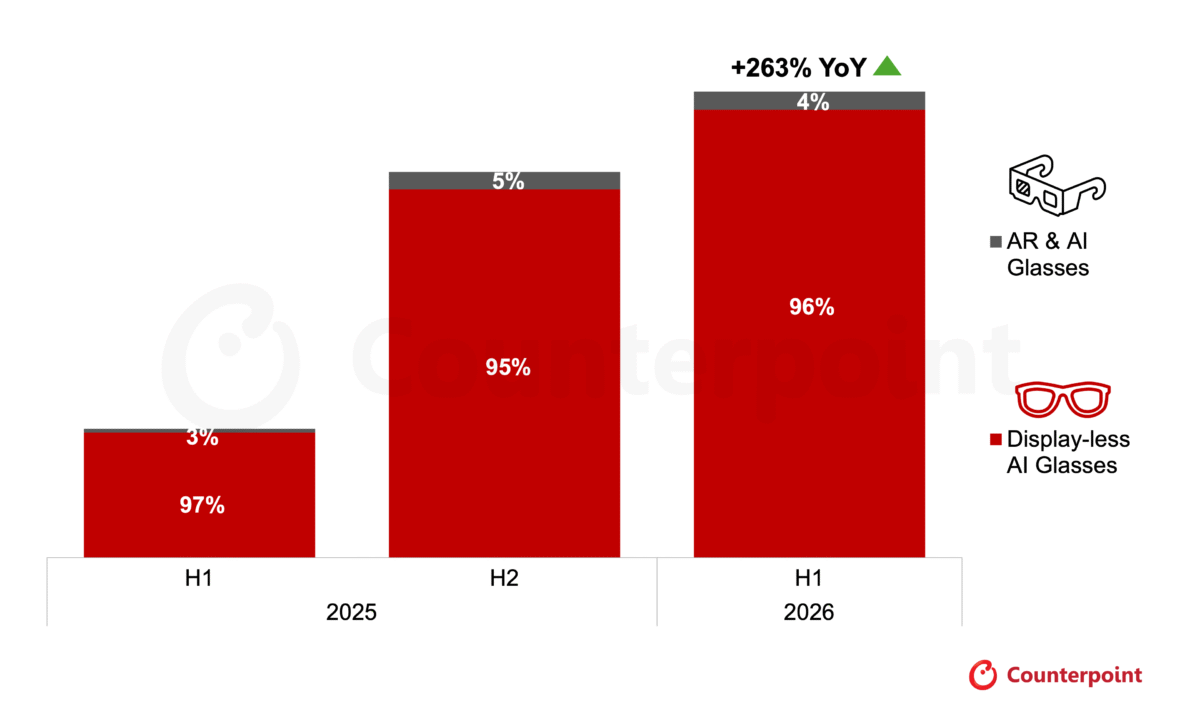
Counterpoint's own tracker put display-less glasses at 97% of shipments in the first half of 2025 and 96% in the first half of 2026. Image: Counterpoint Research
The figures come from the firm's Intelligent Eyewear Market Tracker and were published on September 21. They are shipments into retail channels rather than sales to people, and they are Counterpoint's own estimates rather than audited numbers.
Display glasses grow faster, from almost nothing
Display-less AI glasses, the Ray-Ban Meta shape with cameras, microphones and speakers but no screen, grew 258% year on year and 22% against the second half of 2025. The category Counterpoint calls AR and AI glasses, which uses waveguide lenses you look through, grew 449% year on year and 18% sequentially.
The faster growth rate still leaves display glasses at 4% of shipments. Display-less pairs were 97% of the category in the first half of 2025 and 95% in the second, so a year of display launches has moved the split by a single point.
China took 45% of AR and AI glasses shipments and North America roughly 41%, with Rokid, Even Realities, Alibaba and INMO named as the companies leading that segment. Principal Analyst Flora Tang says the reason is supply rather than demand: "At this early stage, the competitive landscape is shaped more by product supply than consumer demand."
Meta's lead has barely moved in three years
Research VP Peter Richardson says the competitive landscape "remains largely unchanged" three years after the Ray-Ban Meta glasses arrived in 2023. Counterpoint puts Meta's growth down to a wider range from Meta and EssilorLuxottica, including the cheaper Meta Glasses line, entry into new markets and heavier retail promotion.
Outside Meta, the firm describes the market as fragmented despite launches from Alibaba and Huawei. A different firm counted a different thing on September 20, when IDC put glasses at nearly 85% of all XR shipments in the second quarter, measuring glasses against headsets over three months rather than the AI glasses category over six.
Memory prices and privacy are the named risks
Counterpoint lists two challenges to the next stretch of growth: rising component prices, memory in particular, and growing public concern about cameras in AI glasses. It does not expect either to change the industry's direction.
Meta, Google, Samsung and Apple are all expected to spend harder on the category, and Counterpoint puts the next phase in agentic glasses that act on context, built on better voice interaction and ultra-low-power sensing. The display pairs are still mostly promises: URXR One raised $1.29M on Kickstarter for a 93-gram display pair and has not shipped one.

