
ChatGPT can now watch a connected app and act, on a spec that is still a draft
OpenAI has given ChatGPT a way to react to something happening in another company's app instead of waiting to be asked, and the specification it is built on has not been finished. MCP Events lets ChatGPT subscribe to updates from a plugin's MCP server, "such as new messages, content updates, or status changes", OpenAI's developer documentation says, and then carry out whatever the user asked it to do when one arrives.
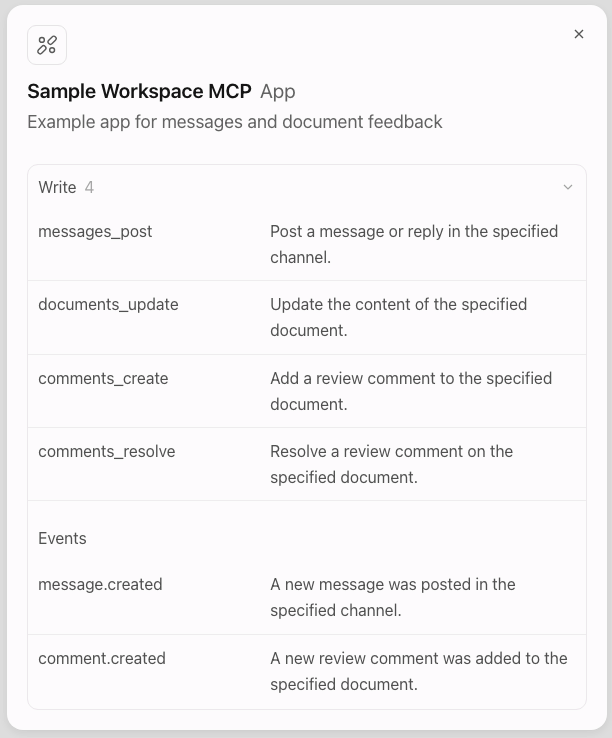
Discovered events appear alongside a plugin's tools on its page, as OpenAI's documentation shows. Image: OpenAI
The draft part is OpenAI's own wording, not a characterisation. "ChatGPT supports webhook delivery and callback verification from the draft MCP Events specification," the documentation says. "Polling, streaming, and the draft's gap and terminated control notifications are not supported by this integration." The design it points at lives in a repository called experimental-ext-triggers-events, and the file it links is headed as a design sketch.
A server has to run MCP 2.0 before ChatGPT will watch it
"MCP Events in ChatGPT requires MCP 2.0 (protocol version 2026-07-28)," OpenAI says, and the server also has to "provide persistent subscription storage and outbound HTTPS access to callback URLs". It advertises itself by adding an events capability to its discovery response, then implements three methods: events/list to describe what can be subscribed to, events/subscribe to start or refresh a subscription, and events/unsubscribe to stop one.
ChatGPT hands the server a callback URL and a signing secret, and the delivery rules are tight. One event per request, with a body no larger than 256 KiB, signed with Standard Webhooks. Callbacks must be HTTPS, redirects are not followed, and private, local and other non-public addresses are blocked for verification requests as well as deliveries.
Events can arrive out of order, and missed ones may be gone
Two of OpenAI's instructions to server authors describe what the delivery actually guarantees. "Events can arrive out of order. Make write tools idempotent so repeated calls do not duplicate changes," OpenAI says. And where an event type does not support replay, "events missed during an interruption cannot be recovered through the protocol".
Prompt injection gets its own instruction, addressed to the people writing the servers. "Treat comments and other user-authored text as data," OpenAI says, and "do not add instructions telling the model how to behave inside the event payload."
OpenAI's two worked examples show the shape of the thing. One monitors a product-feedback channel for bug reports and opens draft pull requests with fixes and tests, triggered by message.created filtered to a channel. The other watches a document for review comments and implements the edits they request, triggered by comment.created filtered to a document.
Hardly anyone can turn it on
The feature reached ChatGPT in OpenAI's release notes dated September 29, the same batch that brought Pages to ChatGPT Space. "Supported plugins can use MCP events to start an automation when something changes in a connected app," that entry says, and "the connected account must have access to the event and any information used by the task."
Availability is narrower than the idea. It runs in Work chats on ChatGPT web, in Work chats in the desktop app with Cloud selected, and with dots, the always-on agents OpenAI introduced in the same release. Workspace controls for plugins and event-triggered tasks still apply. OpenAI has published no price for it and no rate limit, and since plugins are where OpenAI keeps putting third-party apps, the gate on all of this is whether a developer has shipped a server that speaks the newer protocol at all.

