
EA says Battlefield 6 blocked 327,756 cheat attempts in August, up 18% on July

EA Javelin Anti-Cheat blocked 327,756 attempts to cheat or tamper with Battlefield 6 during August, against 277,649 in July, a rise of 18%. Both counts are EA's own, taken from the August anti-cheat report it published on October 2, and no method is given for producing either of them.
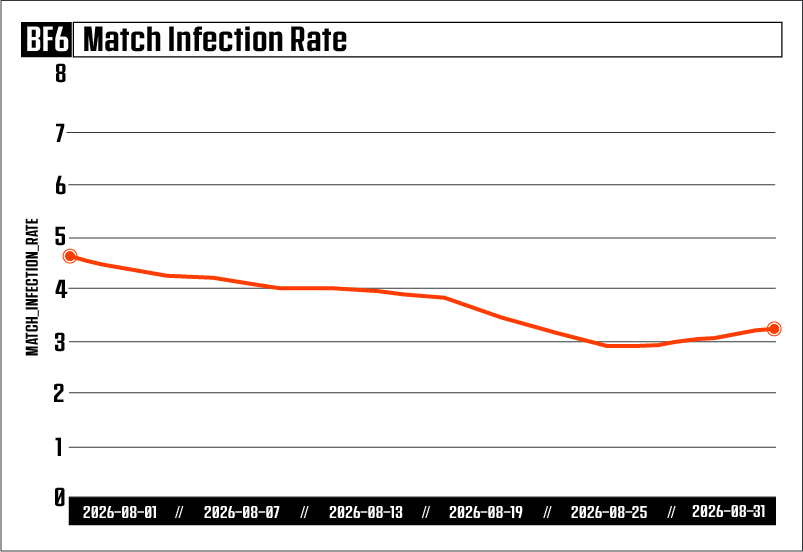
EA's own chart of the August Match Infection Rate, falling to a low on August 25 and rising again by August 31. Image: Electronic Arts
The same report puts the game's Match Infection Rate at 3.24% on August 31. EA defines that as "The percentage of matches across the title that were negatively impacted by at least one cheater", so it counts matches rather than players, and it takes in "all suspected cheaters you've reported, even those we might not have enough evidence to enforce against".
The infection rate fell for three weeks, then turned
MIR opened August at 4.64% and declined "as low as 2.89% on August 25th", EA says, before it "began to see an increase to 3.24% at the end of August on the 31st". The July report had closed that month at 4.76%.
Anything earlier than July will not line up with those readings. EA rewrote the calculation in its Season 4 anti-cheat update after a climb in MIR that matched no change in known cheating tools or communities, and put the cause down to reports filed against legitimate players, "particularly highly skilled players and especially those who spend most of their time in vehicles". The July report puts June at 6.59% under the old calculation and 4.62% under the new one.
How the filtering works is withheld. "While we won't share the exact methodology to avoid enabling abuse," EA says, the principle is that a player who is reported over a long period, never trips another anti-cheat signal and keeps passing manual review will be read as "a skilled Battlefield veteran".
105 of 110 tracked cheat operations report failures
EA says it is tracking 110 active cheat programs, hardware devices, vendors, resellers and the communities around them, six more than in July, and that 105 of those "are reporting related feature failures, detection notices, downtime, or fully taking their cheats offline". EA puts that at 95.45%, below the 96.15% it published when the count stood at 100 of 104.
That wording describes what the sellers themselves say about their own products, which EA is reporting rather than demonstrating. Every number in the report is the publisher measuring its own system, and the raw data behind the attempt count has not been published.
Some of that tracking happens away from the game. EA says it raised concerns with Collective Minds, the maker of the Cronus Zen and Strike Pack devices, "regarding third-party tools that enable cheating in multiple EA titles", and that EA-related content and scripts were taken off those products' public sites and Discord server afterwards. That was posted on September 10, between the two monthly reports.
TPM 2.0 enforcement landed on the last day of the month
Only one day of August sat behind the new firmware requirement. Enforcement went live on August 31, EA stated in July's report, and the company's help article is flat about the consequence: "You need TPM 2.0 enabled to play Battlefield 6 on PC."
The game's Steam listing asks for more than that. Minimum and recommended specifications both carry the note "TPM 2.0 Enabled UEFI SECURE BOOT Enabled HVCI Capable VBS Capable". The first two of those are the firmware switches Call of Duty: Modern Warfare 4 demands on PC. EA asked less of Apex Legends players when it moved that game onto Javelin on September 29, telling them no BIOS menus were involved.
Every figure here was read at source at 09:25 UTC on October 6, on EA's own pages and in the copy posted to the game's Steam hub. The next report, covering September, will be the first to span a full month with TPM 2.0 enforced.

