
Juniors took 27% of Anthropic's technical hires in early 2025, and now take 9%

Junior roles now account for 9% of Anthropic's technical hires, against 27% in early 2025, and Anthropic published the figures itself. Its research post of October 16, by Nathan Wilmers, Regina Catipon, Maxim Massenkoff and Peter McCrory, says the share of junior-level employees in technical departments "slipped from 21% to 14%" since early 2025, and that "the proportion of junior technical hires fell even faster, from 27% to 9%".
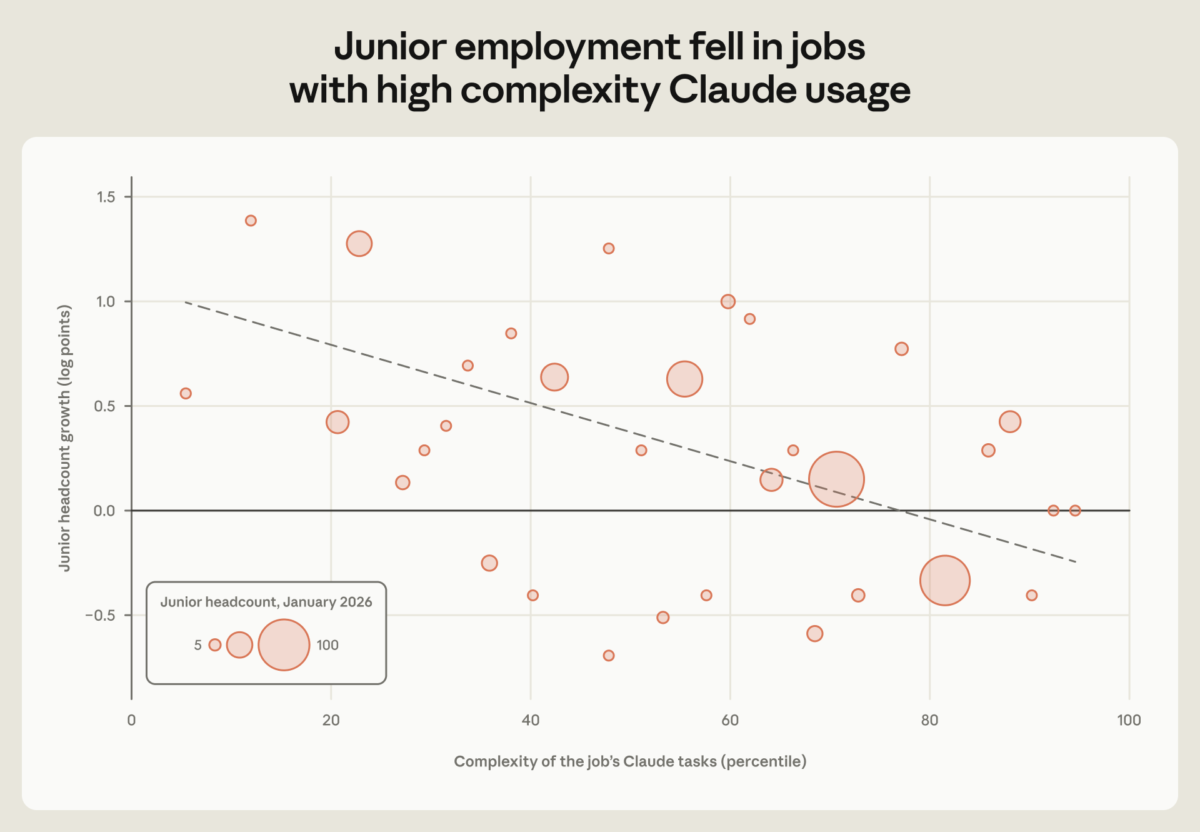
Figure 5 from Anthropic's research post, comparing junior headcount in January 2026 with July 2026. Image: Anthropic
Both are shares rather than counts, and the post says the hiring did not stop. Technical hiring "has continued growing in absolute terms" as the company expands, it says, while "intensive hiring in sales, finance, and recruiting has outpaced it". Postings for juniors are the exception, and have fallen "particularly sharply since December 2025".
Anthropic dates the turn to January 2026
Discussion of falling demand for junior technical employees "emerged in core technical functions in January 2026", Anthropic says, and it credits newly capable models with accelerating that view. It quotes an unnamed employee: "the thing that raised eyebrows was the uplift for performance engineers in particular and it basically overnight changed what we were looking for."
By April, engineering and research teams "had deemphasized hiring for lower band technical positions", and a survey in the same month found a majority of managers hiring for a different set of skills because of AI. "Around a third of ML and a fifth of SWE managers reported hiring less due to AI," the post says.
What those managers want instead is put plainly: hiring managers "increasingly emphasize applicants' autonomy and judgment relative to specific technical expertise". Anthropic also reports junior employment slowing in the jobs that use Claude for the most complex tasks, which it presents as a description rather than a cause.

The artwork Anthropic published with its October 16 research post. Image: Anthropic
Anthropic counts agent hours two different ways
The comparison the company leads with is between agent time and employee time, and it appears in two forms that are not the same measure. "By August interactive AI agent hours outnumbered employees' six to one," Anthropic says, and also that "Agent hours worked outnumber human hours 6 to 1". One sets agent hours against a number of people and the other against hours worked, and the post does not say which reading is meant.
The human side of that measure is not hours anybody logged either: "Human work hours are calculated as headcount and assumed 40 hours per week."
The scale underneath the ratio is not new. Anthropic said in September that about 30,000 agents were doing research and engineering work on its most-used internal platform at any one time in August, and in its own account of moving its monorepo off git it put merge volume at about 2,500 code changes a day in May, rising above 30,000 by September.
Technical staff are a smaller slice of a bigger company
Technical departments fell from 61% to 56% of Anthropic's employment over the last year. The company also reports hiring less per dollar of revenue than the previous generation of large tech firms: at five years old it takes in between two and four times as much revenue per employee as Meta and Google did as they crested in their own rapid growth.
Inside the technical teams the mix has moved as well. The share of employees making no code commits in the prior 30 days fell by almost half over the year to April 2026, the ratio of engineers to product managers sits at about 17 to 1, and the number of commits from managers has doubled. Coding-focused agent sessions for non-technical employees, measured among people with no commits at baseline, went from two a month in August 2025 to 90 in May 2026.
Staff move around more too. Employees with at least a year at the company were 50% more likely to change department each month in 2026 than in 2025.
Anthropic says it has responded "by setting up an early warning system to track jobs at risk of disruption", and that "as jobs evolve the company has prioritized internal redeployments". The system reads role-level metrics for demand and productivity against AI capabilities and use, and Anthropic puts no number on how many roles it has flagged or how many people it has moved.
All of it is Anthropic measuring Anthropic, from internal employment, output and survey data and 17 employee interviews, and the post offers the company as "a leading indicator of how AI will shift work organization, hiring, and labor demand across the economy". It is also the company selling the tools, and nothing in it measures a job market outside its own walls.

