
AMD's Jack Huynh says FSR 4 reaches APUs, laptops and handhelds by the end of 2026

AMD will extend FSR 4 to APUs, gaming laptops and handheld PCs "by the end of this year", according to Jack Huynh, the company's senior vice president and general manager for the Computing and Graphics Group. The upscaler has never run officially on an AMD handheld, and its machine-learning model is the reason.
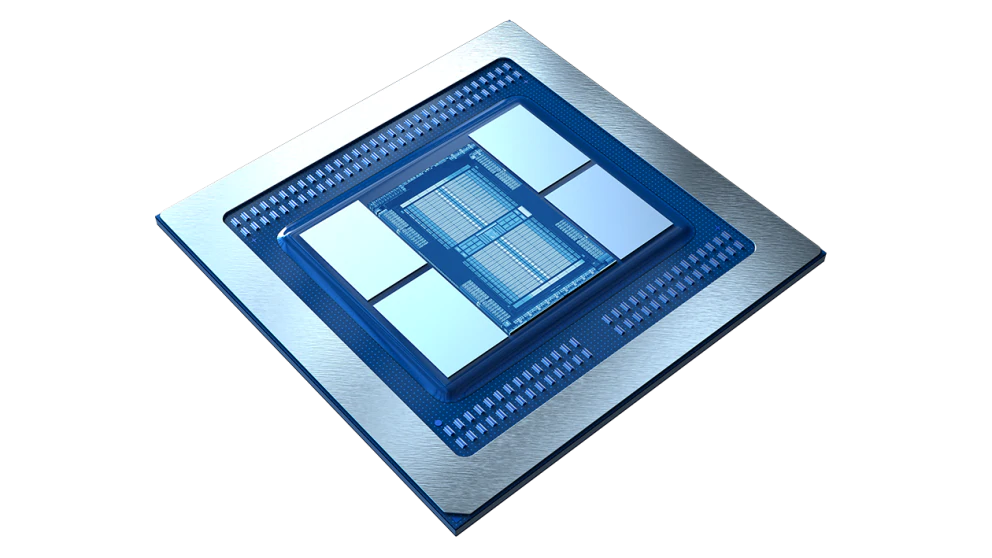
A render of a Radeon GPU package, with memory stacks either side of the central die. Credit: AMD. Image: AMD
Huynh made the remarks at a press meeting with Korean reporters at Seoul Dragon City in Yongsan on October 7, reported by The Elec, which attended and filed its account at 19:27 Korean time the same day. The quotations below are translated from its Korean, and the article was read at 21:04 UTC on October 8.
A lightened model built for integrated graphics
The plan runs on two tracks. AMD will "expand the machine-learning, AI-based FSR4 technology, which we introduced first on discrete graphics cards, to the whole product line, including APUs, gaming laptops and handheld devices, by the end of this year", Huynh says, and will "respond in two directions: existing APUs, and launching a new product line".
For the chips people own now, the answer is a different model rather than different hardware. "We have newly developed a dedicated, lightened model of FSR4 suited to the APU environment," Huynh says, and "the focus is on good in-game image quality and low latency." No image quality or frame rate figure was given for it, and no game, date or driver version was named.
The reason a lighter model is needed sits in how FSR changed. Everything up to FSR 3 was a general-purpose algorithmic technique, while FSR 4, shown at CES 2025, moved to a machine-learning model in the manner of Nvidia's DLSS. The report says existing APUs could not supply the compute that model wants, which is why graphics-heavy mobile parts including the Ryzen Z2 Extreme and what it calls Ryzen AI Halo have had no official FSR 4 support, and why only RDNA 4 cards had it on the desktop.
One reading in the report is not Huynh's
The Elec reads his comments as meaning a new APU with an RDNA 4-based integrated GPU this year. That inference is the publication's rather than Huynh's, and the Korean sentence carrying it is written as an interpretation. Huynh named no architecture, no product and no SKU, and "by the end of this year" is as precise as the timing gets, so anyone waiting on a specific handheld chip is waiting on an announcement that has not happened.
What the two tracks do settle is that the chips already sitting in handhelds are not being written off. The report says support for existing APUs is to be handled with the lightened model, which would reach a Ryzen Z2 Extreme device as software rather than as new silicon.
What a lightened model would change on a handheld
Upscaling is worth more on a handheld than on a desktop, because the power budget is fixed and rendering fewer pixels is the cheapest way to raise a frame rate inside it. The strain shows in games that make no allowance for that: Gears of War: E-Day cannot switch its ray tracing off, and the Steam Deck cannot keep up with it.
Owners of unsupported AMD parts have been reaching for modern upscaling without AMD's help, as with the unofficial mod that pushes Nvidia's neural rendering onto RX 6000 cards. An official lightweight model, running on the integrated graphics AMD sells by the million, would be the supported version of the same idea, and the only number attached to it so far is a year with fewer than three months left.

