
visionOS 27 opens Vision Pro tracking to third-party accessories at up to 90Hz

visionOS 27 lets other companies build tracked accessories for Apple Vision Pro, but the first hardware is not on sale yet. Apple's developer page says a spatial accessory "combines IR LEDs and an IMU for precise, low-latency six-degrees-of-freedom tracking", and it can be tracked at up to 90Hz.
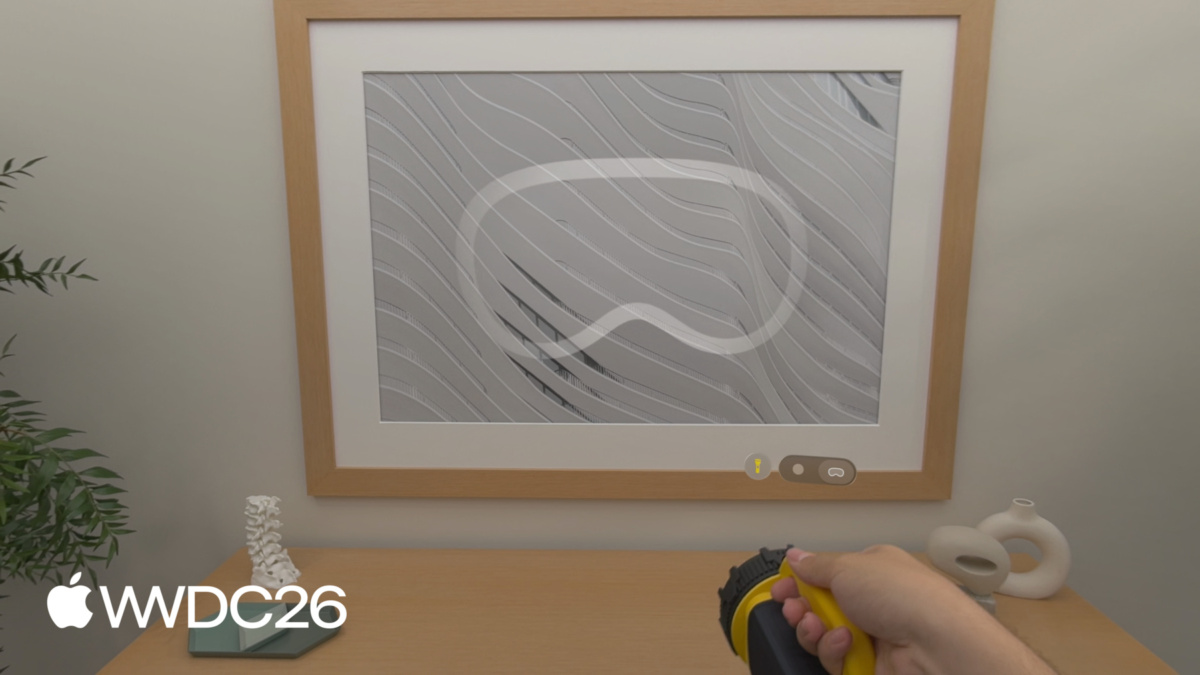
A hand-held accessory in Apple's WWDC26 visionOS developer artwork. Image: Apple
The update reached Vision Pro owners on September 14, alongside Apple's other platform releases. Apple says manufacturers including DFRobot and MikroE will release reference hardware and development kits "later this year", for testing or for direct use in visionOS apps.
Apple builds a controller framework for everyone else
Vision Pro launched in 2024 with eyes and hands as its only built-in input, and Apple has never made a controller for it. The new framework gives accessory makers a standard route instead: according to Apple, a spatial accessory can combine tracking with "physical inputs such as buttons, touchpads, and haptics".
Apple says the 90Hz tracking supports "high-motion use cases and tracking under low-light conditions". Styluses, tool handles or game controllers are the obvious candidates, although Apple has not named any consumer product.
This is the same basic recipe Meta used for its Quest controllers: infrared LEDs that the headset cameras can see, plus an inertial sensor to fill the gaps between camera frames. The difference is that Apple is publishing it as a platform for third parties rather than shipping a controller of its own.
Earlier attempts had to work around Apple. The Surreal Touch controllers went to Kickstarter in 2024 as the first Vision Pro controllers. Apple's framework now gives products like that an official route onto the headset.
PS VR2 controllers reach Unity games, with Godot to follow
Sony's PS VR2 Sense controllers get broader reach too. Apple says "visionOS now supports spatial accessories in Unity apps and games", naming the PS VR2 Sense controllers as an example, and that "Godot on visionOS will also have support" for them.
The controllers themselves are not new on the headset. Apple announced Sense controller support for visionOS 26 in June 2025, about half a year after the first reports that Apple was working on it. The change is engine support: Unity developers can now build for the controllers as spatial accessories, and Apple says Godot support is on the way.
Many VR games on Quest and SteamVR are built in Unity, and Godot powers a growing number of smaller projects. For studios porting from those platforms, that means controller input on Vision Pro inside the engine they use, now in Unity and later in Godot.
Object tracking and Gaussian splats get upgrades
Two smaller developer changes round out the update. Apple says "high-frame-rate tracking gives your app more frequent pose updates as objects move through space", and an extended training option in Create ML improves accuracy, "particularly for objects held in hand".
RealityKit also "now efficiently renders 3D Gaussian Splats", according to Apple, which lets apps place photorealistic scans of real objects into virtual scenes. Quest owners have seen the technique in apps such as Gracia since 2024, and Apple now supports it in its own rendering engine.
For owners, none of this does anything until accessory makers ship hardware and developers adopt the new APIs. The DFRobot and MikroE kits, due later this year, are the first step.

