
Google DeepMind watermarks AI-designed proteins, and the first binders still bind
Google DeepMind has taken its SynthID watermark into biology, and says the first watermarked protein binders still bind. In wet-lab testing against three target proteins, VEGF-A, the SARS-CoV-2 spike protein RBD and PD-L1, the watermarked designs “matched the hit rate, binding affinity, and natural sequence diversity of unwatermarked versions”, the company says.
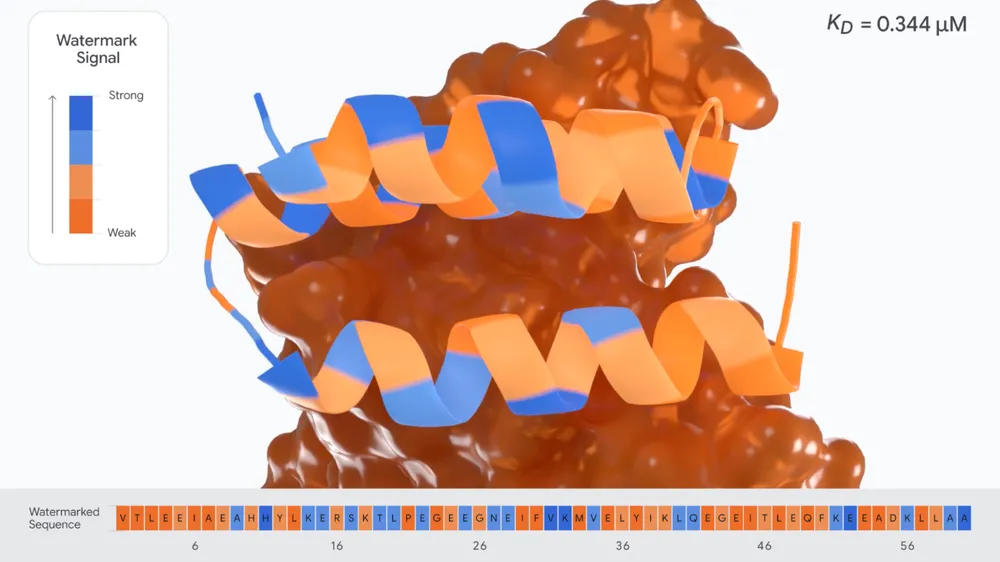
Google DeepMind's visualisation of the predicted structure of its watermarked VEGF-A binder, with the watermark signal shown as a colour for each amino acid. Image: Google DeepMind
It calls those “the first-ever watermarked and biologically functional protein binders”. The method is published as a peer-reviewed paper in Nature, “Function-preserving watermarking of AI-generated proteins”, and Google describes the work as a proof of concept.
The mark goes into the sequence, not into a file
SynthID Bio “embeds an imperceptible signature directly into the biological code”, Google says, so the watermark is “verifiable not just on a digital model but on the synthesized, physical protein itself”. A design that leaves the model and gets made in a laboratory carries the mark with it.
For binders, molecules built to latch onto other proteins, the team used AlphaProteo, DeepMind’s own binder design method, alongside a SynthID Bio-enabled version of ProteinMPNN, a widely used protein sequence generator. Adaptyv Bio helped with the in vitro validation.
AlphaFold 3 carries the watermark in its weights
The second target is 3D structures. Google says SynthID Bio fine-tunes “a small part of AlphaFold 3’s diffusion network” so that predicted coordinates “inherently carry a detectable signature regardless of who runs the model”, and says prediction accuracy is preserved alongside near-perfect detectability.
Google gives two reasons for wanting any of this. Novel AI designs “can bypass traditional DNA synthesis screening”, and mislabelled synthetic 3D structures “risk polluting public databases and misleading downstream research”.
Tampering is the part that does not work yet
“Moving forward, key challenges include making the watermark more robust against deliberate tampering,” Google says. It suggests pairing the watermark with provenance metadata, along the lines of C2PA for digital media, or with central repositories of AI-generated biological data.
The work on viruses is further back. With the Hie lab at Stanford University and the Arc Institute, DeepMind put SynthID Bio into the genomic model Evo 2 and watermarked the genome of a bacteriophage Evo 2 designed. Early laboratory testing in bacteria cultures has confirmed those phages are functional, Google says, with the details promised in a later manuscript.
Google is publishing the methods paper, open-sourcing the code and the in vitro data, and releasing the weights to the research community.
Sarah Carter, a biosecurity policy expert and Principal at Science Policy Consulting who reviewed the work for Google, calls SynthID Bio “an important piece of the puzzle for tracking the provenance of biological designs”. James Diggans, Vice President, Policy and Biosecurity at Twist Bioscience, who gave early feedback on the paper, says watermarking “offers a promising new addition to the biosecurity toolbox”.
Google sets the watermark alongside the other layers it names, model-level mitigations and customer vetting. Vetting is the layer Anthropic moved in September, when it loosened Claude’s biology safeguards for vetted teams and removed them for some projects.
What exists so far is one paper, one watermarking method and binders against three targets. The tamper problem Google names is still open, and the phage results have not been published.

