
Steam's new Pyrowave convars point to one engineer's own sweep: 125 to 300 Mbit/s
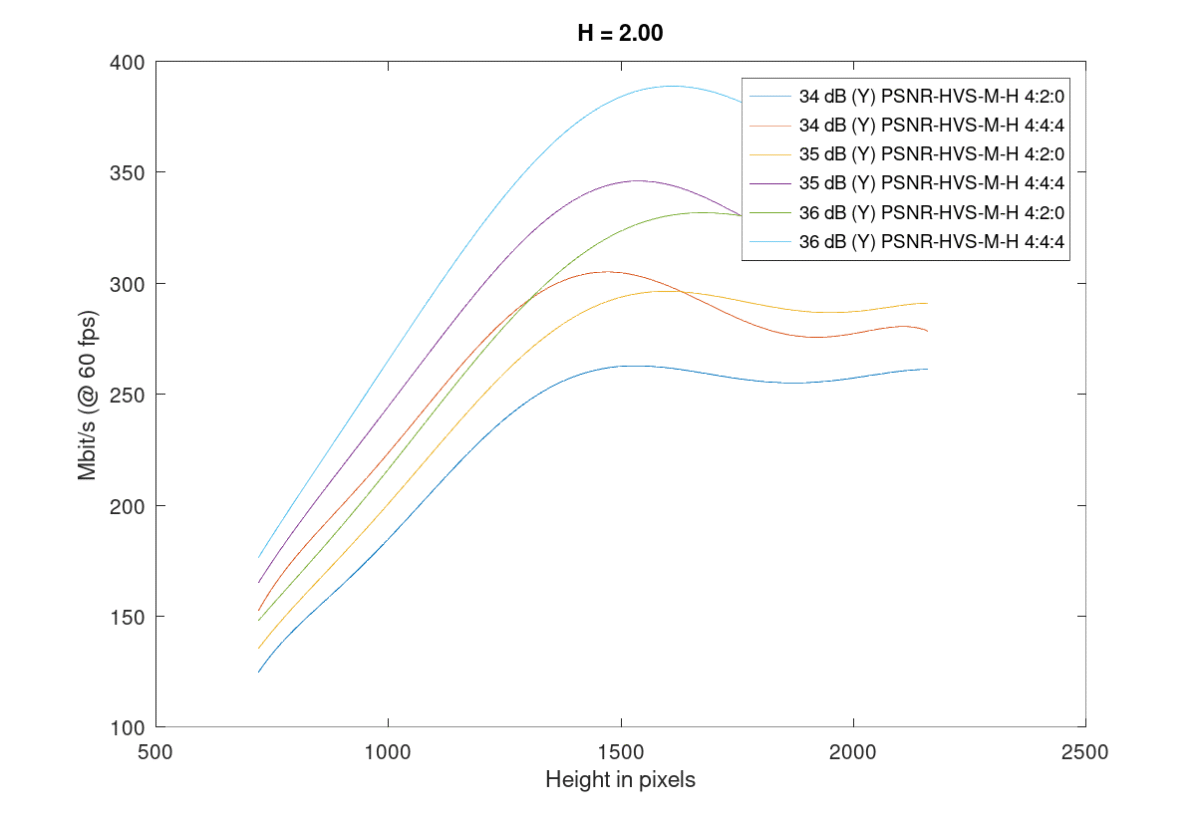
Valve's beta Steam client update of October 1 added two convars, @PyrowavePSNR and @PyrowaveHeightFactor, which Valve added to "tune automatic bitrate calculation" for the Pyrowave codec on a Remote Play stream. Valve's patch notes point to a single document for the details, and that document puts the bitrate curve for 720p to 4K at "about 125 mbit to 300 mbit" at its reference viewing distance.
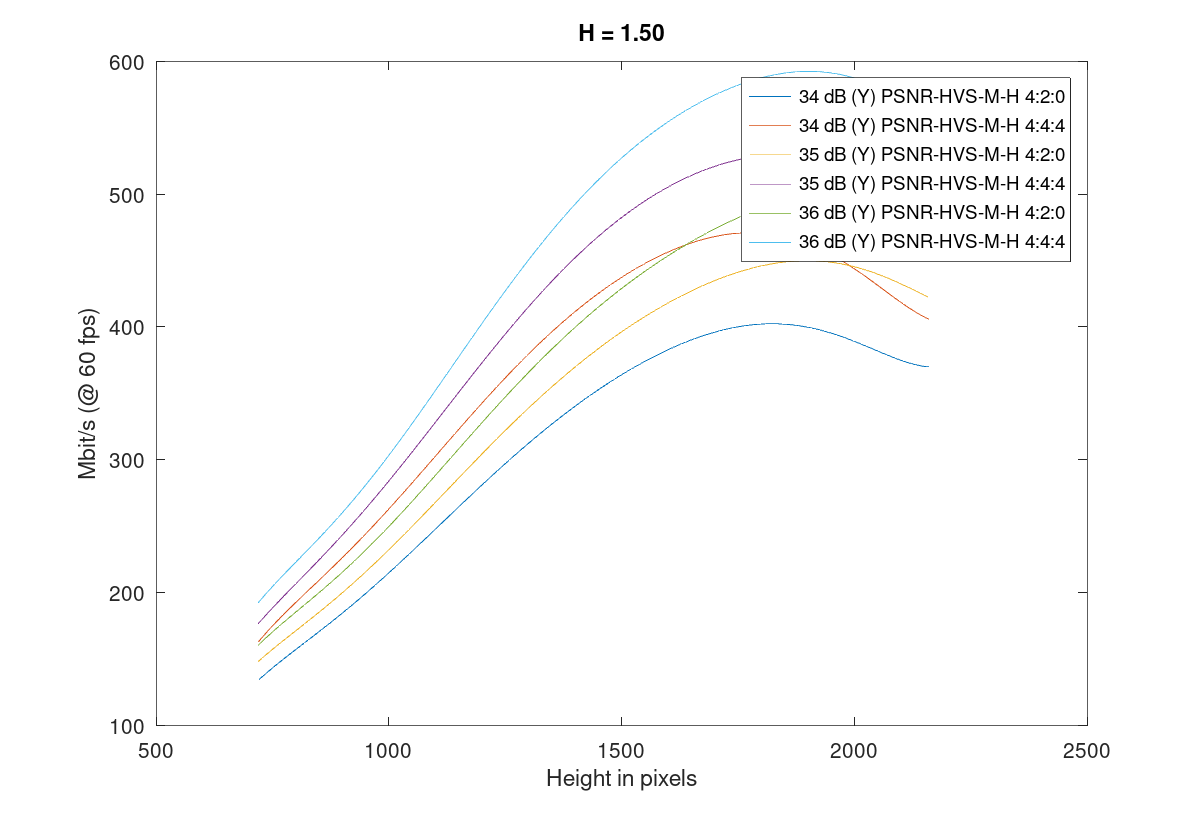
At H = 1.5 the measured curves flatten out at around 1800p instead of 1440p. Image: Hans-Kristian Arntzen / PyroWave
The numbers are not Valve's. They were measured and published by Hans-Kristian Arntzen, the author of PyroWave, in his own repository, and Valve's notes name his evaluation as the reference for the two new settings. Everything below is his work, on his own test suite.
More pixels stop buying quality past 1440p
At a viewing distance he labels H = 2.0, Arntzen writes that "the objective numbers agree with my subjective assessment that the bitrate curve for 720p to 4K is about 125 mbit to 300 mbit. However, bitrate requirements start falling off around 1440p", because "some sort of equilibrium is hit and caps out at about 300 mbit". The cause he gives is the codec's own habit: PyroWave and wavelet codecs in general "like throwing away high frequency detail when it can, and a 1080p bitstream is implicitly also a (blurry) 4K bitstream too".
Sit closer and the cap moves. At H = 1.5, "the rates start capping out at ~1800p". At H = 1.0, which he describes as "sitting uncomfortably close to the screen", requirements "explode at higher resolution", a case he says "PyroWave was never quite designed for". Chroma has its own cost: "about a 15%-20% penalty for 4:4:4 to reach same luminance quality".
H is a ratio, not a number of centimetres
The evaluation defines H as "the distance to screen divided by height of active video area", with 1.0 meaning "very close to monitor, filling almost the entire view" and 3 standing for "couch gaming on a modestly sized screen". The quality anchor is "~35 dB PSNR-HVS-M-H", which Arntzen says "tracks well with my default good quality curve".
Those two inputs line up with the names of the two convars, but Valve has not published their defaults, their units or the values they accept, so the mapping is an inference from the linked evaluation rather than documentation.
How the curves were produced
Arntzen built his own metric for this, PSNR-HVS-M-H, adapting the published PSNR-HVS-M so that viewing distance can be fed in, implementing it as a GPU compute shader and checking it against the original Matlab code. The material is lossless 4K clips from Horizon Zero Dawn Remastered, Expedition 33, Witcher 3 and Street Fighter 6, about 10 frames per game, swept across every 16:9 resolution from 720p to 4K, both chroma modes and 16 viewing distances. Only luminance error is measured, since "PSNR-HVS-M does not define error metric for chroma".
The sharpest limit is one he sets himself: "Only 16:9 aspect ratio has been tested. It's expected that ultra-wide 21:9 or super ultra-wide 32:9 would need separate analysis." The curves are then fitted by "linear regression of a 7th order polynomial" into a lookup table he puts at "about 1% accuracy".
One caveat for headset owners: this is an evaluation of monitors and televisions at stated viewing distances, not of lenses a few centimetres from the eye. The same beta also raised Pyrowave's manual ceiling, which Valve warns costs latency, and nothing in these curves argues for going anywhere near the top of that range on a desktop stream.
The convars ship in the beta client with no published defaults or ranges, so the only public arithmetic behind them is Arntzen's, in his own repository.

