
Skild AI's only reward was score, and it says dribbling and tackling emerged on their own

Skild AI gave a football-playing robot policy exactly one objective, “score”, and says dribbling past a defender, shielding the ball and tackling an opponent all appeared without anyone writing a reward for them. “Rather than hand-crafting rewards for these behaviors, they emerged simply because they helped the model score”, the company says in a research post published on September 23.
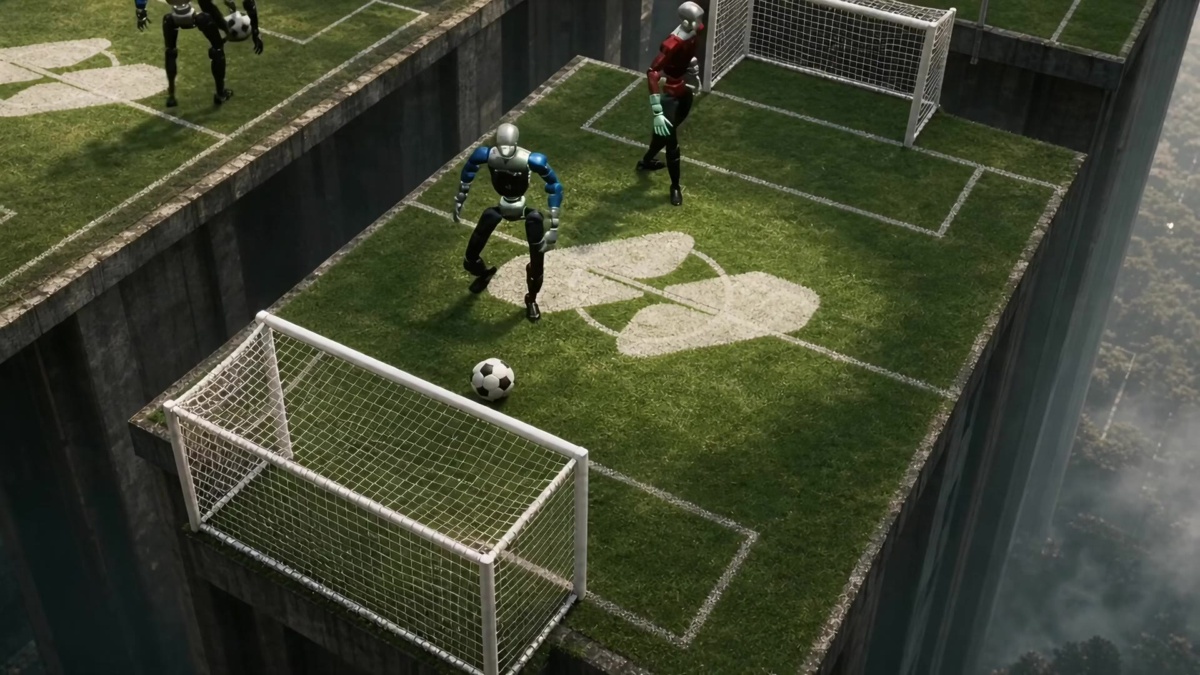
Skild says the policy trained against recent versions of itself inside NVIDIA's Isaac Sim. Image: Skild AI
Skild puts a number on the training, and it needs reading carefully: “After 140 years of simulated play, we transferred the policy into a robot and challenged it to a match”. That is 140 years inside a simulator, not 140 years of a machine kicking a real ball, and Skild gives no wall-clock training time, no compute budget and no count of how many matches ran in parallel.
Self-play is the AlphaGo Zero trick, applied to a body
The method sits on top of Skild’s S1, which the company calls its flagship robotics foundation model. Skild says the policy “learned to score by playing against recent versions of itself”, so each improvement produced a harder opponent.
The precedent Skild leans on is board and video games. It cites AlphaGo beating Lee Sedol in 2016, AlphaGo Zero defeating the original AlphaGo 100 to 0 three days after it started playing itself, and then AlphaStar in StarCraft II and OpenAI Five in Dota 2.
Skild’s argument for doing this on a robot is a ceiling argument. Models like S1 are pre-trained on human data and are therefore “capped at human capability”, the company says, and it “believe[s] physical self-play will enable robots to far exceed human capability”. That second half is a stated belief, not a result in the post.
Progress is measured in simulated years
Skild describes the learning curve in the simulator’s own timescale. “In its first few simulated months inside NVIDIA’s Isaac Sim, it could barely walk”, the post says, and “by the time it was college-aged, it could stand back up after falling down”.
Then came the transfer onto real hardware, which Skild calls “a bright green flag for self-play on the road to physical AGI”. The post’s videos go as far as showing what Skild calls the successful transfer from simulation to humanoid.
There is no paper, and no named robot
Skild never says what the robot is. The post goes only as far as “into a robot” and “from simulation to humanoid”, with no manufacturer, no model number and no mention of how the policy was tuned for whatever body it landed in.
Nor is there a score. No win rate, no goal count, no baseline comparison and no benchmark table is published, and Skild says only that it “challenged it to a match”, without reporting how the match went. This is a company blog preview with no paper, no peer review, no code and no released checkpoint, which puts it a long way from the AlphaGo Zero work it is measuring itself against. Other robotics claims this month have arrived with a number attached, such as Robocurve’s count of 60 completed harmful robot-arm trials out of 100, and MIT’s robot sending data back through 3.6 feet of Arctic ice was reported the same way.
Skild says its next post will look at social behaviours in larger teams, and that it is extending the approach from football to collaborative manipulation and city-scale navigation. Until one of those arrives with numbers attached, the 140 years remain simulated and the match remains a video.

