
QuestLHSync aligns Lighthouse trackers from a Steam Frame's own cameras, no SpaceCalibrator
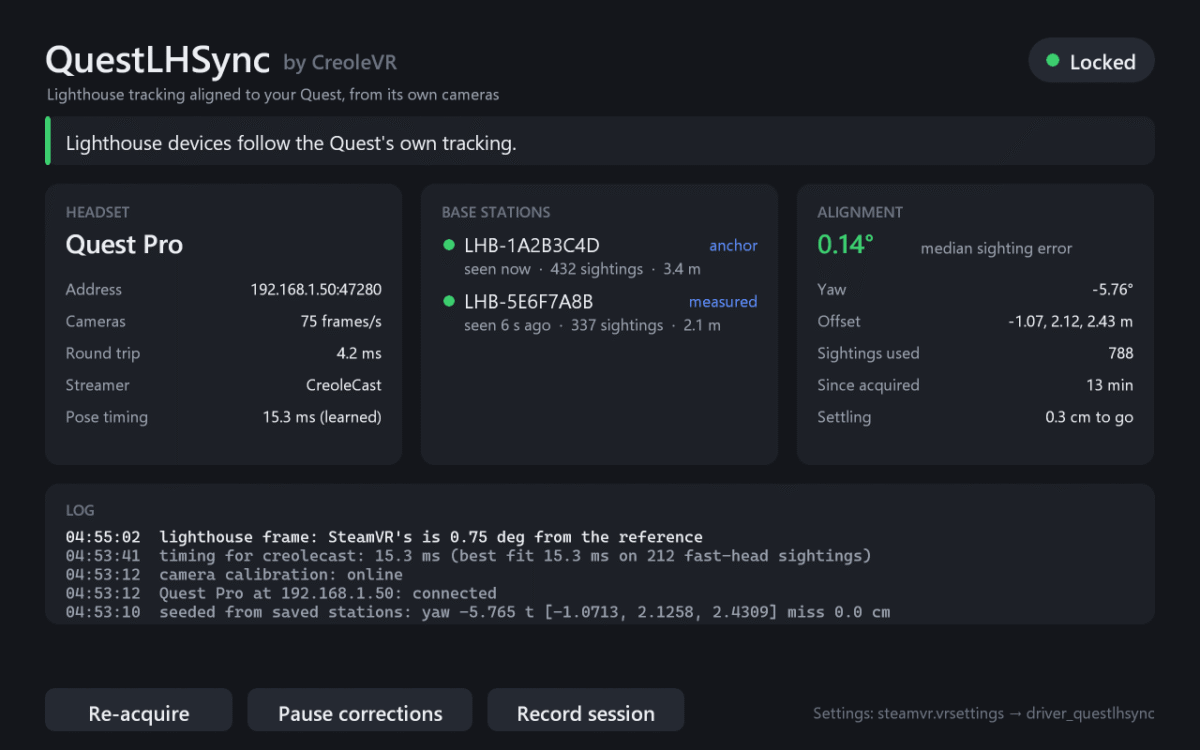
QuestLHSync, an unofficial SteamVR driver released on 3 October, lines up Lighthouse trackers, controllers and base stations with a headset's own inside-out tracking by letting the headset's cameras watch the base stations' laser flashes. Its README is blunt about the point: "No SpaceCalibrator, no tracker strapped to your head."

QuestLHSync added Steam Frame support in release 1.5 on 3 October, and says the headset half installs without root. Image: Valve
Steam Frame support arrived in release 1.5 at 19:37 UTC on 3 October, credited in the notes to a second contributor, the GitHub user NotZoeyDev. On a Quest the headset half is a Magisk module and needs root; on a Frame, the project says, there is "No root, no developer password: everything installs as your user."
The driver splits across the PC and the headset
The project splits into a headset component that "serves what the cameras see on your local network" and a SteamVR driver on the PC that "solves the alignment, applies it to every lighthouse device and adds a page to the SteamVR dashboard". It wants SteamVR 2.0 base stations, because "1.0 isn't supported", Windows with SteamVR, both machines on one network, and at least one Lighthouse device switched on.
Streaming can be anything, including Steam Link, Air Link, Virtual Desktop and ALVR, which is a different approach to Virtual Desktop's own Vive tracker emulation on Quest headsets. It "locks within about half a minute", the README says, and three base stations buy more than two: with only two in view "a tilt of 1.5° puts trackers on the floor 15 cm to the side", while with three the driver "levels the reference frame with the headset's gravity". That figure is the author's illustration of the problem, not a measured error rate.
Three buttons sit on the dashboard page, Re-acquire, Pause corrections and Record session, and release 1.4 added a readout of how many bright spots the cameras can see and how many of them are being used. Optional settings go into SteamVR's own configuration file, among them a host address for networks that drop broadcasts.
Only the Quest Pro has actually been tried
The requirements name the Quest Pro, Quest 3 and Quest 3S, then qualify them: "Tested on the Quest Pro. The Quest 3 has the same tracking cameras but hasn't been tried yet, nor has the 3S." Release 1.2, which added those two headsets earlier on 3 October, carries the same caveat in brackets, "not tried on either yet". The Steam Frame path, added hours after that, carries no test note at all.
Five releases shipped on 3 October, from 1.1 at 14:32 UTC to 1.5 at 19:37, and the repository showed 28 stars and two forks when read at 21:13 UTC, around seven hours after the first of them. That is attention on a project hours old, not a verdict on it. The code is MIT-licensed, and the project states its own standing: "QuestLHSync is not affiliated with Meta or Valve."
What the headset half exposes
The project is equally plain about the security trade: "The headset part answers anyone on the local network without authentication. It sends bright-spot positions (never images), the camera calibration, and the headset's serial number, model and firmware." Rooting a Quest to run the module is, in its own words, "at your own risk".
Base stations have been part of PC VR since the first Vive, and Valve's Lighthouse system has outlasted most of the headsets built around it. Anyone already running SpaceCalibrator or OpenVR-SpaceSync is told to switch it off first, because "two tools correcting the same devices fight each other". On a Steam Frame that choice did not exist before 19:37 UTC on 3 October.

