
OpenXR's new spatial containers let several XR apps share one space

XR apps built on OpenXR will be able to run side by side in one space. The Khronos Group has ratified "spatial containers", a standard way for several XR apps to share the room, and Google says Android XR will support them.
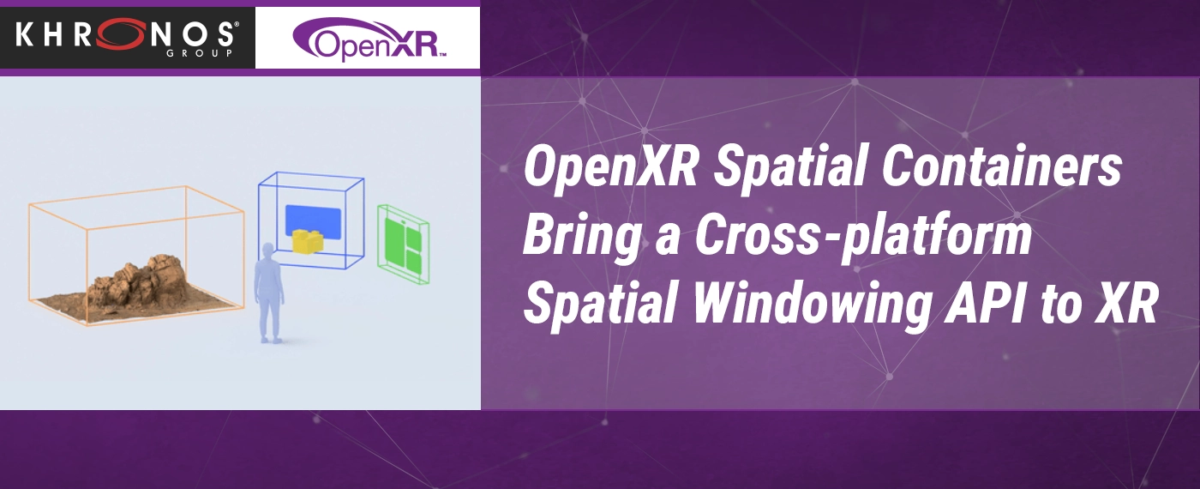
The Khronos Group announced the spatial container extensions on its blog. Image: Khronos Group
Spatial containers are system-managed spaces that apps draw into, much as desktop programs draw into windows. That is how the Khronos Group describes them. The work took 18 months.
Each container can switch between a window and full immersion
An app can open one or more containers. Each can run in a new bounded mode, sized for multitasking next to other apps, or in a full-screen immersive mode.
The system decides where a container sits, not the app. That lets the user place it, or lets it follow the user when walking. Containers can also be hidden, shown or picked to receive input, as on a desktop.
Two extensions do the work. XR_EXT_spatial_container creates and manages containers, and XR_EXT_spatial_container_self_rendering lets apps render into them with OpenXR composition layers. A sample is on GitHub.

Google says Android XR will support spatial containers. Image: Google
Google and Godot have committed, while Meta and Pico only voice support
Jared Finder, who leads XR platform and SDK work on Android XR, says Google is "excited to bring Spatial Container support to Android XR". The Godot XR team says the engine "will support spatial containers in its upcoming release".
Meta, Pico, Unity and Varjo back the standard in the announcement but make no promise to implement it. Pico's OpenXR lead, Praveen Babu J D, says the industry is "finally moving past isolated, single-app experiences".
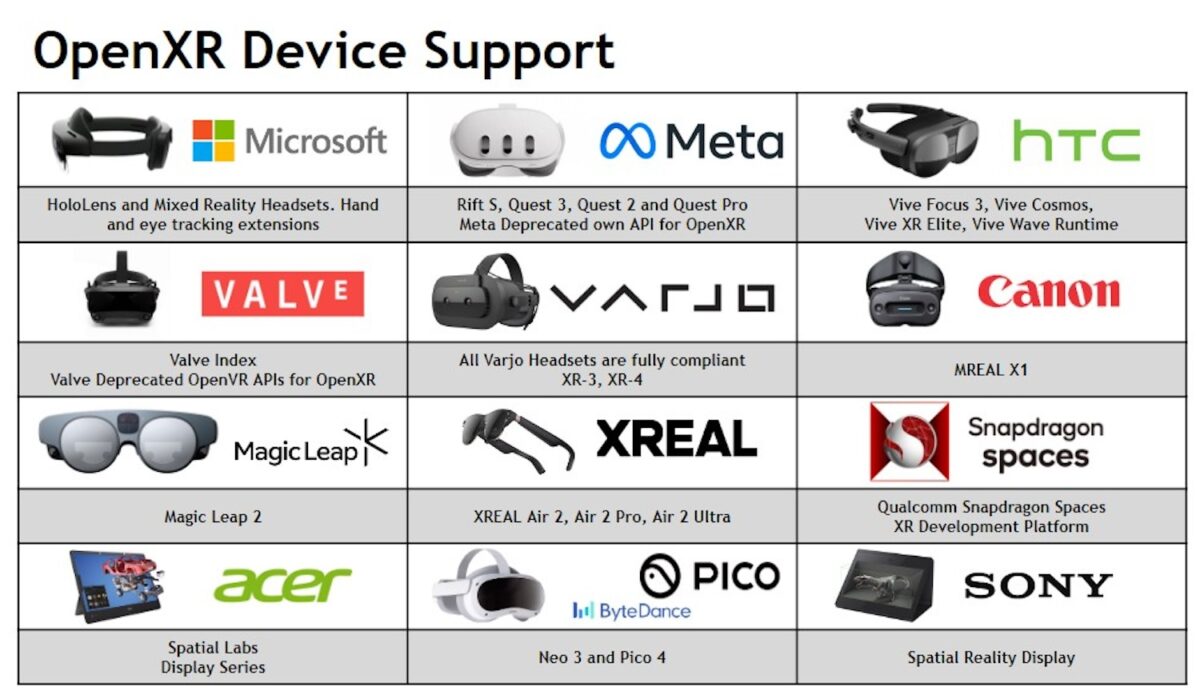
OpenXR already runs on headsets from many makers, which is why a shared multitasking standard reaches so far. Image: Khronos Group
No headset supports spatial containers yet, but Khronos expects the first ones soon
Khronos says implementations should start appearing across the OpenXR ecosystem during 2026. None has shipped yet.
Quest owners already have three-window multitasking, but Meta built it for its own system and flat apps. Spatial containers go further: full 3D apps from different developers sharing one room, on any headset that adopts the standard. Apple's Vision Pro already runs several 3D apps at once, but Apple does not support OpenXR.
Khronos says it is also working on extensions that let apps use a renderer supplied by the system, tuned for each device.

