
OpenAI will put labelled ads beside the images ChatGPT generates, on Free and Go
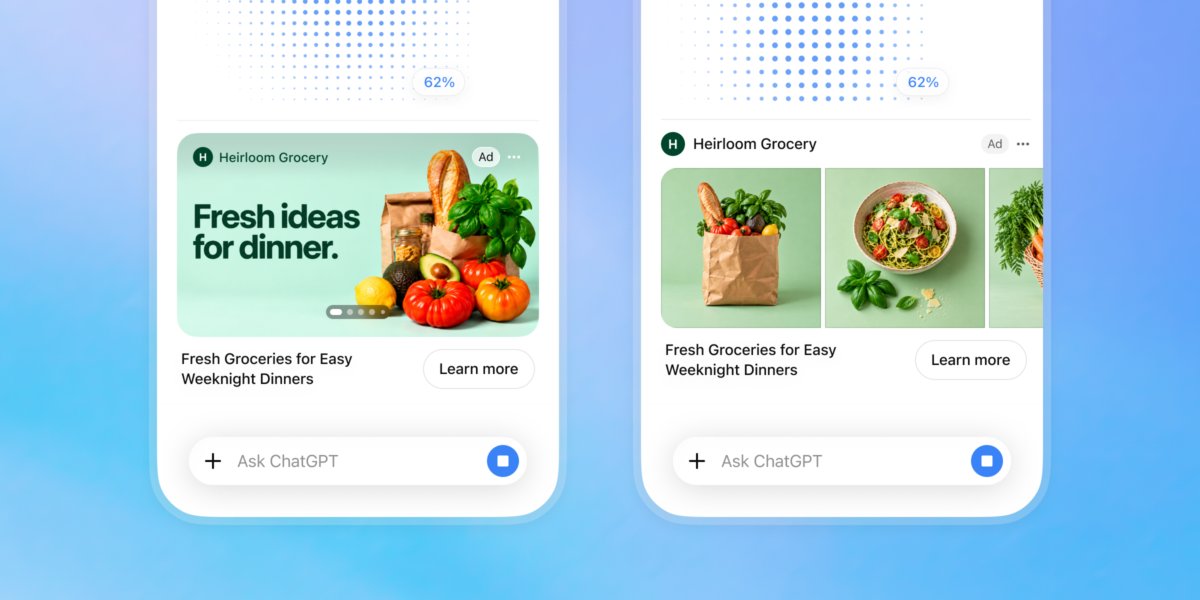
OpenAI is putting a new visual ad format inside ChatGPT's image generation, and only people on the Free and Go plans will see it. OpenAI says "testing will begin later this month in the US with an initial group of advertisers", in a post dated October 5.

ChatGPT open in a desktop web browser, with the prompt box at the centre of the window. Image: OpenAI
OpenAI describes the ads as "images showing product inspiration, product usage, or the experiences they make possible". Ads "will be clearly labeled, and remain separate from the image being created", and OpenAI repeats its standing line that "advertising does not influence the answers ChatGPT provides".
OpenAI puts ChatGPT's weekly reach at 1.2 billion people
The audience OpenAI quotes for the format is its own: "ChatGPT reaches 1.2 billion people each week, making it the world's largest AI-native consumer platform". Nothing in the announcement puts the visual format on Plus, Pro, Business, Enterprise or Edu, gives it a date inside October, names an advertiser in the test, or extends it beyond the US.
Fifteen measurement firms now sit around the ad product
OpenAI names 10 attribution partners for web and app conversions: AppsFlyer, Triple Whale, Adjust, DV Rockerbox, Northbeam, Branch, Singular, Kochava, Airbridge and Tenjin. Three more, Fospha, Measured and INCRMNTAL, cover full-funnel and advanced measurement, and three, Haus, Measured and WorkMagic, cover geo-based incrementality experiments, work OpenAI calls "still in its early stages".
Measured is named twice, so the 16 slots come to 15 distinct companies, counted from the named lists at 22:56 UTC on October 6. Separately, Hightouch, Tealium and LiveRamp are named as integrations that "make it easier for advertisers to send conversion data from their existing systems to ChatGPT Ads".
Three performance figures come from vendors, not from OpenAI
OpenAI relays three advertiser results and credits each to a measurement company rather than to its own analytics. DV Rockerbox is cited for WeightWatchers' attributed cost per acquisition on ChatGPT Ads coming in "15.3% lower than its blended paid-search benchmark".
WorkMagic is cited for the wellness brand Dose, reported as "statistically significant lift" with "67% of incremental purchases coming from net-new customers", and Triple Whale for "93% of Portland Leather's visitors from ChatGPT Ads" being new. Each is a vendor's own attribution of its own client's campaign, passed on by the platform selling the ads, and OpenAI gives no methodology, measurement window or sample size for any of the three, calling them "early partner findings".
Brand suitability goes to outside firms, in a test environment
OpenAI says its "placement guardrails assess whether a conversation is appropriate for advertising, helping keep ads out of emotionally vulnerable, sensitive, or otherwise unsuitable contexts", policed by "automated review, human oversight, and ongoing monitoring". It is running brand suitability evaluation pilots with DoubleVerify and Integral Ad Science "in a controlled testing environment, without accessing private user conversations".
Both evaluation partners are quoted in support of the pilots. Lidiane Jones, chief executive of Integral Ad Science, says the work will "assess how OpenAI's safeguards perform across a broad and evolving range of scenarios", and DoubleVerify chief executive Mark Zagorski calls ChatGPT "a fundamentally different advertising environment, where context is defined by the conversation itself rather than a page or video". Neither has published a result.
Advertisers get one more lever. "Negative Phrases are now available to qualifying advertisers" for "narrow placement requirements specific to a brand's own policies", which is a seller-side setting rather than anything a reader can reach. OpenAI has not said where the visual format travels after the US test, or how it fits the countries where ChatGPT Ads already run.

