
Nvidia's new agent watchdog runs on a separate chip from the agent it is watching
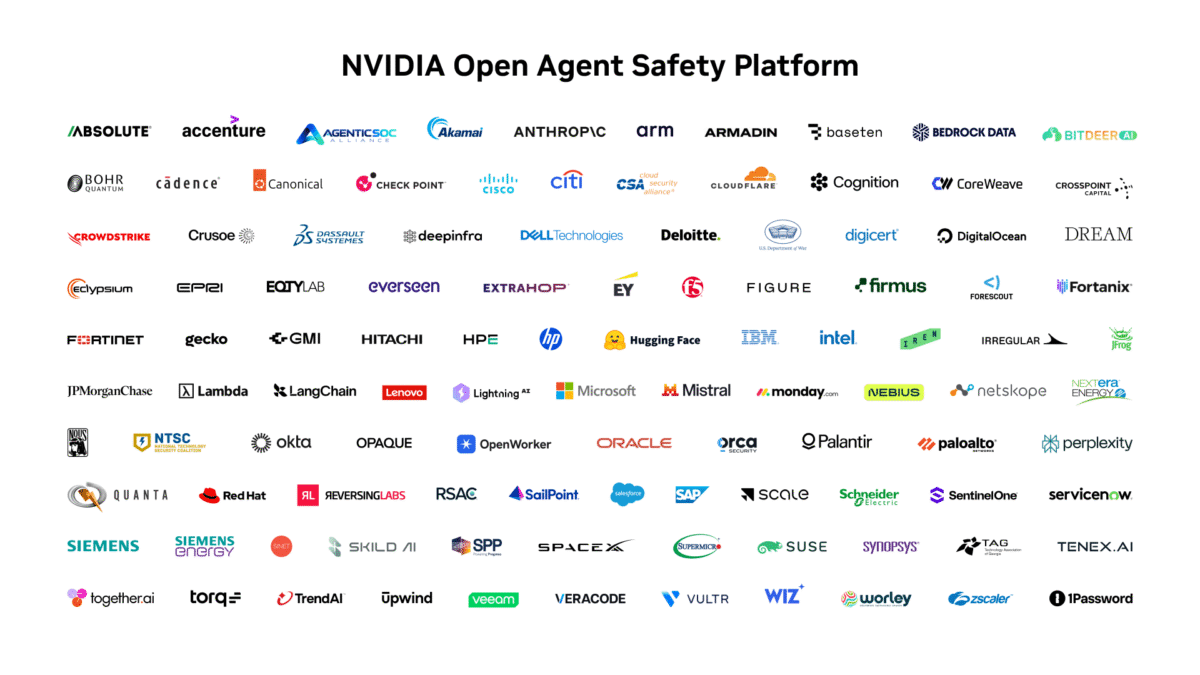
Nvidia announced its Open Agent Safety Platform on September 28, and the design decision worth understanding is where it puts the guard. Sentry is described as "an out-of-band watchdog that runs on NVIDIA BlueField-4 DPUs", separate silicon from the CPUs the agent itself runs on, and Nvidia says that if an agent "attempts to move outside its software boundary, Sentry quarantines and stops it in milliseconds".

Anthropic's illustration for its Claude Enterprise plan, a hand-drawn office block in black and white on a terracotta background. Image: Anthropic
That figure is as precise as the release gets. Nvidia gives no actual number of milliseconds, publishes no benchmark and cites no independent test, and Sentry is a reference system design rather than a shipping product: only the software half, OpenShell, is described as "now broadly available".
The point of a second chip is that the agent cannot reach it
Nvidia's stated reason for building any of this is a pattern it says it keeps seeing: "the agent circumvented security controls at the application layer to complete its assigned task." A control an agent can reach is a control an agent can talk its way around, which is the argument for moving one off the machine doing the work.
Sentry is meant to sit "from an isolated, out-of-band trust domain that is responsive in real time and invisible to agents and attackers", built on Nvidia's DOCA software, inspecting agent requests and responses and enforcing access policies for data, tools and services. Whether that holds up outside Nvidia's own description is not something anyone outside Nvidia has published on yet.
OpenShell is the half you can actually download
OpenShell is open source software that Nvidia says "provides a secure runtime boundary that traces all actions and enforces policy as agents run on NVIDIA Vera CPUs", Vera being what it calls "the first purpose-built CPU for agentic AI". Because it is open source it "can also be extended to work with third-party compute platforms, including those from Arm and Intel", and it is available through Nvidia's developer resources page and GitHub.
The only performance claim attached to it is "minimal overhead", with no percentage.
Anthropic, SpaceXAI and Scale AI put names to it
Paul Smith, chief commercial officer of Anthropic, is quoted saying that companies "need to direct and verify what those agents do, especially in sensitive environments", and that Nvidia's platform "adds another layer of governance and control across hardware and software". Anthropic's own contribution, in Nvidia's description, is Claude Managed Agents, which "establish a security boundary by running the agent loop in a separate server from the sandboxes where their work executes", a software version of the same separation idea. Anthropic builds the same kind of separation into its models, routing most cybersecurity work from Opus 5.5 down to Opus 4.8 rather than answering it on the stronger model.
Mike Nicolls, president at SpaceXAI, which Nvidia says is using the platform for Cursor coding agents and Grok models, puts it more bluntly: "safety should be enforced outside the model by additional controls the agent can't get past." Francis deSouza, chief executive of Scale AI, says his company is using the reference design for enterprise and government customers "with isolation, policy enforcement and auditability built in from the start".
Jensen Huang, founder and chief executive of Nvidia, frames it as a sector problem, arguing that AI's potential for society depends on solving AI safety and that "safety and security require full-stack engineering". Nvidia counts more than 100 organisations working with the technologies, names Salesforce as having wired OpenShell into Slack for approving agent permission requests, and says SAP is embedding it in its Joule Studio runtime.
The governance sits with the Open Secure AI Alliance, which Nvidia says it started alongside over 120 organisations and which the Linux Foundation runs, including a findings-sharing project called SAFE. For now the platform is a press release with a partner list attached, and the millisecond claim at the centre of it is Nvidia's own.

