
Nvidia will let eight DGX Spark computers pool 1TB of memory for local AI

Nvidia has announced support for connecting eight DGX Spark systems into a cluster with 1TB of combined unified memory. The larger configuration is intended to run AI models locally that would not fit on a smaller group of the desktop computers.
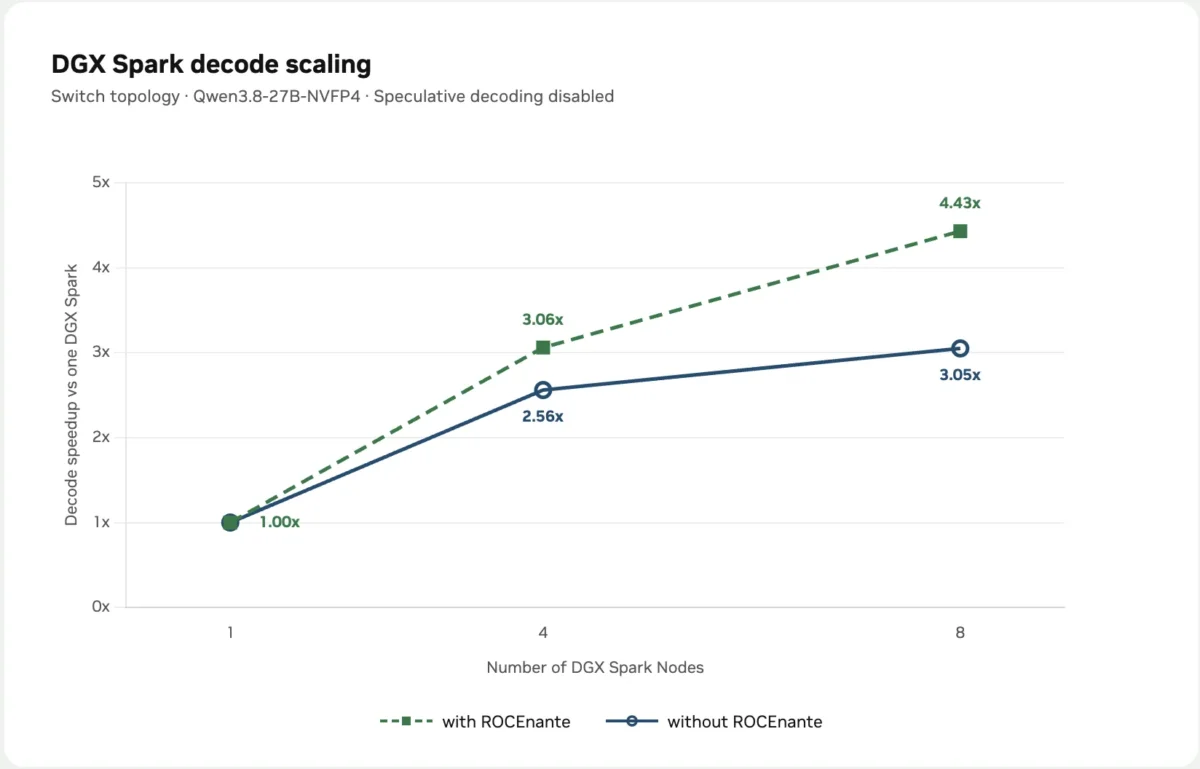
Nvidia’s Qwen3.8-27B test compares scaling with and without ROCEnante; results depend on the stated configuration. Image: Nvidia
There is still a setup milestone ahead: Nvidia says eight-node support in its Sync management software is coming by the end of the year. The announcement and published benchmarks should not be confused with that simplified setup feature already shipping.
The larger memory pool makes room for much bigger models
The configuration uses eight 128GB systems. Nvidia reports running the full 753-billion-parameter GLM 5.3 model in NVFP4 precision, with a checkpoint of roughly 470GB, across the cluster.
At one concurrent request, its test produced 31 output tokens per second. Nvidia separately reports roughly 80 tokens per second for GLM 5.3 Flash. Those results concern different models and are not interchangeable performance claims.
The announcement also differs from the new 64GB DGX Spark configuration. The 1TB total here depends on eight machines with 128GB each.
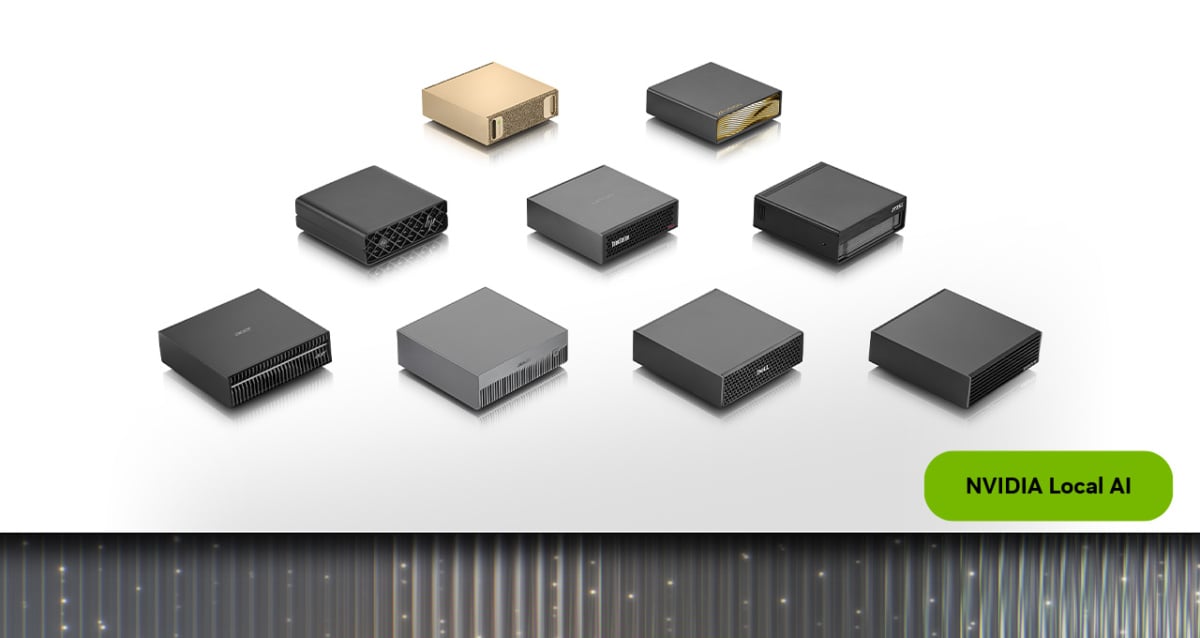
Partner-built DGX Spark systems in Nvidia’s product artwork. Image: Nvidia
Eight computers do not deliver eight times the inference speed
In another test, Nvidia ran Qwen3.8-27B in NVFP4 precision with speculative decoding disabled. Output speed rose from 11.86 tokens per second on one Spark to 52.58 on eight systems connected through a switch, approximately a 4.43-fold increase.
The result used a communication backend called RoCEnante, designed to reduce the time nodes spend exchanging small amounts of data. Nvidia says conventional NCCL communication remains preferable for some larger or busier workloads.
A four-node ring can reduce networking costs, but a switch is needed for configurations that require direct communication between every machine or separate groups of nodes. The published figures are Nvidia's own measurements under specified settings; they do not establish the speed of every model a buyer might run.

