
Nvidia gives robot developers new tools to generate rare training scenarios
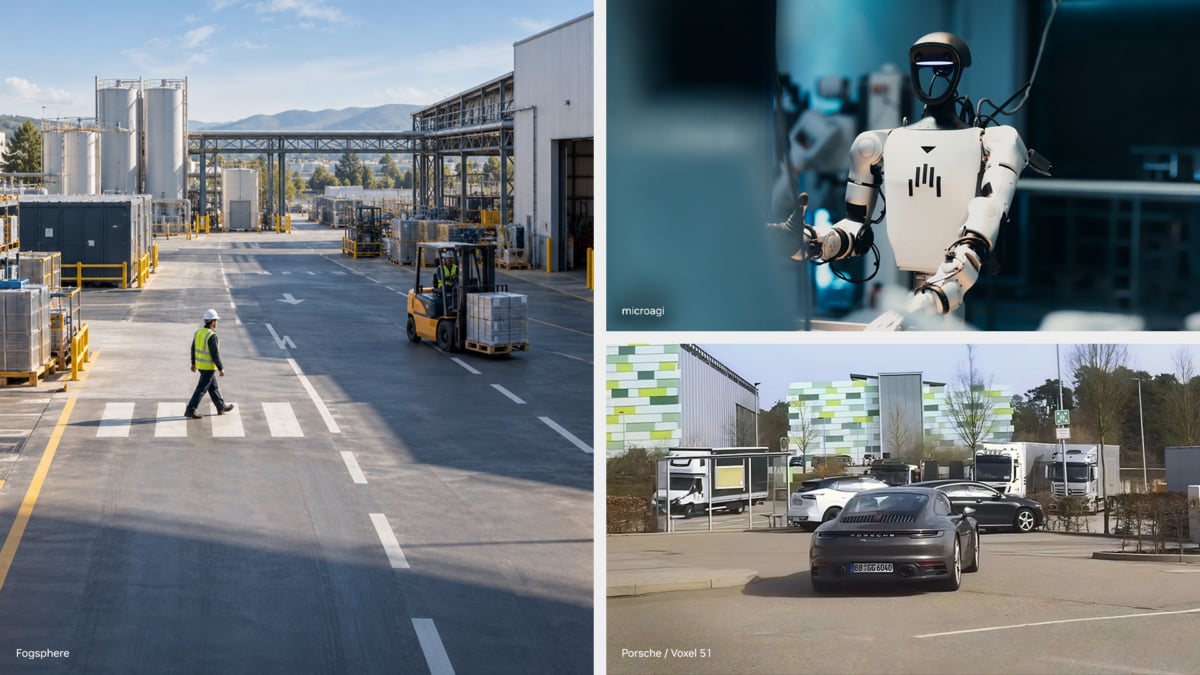
Nvidia has expanded Cosmos with tools for generating training examples that would be difficult or unsafe to collect in the real world. The additions include synthetic video of rare events, manufacturing defects and changes in weather or lighting.
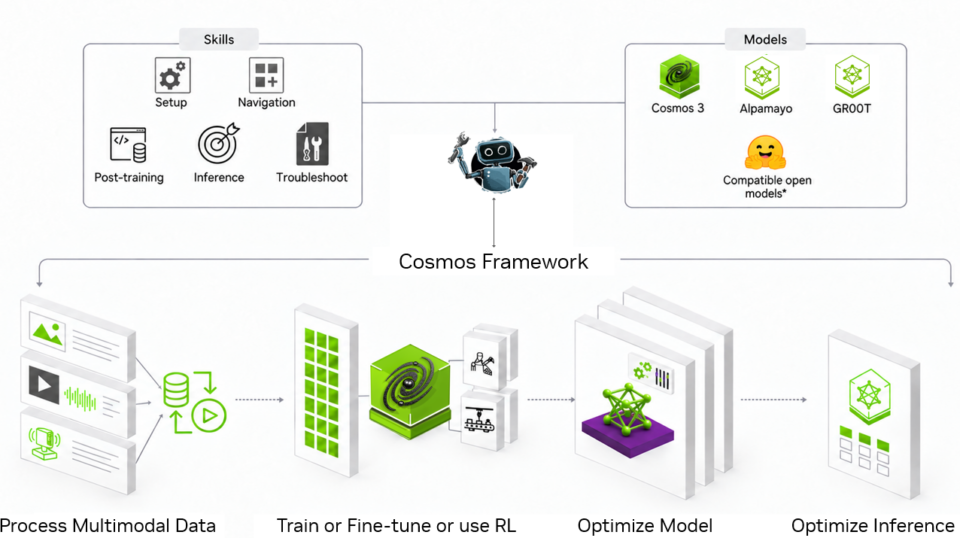
Cosmos Framework links model-building stages from data preparation to inference. Image: Nvidia
The October 22 announcement covers data preparation, model training and simulation. It is aimed at developers building systems such as industrial robots and autonomous vehicles, rather than a consumer video-generation app.
Five new blueprints cover driving footage, defects and changing conditions
Cosmos Data Factory now offers five workflows: generating autonomous-driving datasets, varying the appearance of objects in images, turning still images into event videos, creating defect images and altering weather or lighting in existing footage while preserving scene structure.
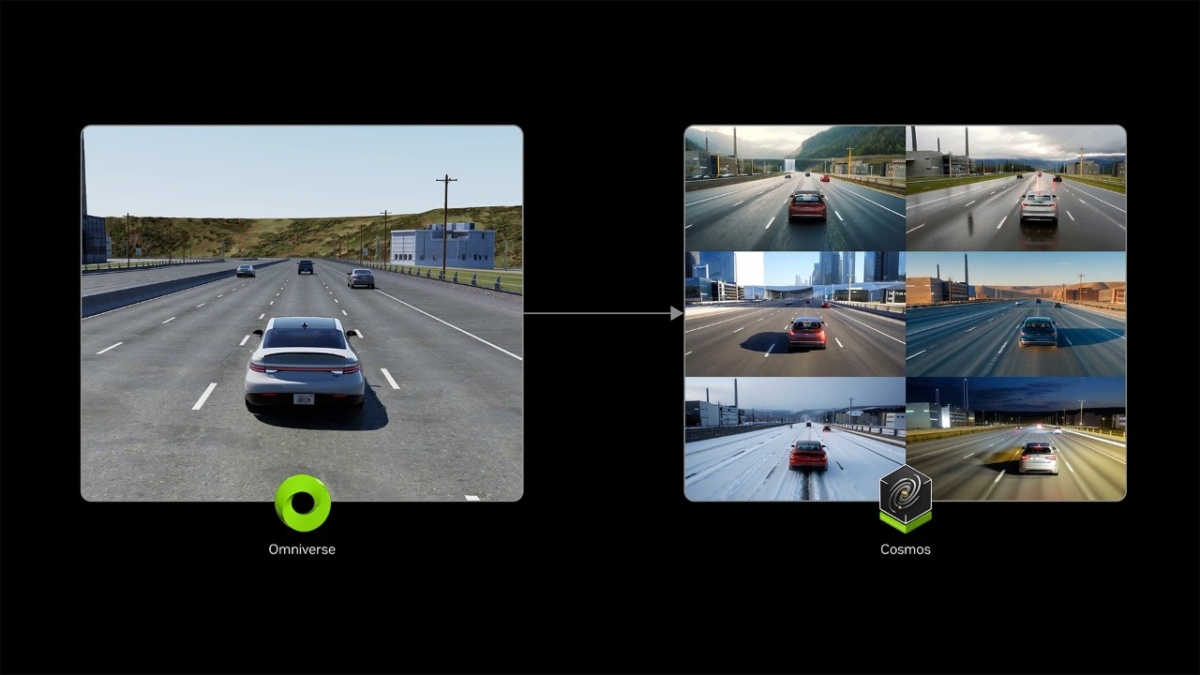
Nvidia illustrates synthetic driving data on its Cosmos product page. Image: Nvidia
Nvidia says inspection-robot company ANYbotics generated more than 1,500 synthetic clips to help train systems to recognise liquid spills and other changes between site visits. That is an example reported by the companies, not an independently measured improvement in robot safety.
The platform is available through GitHub and cloud services including Microsoft Azure, Nebius and CoreWeave. Developers can use individual components rather than adopting every part of the Cosmos stack.

Cosmos can support robot-policy training in simulated environments. Image: Nvidia
New simulation models are designed to test policies before deployment
New Cosmos 3 Nano variants support scenarios with multiple camera views and sensor inputs. Accompanying code lets developers adapt them for evaluating autonomous vehicles and robots with two arms in interactive simulations.
The broader Cosmos Framework also extends training and optimisation tools to compatible open models, including fine-tuning, reinforcement learning, distillation and quantisation.
Nvidia reports up to twice the inference performance from updated Cosmos 3 NIM services in validated configurations. That qualification limits the claim: it is not a universal speedup across all models and hardware.
The work complements Nvidia's local AI hardware, including the DGX Spark range. Here, the main addition is the software needed to build and test physical-world AI before exposing a robot or vehicle to the same conditions outside simulation.

