
MIT's stretchable sheet reconstructs its own 3D shape to within 0.4 centimetres
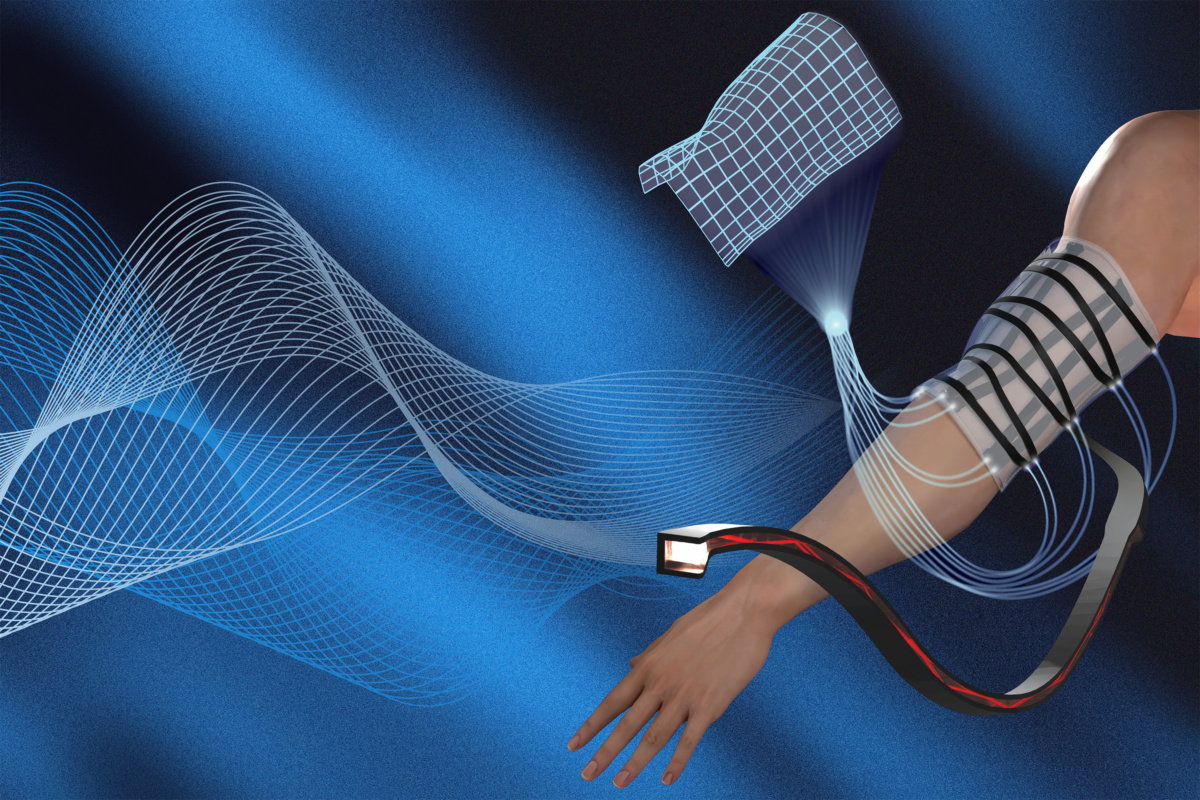
MIT engineers have built a soft, stretchable sheet that works out its own 3D shape as it bends and twists, with an error the team puts at under 0.4 centimetres. "Existing designs, which are based on rigid sensors, have errors of around 1 to 2 centimeters," graduate student Qifan Yu says in MIT's release of October 8. "So that's respectable, and at least on par with existing technologies."
The sheet is silicone with soft optical fibres zig-zagging through it. Each fibre is a clear flexible rubber core inside cladding made of the same rubber dyed black, and one side of the core is deliberately roughened, so bending the fibre towards the rough side scatters more light than bending it the other way. That asymmetry turns each fibre into a bidirectional sensor rather than one that only reports how much it is bent.
An LED sits at one end of every fibre and a light sensor at the other, wired out to a circuit board, and an algorithm turns the readings into a moving reconstruction of the whole surface. MIT says the design also survives damage: "Even when a few fibers are cut or disconnected, the remaining fibers can still accurately reconstruct the sheet's overall shape."
MIT names virtual reality among the uses
The release describes the material as a wearable, motion-monitoring "skin" for "physical therapy, virtual reality, and gaming", and the team envisions a garment someone could wear to control a game character or a tele-operated robot. The comparison it draws is with motion-capture suits, which stitch rigid sensors into fabric at chosen points, where this approach senses across a surface instead.
That is the gap between it and the tracking most headset owners use now. Inside-out cameras and controller tracking infer a body from a few known points, and the alternatives have usually meant strapping on more hardware or sending camera data somewhere to be interpreted. Nothing here ships, and MIT attaches no company, product or date to it.
The fibres are a millimetre thick for now
The accuracy figure comes from a laboratory test rather than from a person. The team laid the sheet over 3D-printed moulds and measured the distance between the real surface and the reconstructed one, which is what produced the 0.4 centimetre number. In other runs they folded the sheet diagonally and then back the other way, and MIT says the virtual copy followed almost in real time.
The fibres currently measure 1 millimetre across. MIT says other fabrication processes could take them down to tens of micrometres, thinner than a hair, which is the step the team needs before many more of them can be embedded in something wearable. "We hope to build tools that augment what a physical therapist can do and help them track and quantify their patients' progress over time," says assistant professor of mechanical engineering Kaitlyn Becker, who wrote the paper with Yu and graduate student Nina Cao.
The work is published in Advanced Intelligent Systems as "Toward fully soft and multifunctional shape sensing via optical waveguide arrays", and MIT says it was supported in part by MathWorks. For now the sheet is a laboratory prototype wired to an external board, and the figure to hold on to is the one Yu gives: under 0.4 centimetres, against a mould.

