
GitHub lets companies compare Copilot agent use with industry peers

GitHub now lets eligible companies compare their use of Copilot agents with similar businesses. The new industry-comparison section in the Copilot impact dashboard is opt-in and disabled by default.

GitHub’s earlier impact-dashboard illustration, shown as context for the new industry comparisons. Image: GitHub
The October 22 update compares agent adoption and a measure GitHub calls leverage: how the pull-request merge rate of agentic users compares with that of non-agentic users. That is a comparison between groups, not proof that an agent caused a productivity increase.
Companies can choose peers by industry and workforce size
Owners can select one of ten industries and a company-size category, then compare results with their industry or with all industries. The reporting period covers 28 days.
If an industry group is too small, GitHub broadens the comparison to companies of the same size across industries and labels the group used. Rankings appear only once enough businesses have opted in.
Early participants may therefore see only a median, a broader comparison group or no ranking yet. A company can also lack a leverage score when all its users are already agent-first or multi-agent, leaving no non-agentic baseline.
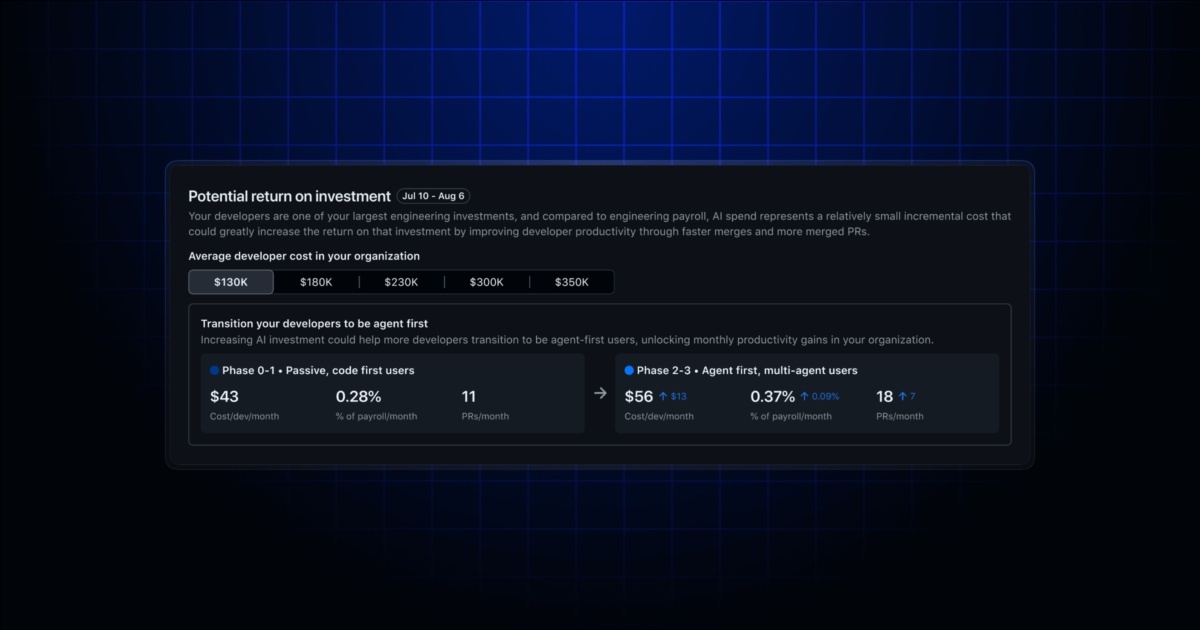
The dashboard already includes an ROI section; the October update adds peer comparisons. Image: GitHub
Opting out stops comparisons and ends the next data contribution
Participation is controlled by the same policy whether changed from the dashboard or central Copilot settings. Turning it off immediately removes comparisons, and the company's data is excluded from the next daily update.
GitHub says aggregated benchmarks contain no identifying data and are deleted after 30 days. Enterprise Cloud customers with data residency are compared only with participants in the same region.
The feature is available to enterprises and organisations that are not owned by an enterprise, subject to the stated eligibility rules. The Copilot usage-metrics policy must be enabled, and the comparisons appear only in the dashboard, not its API or exports.
As coding agents expand into workflows such as game-engine integrations, these measurements offer adoption context. They still need to be read alongside the complexity and quality of the work being merged.

