
FramePort puts Quest games on a Steam Frame, and lists six that still don't run
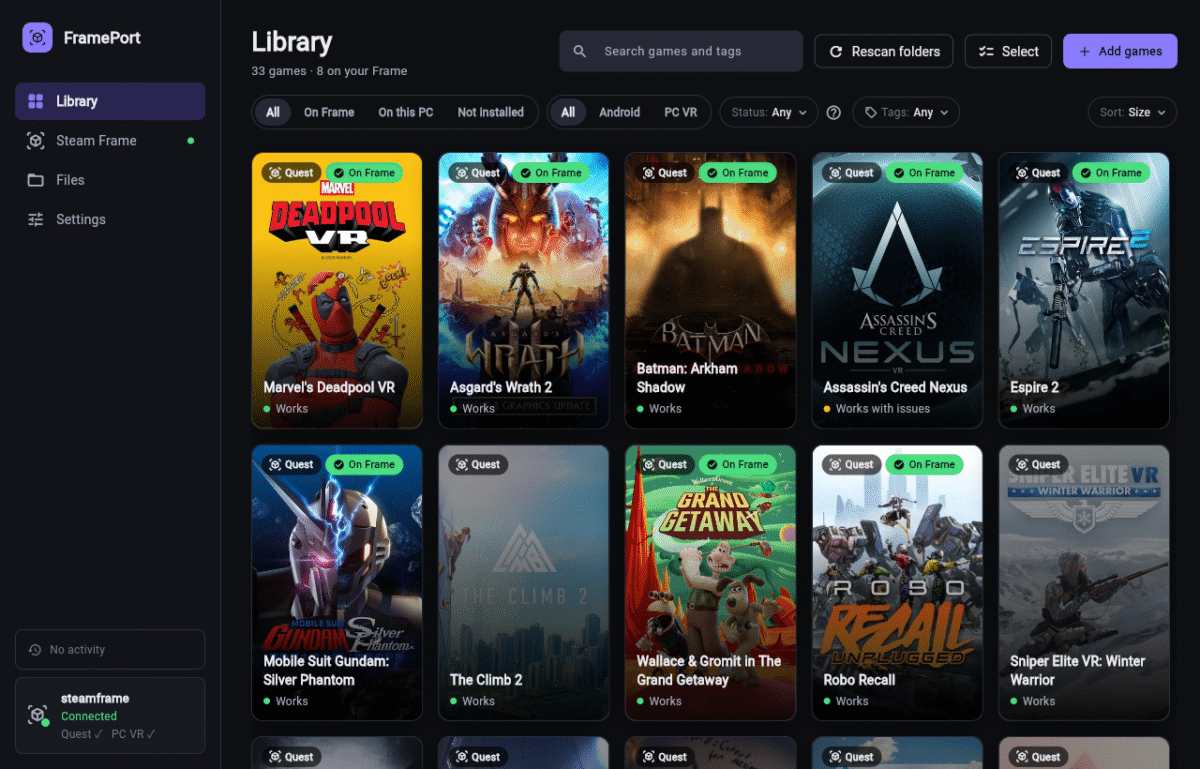
FramePort, an unofficial tool published on GitHub on 2 October, installs games built for the Meta Quest, for Android or for PC VR onto a Valve Steam Frame. Its own list of tested titles runs to 39 games, and six of them are marked "Doesn't run".

Type on Frame, added in v0.6.0, sends a desktop keyboard's input to the headset. Image: FramePort
The project's README says it "handles everything from uploading game files, setting up your Frame, injecting compatibility patches, and adding shortcuts to your Steam library", and it settles the question of its standing in one line: "Not affiliated with Valve or Meta."
The tool wraps work other projects had done
FramePort is written in Python under GPL-3.0 by the GitHub user spoopyghosty0, with builds for Windows, for macOS on Apple Silicon and for Linux on x64 and ARM64. It converts, patches and signs a game, uploads it and adds a Steam shortcut, and it leans on other people's code to do it: OVRPort for the Quest-to-OpenXR step, Valve's Lepton container for Android VR games, Proton, Revive and the Khronos OpenXR SDK.
What it adds itself is an OpenXR shim it calls FrameBridge, which the README describes as emulating "what the Frame natively lacks (passthrough, room, controller models, curved and 360° layers)". Since release v0.5.0 the project says the Frame can also be paired through Valve's own devkit pairing in its developer settings, instead of the typed setup command earlier versions needed.
Release v0.4.0, on 2 October, widened the scope past VR. Ordinary Android apps with no VR mode run as a flat window in the headset, with Android's navigation buttons hidden, and a Files tab moves videos, documents, mods and saves on and off the Frame. The same notes warn that the Windows and macOS builds carry a free self-signed certificate and an ad-hoc signature, so the first launch throws an operating-system warning.
Ten releases in 38 hours
The pace is the other half of this. The project's releases page lists v0.1.0 at 02:03 UTC on 2 October and v0.6.1 at 16:14 UTC on 3 October, 10 releases inside 38 hours. The v0.6.0 notes add a feature called Type on Frame, for using "your computer's keyboard on the Frame, in VR apps, Android apps, Steam and the desktop"; v0.6.1 added a Linux ARM64 build and published the compatibility list.
The repository showed 13 stars and no forks when read at 21:13 UTC on 3 October. That counts attention on a project two days old, not whether any of it holds together.
The compatibility list is blunt about failures
The published list of tested games marks 28 as working, five as working with issues and six as not running at all. Three of the six failures are 32-bit Quest titles, Journey of the Gods, Shadow Point and Sports Scramble, each with the same one-line reason: "32-bit only; the Frame has no AArch32." HITMAN 3 VR: Reloaded is logged as a "Vulkan driver crash (freedreno)" and Sniper Elite VR as a "GPU hang (zink: DEVICE LOST) even with MSAA off". Among the five partial successes, Arcsmith's right eye "distorts during movement", which the list marks unresolved.
For scale, Steam listed 143 Steam Frame Verified titles on September 18, fewer than half of them VR. FramePort supplies no games of its own, and says so: "FramePort explicitly does NOT download, share, or unlock games. You must provide legally obtained game executables."
Every claim here is the project's own, about software two days old that has not reached version 1.0. The tested list is a first count from one developer's own testing, 28 games working against six that crash, not a verdict.

