
Even G2 varifocal lenses cost more than the glasses in Japan, up to 150,800 yen
A full Japanese price list for the Even G2 shows that fitting Even Realities' camera-free display glasses with prescription lenses can cost more than the glasses themselves. Varifocals are listed at 120,800 yen, 135,800 yen and 150,800 yen depending on the lens index, on top of a frame that costs 99,800 yen including tax.
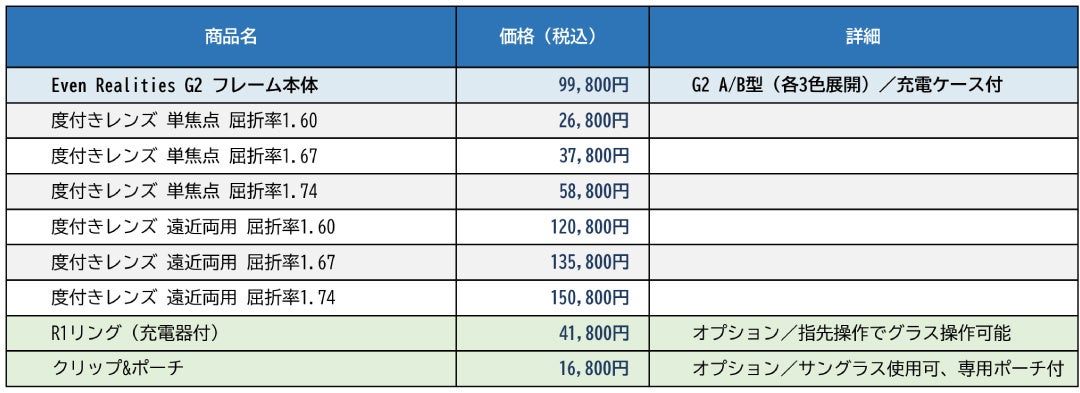
The price table from the retailer's release, listing the 99,800 yen frame, single-vision lenses from 26,800 yen and varifocals up to 150,800 yen. Image: AI Japan Co., Ltd.
The list was published on September 30 by Acalie, the Nagoya company that distributes the G2 in Japan, alongside a release from AI Japan, which runs the Aimegane optical chain and does the fitting in store. Single-vision lenses are far cheaper: 26,800 yen at index 1.60, 37,800 yen at 1.67 and 58,800 yen at 1.74. The varifocal figures follow the same three indices, which puts a 1.74 varifocal pair at 250,600 yen once the frame is included.
Made to order, with a four-week wait
Prescription lenses for the G2 are produced individually for each customer, and the distributor puts the guide time from order to handover at roughly four weeks. Two optional extras appear on the same list: the Even R1 ring with its charger at 41,800 yen, and a clip and pouch set at 16,800 yen. The frame itself is sold in G2 A and G2 B shapes, three colours each, with a charging case.
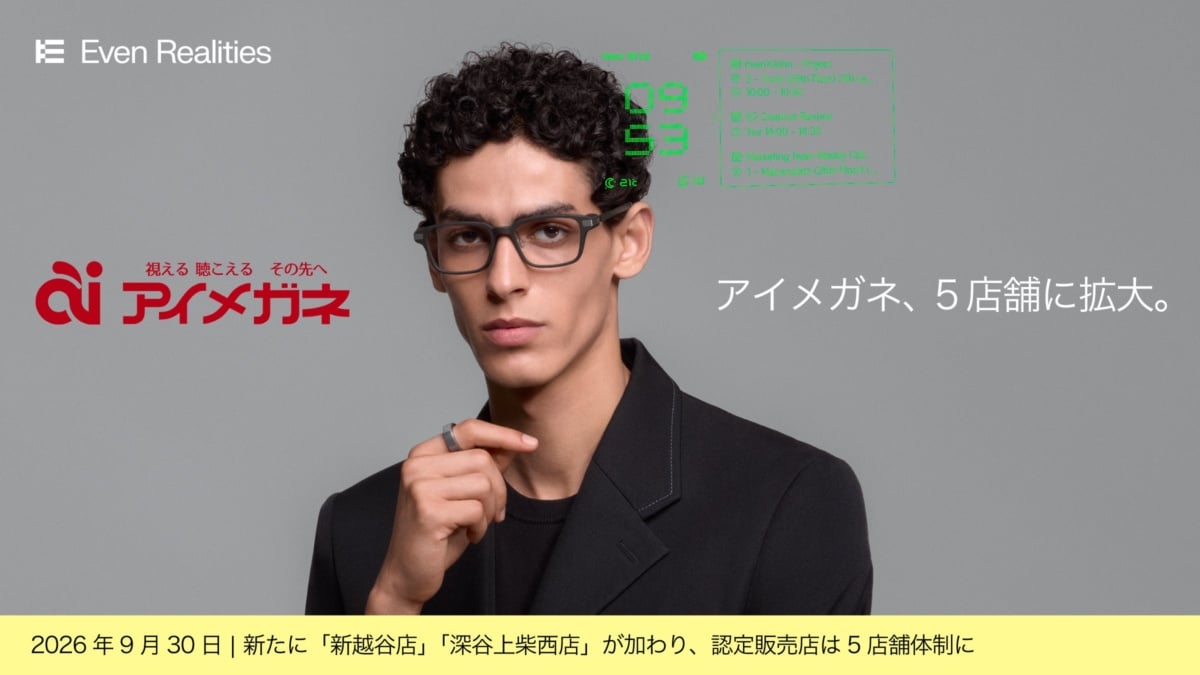
The number of shops that can actually do the fitting is small. Across Saitama, Tochigi and Chiba, the releases state that those five Aimegane shops are now the only certified dealers offering in-store prescription-lens fitting for the Even G2, up from three. Aimegane Shin-Koshigaya and Aimegane Fukaya Kamishiba-nishi, both in Saitama, join the existing Minami-Urawa, Utsunomiya Nishiki and Yachiyodai Your Elm branches. The chain has 38 stores in total, so five is a fraction of its own network.
What the money buys
The G2 is the camera-free camp's flagship. It carries no camera at all, which is the point both releases lead with, and puts a binocular display in front of both eyes for notifications, schedules and real-time translation the releases put at about 35 languages. Prescription lenses are built directly into the frame, which is why the fitting has to happen in store, after an eye test.
That positioning has been working. Omdia put Even Realities second in AI glasses shipments in the first half of 2026, a long way behind Meta on 81.3% but ahead of every other camera-free maker, and the company raised $150 million at a $1 billion valuation in July. The Japanese price list is the first detailed look at what the prescription side of that proposition costs.
Two things the numbers do not do. They are Japanese list prices set by a distributor and a retail chain, not Even Realities' own global pricing, so they say nothing about what the same lenses cost anywhere else. And they are not a like-for-like comparison with any other maker's prescription pricing, because index, coating and lens type move the total far more than the frame does.
For anyone in Saitama, Tochigi or Chiba who needs varifocals, the arithmetic is unusually blunt: the lenses are the expensive part, and the wait is a month.

