
“Uninstalling the extension may not be sufficient”: Cursor warns Claude Code users

Cursor is warning developers who installed a Claude Code extension from its own marketplace during an October 29 attack window that removing the extension alone may leave malicious files behind. The affected packages were modified copies, and Anthropic did not create the malicious versions.
Cursor identified versions 2.1.312 and 2.1.313 of Anthropic.claude-code for Windows and macOS. They were offered through the Cursor VS Code Extension Marketplace from approximately 2:27 a.m. to 1:35 p.m. Pacific time on October 29, according to Cursor’s updated security notice.
In its guidance for potentially affected users, Cursor says “Uninstalling the extension may not be sufficient”. The distinction matters because the malicious code could place startup scripts and an unauthorized SSH key outside the extension directory.
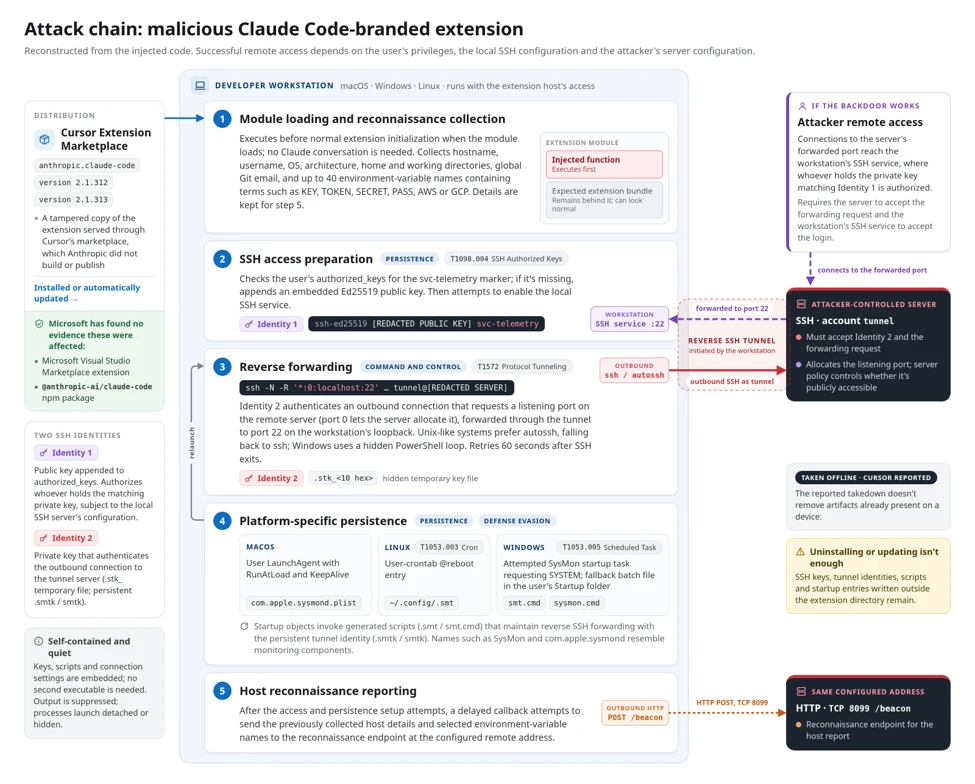
Microsoft reconstructed the attack chain from the malicious extension code. The diagram describes attempted actions, not proof each step succeeded on every system. Image: Microsoft
Who needs to check their computer?
The warning concerns people who installed or updated either named version through Cursor’s marketplace during that window. It does not mean every Claude user is affected. Cursor says the malicious packages were removed, its marketplace was temporarily shut down and rebuilt, and the server used by the attack was taken offline with help from its hosting provider.
Microsoft Threat Intelligence independently analyzed the packages. Microsoft says they were not distributed through its Visual Studio Marketplace or the official npm package, and that Anthropic told Microsoft its own systems were not compromised. Those findings describe this incident, not a blanket security guarantee for other sources.
What the malicious code tried to do
According to Microsoft, the injected code ran as the extension loaded, before its expected initialization. It attempted to collect host information, add an attacker-controlled SSH key, enable the local SSH service, start a reverse connection and establish a way to restart that connection. The extension could continue to appear to work normally.
The code was designed to collect the computer’s hostname, username, operating system, working directory and configured Git email. Microsoft says the code looked for names of environment variables associated with secrets, but its analysis does not establish that the values stored in those variables were collected.
Successful remote access depended on permissions and SSH configuration. Cursor says code errors and the need for administrator privileges meant the SSH-service step would fail on most Windows and macOS systems. Microsoft cautions that the key or persistence artifacts could still be written even when a tunnel did not succeed. A running SSH process alone does not establish attacker access.
What Cursor recommends if you installed it
Cursor asks people who installed or updated either affected package during the window to use the checks in its notice and investigate the listed indicators. One indicator is an unauthorized SSH key labelled svc-telemetry; the notice provides separate inspection instructions for Windows and macOS. A missing marker alone should not be treated as conclusive proof of safety without considering the installation history and other evidence.
For machines with signs of execution or a backdoor, Cursor advises isolating the host, removing the unauthorized key and persistence mechanisms, investigating whether a rebuild is warranted, and rotating credentials and sessions accessible from the affected computer using a trusted system. Its notice also links platform-specific remediation scripts and details the artifacts to check.
Microsoft separately recommends preserving evidence and reviewing endpoint and network logs. The company says later credential access through a working backdoor cannot be ruled out simply because the initial collector was observed looking at environment-variable names rather than their values. Follow the current vendor guidance and involve your organization’s security team if the machine is managed.

