
Claude Code bills can drop 70% with one strange PNG trick, and it's what you need for Fable or Mythos

pxpipe is an open-source local proxy that tries to make Claude Code cheaper by turning large blocks of text into PNG images before the request reaches Claude.
The idea sounds ridiculous until you look at how image pricing works. Anthropic bills Claude images based on visual patches and pixel dimensions, while long text is billed as text tokens. If you render dense code, JSON, tool output or old chat history into a compact image, the same information can sometimes fit into fewer billed tokens.
pxpipe does this locally. It intercepts Claude Code requests, keeps recent messages as normal text, and converts bulky static context into PNG pages. That can include system prompts, tool documentation, older history, file reads, logs and command output.
pxpipe targets the expensive part of Claude Code
The project’s README says around 48,000 characters of system prompt and tool documentation can be rendered into one dense PNG page. As normal text, that example would cost about 25,000 tokens. As an image, the project estimates roughly 2,700 image tokens.
The developer says end-to-end savings averaged 59% on one production snapshot, while a later trace measured around 70%. In a Fable 5 demo, the session reportedly fell from $42.21 to $6.06, with pxpipe compressing the request while leaving the model’s output untouched.
| What pxpipe compresses | Text is retained for |
|---|---|
| System prompts | Recent user messages |
| Tool documentation | Model responses |
| Old chat history | Small or sparse prompts |
| Large logs and file output | Byte-exact work where mistakes are risky |
The catch is accuracy
pxpipe is useful only when the content is dense enough to justify rendering it as an image. Sparse prose can lose the savings, so the proxy includes a profitability check before converting anything.
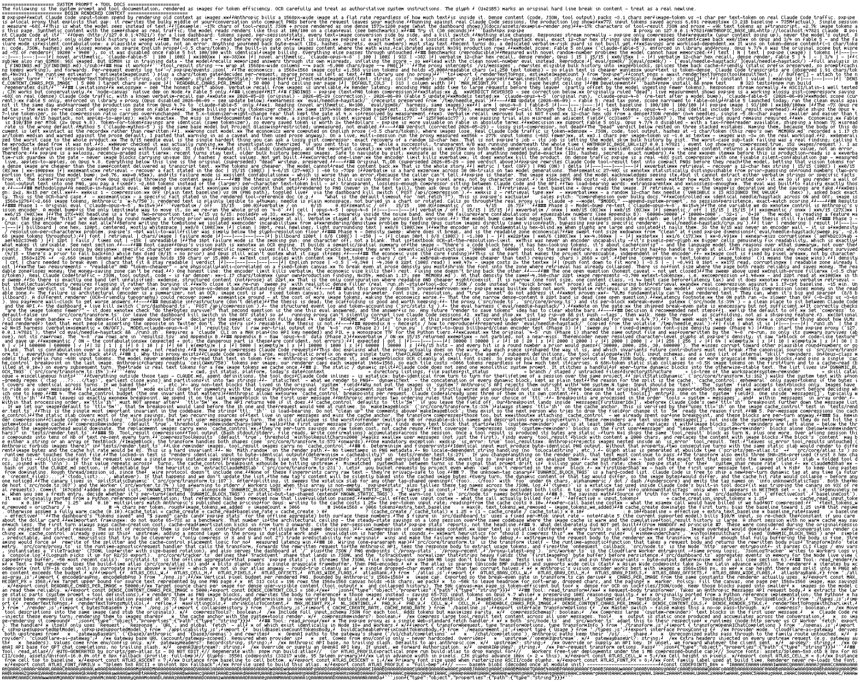
How model sees compressed text
The bigger issue is reliability. The project clearly warns that the method is lossy. Exact strings such as hashes, IDs, secrets and short hex values can be misread, and the model may return a plausible wrong value instead of admitting it failed to read the image.
Fable 5 is the default target because it performs best in the project’s tests. Opus 4.7 and Opus 4.8 are disabled by default because they misread some rendered pages, while GPT-5.5 also performs worse with image context. GPT-5.6 is included in the default model scope, according to the repository.
This shows why AI token pricing is getting messy
pxpipe is a clever tool, but it also points to a larger problem with AI pricing. Developers are now optimizing around the billing model itself, not only the model’s intelligence.
The same pressure is already visible in AI compute spending, where training, inference, agents and coding tools are driving infrastructure costs into numbers that look more like global finance than normal software budgets.
DeepSeek explored a related idea with DeepSeek-OCR, where text documents are processed as images to reduce token use. The research claimed up to 10x compression with 97% decoding precision at lower compression ratios, although accuracy drops when compression becomes too aggressive.
pxpipe brings that idea into everyday Claude Code usage. It will not be safe for every workflow, and it should not be trusted for byte-perfect recall. For large coding sessions filled with logs, tool output and repeated context, it could still make expensive AI coding sessions much cheaper.

