
Your ChatGPT Plus allowance now runs 16 other apps, but each one gets a limit
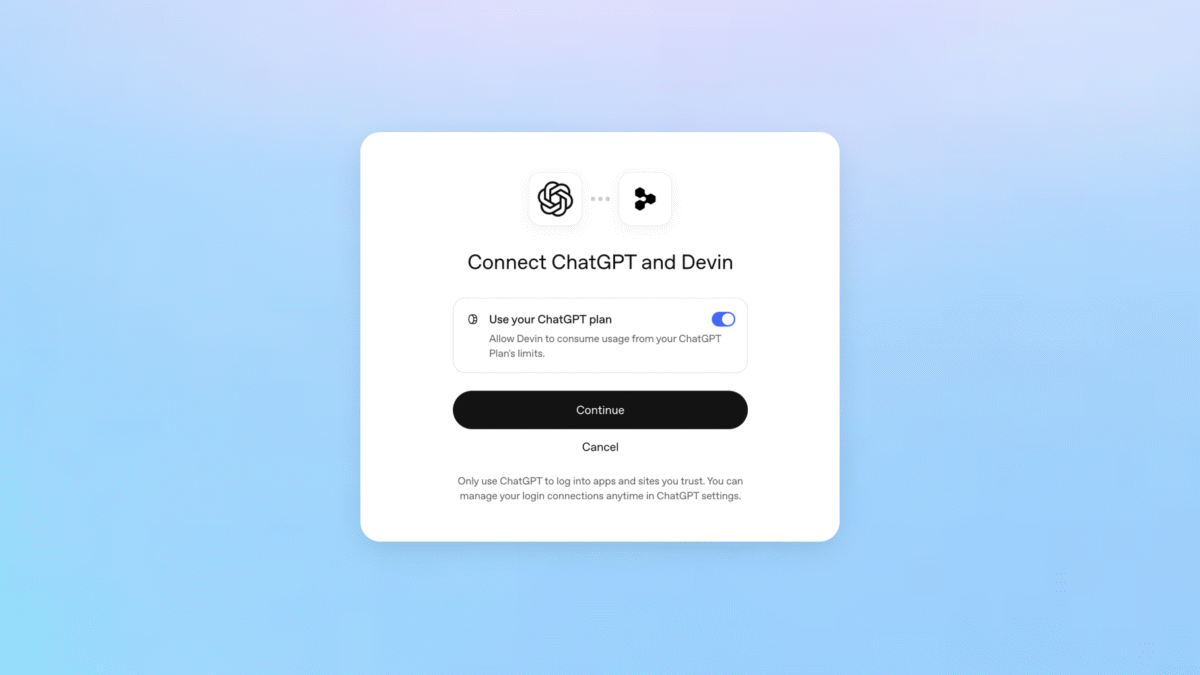
Since September 29 a ChatGPT Plus or Pro subscription can pay for work done outside ChatGPT, in 16 other companies’ apps, with no API key involved. OpenAI’s release notes put it this way: "Eligible Plus and Pro users can authorize participating apps to use their ChatGPT model allowance without creating an API key. Choose which apps can use your allowance and set an app-specific limit."

Signing in with a ChatGPT account and letting an app spend the plan allowance are two separate permissions. Image: OpenAI
The allowance does not grow to cover them. "Usage counts toward your existing plan allowance; connecting an app does not add more usage," the notes say, so every token an outside app spends is one the subscriber cannot spend in ChatGPT.
OpenAI names all 16 apps
OpenAI’s DevDay 2026 recap gives the count and six of the names: "Use your allowance across 16 partners including Cognition’s Devin, Notion, Vercel, T3, OpenClaw, and Dactyl, and control how much each can use." The other 10 sit in OpenAI’s partner directory, which lists 12 apps that take ChatGPT plan usage: Amp Code, Conductor, Dactyl, Devin, Hermes Agent, Hyperagent, Kilo Code, Lovable, Notion, Vercel, Vorflux and Warp. Lovable is marked coming soon. Four open-source integrations complete the 16: OpenClaw, OpenCode, Pi and T3.
A second group takes the login and nothing else. Airtable, Canva, GitLab, HubSpot and Supabase accept a ChatGPT sign-in without touching the plan allowance.
Availability splits in two. "Identity is available globally," OpenAI says, while "plan usage is available to Plus and Pro users in participating tools".
The limits are the part to read
This is a preview, and OpenAI says so in the same release notes: "This is a limited preview with participating integrations. Using purchased credits requires a separate opt-in. A partner may still charge for its own product or services."
The per-app cap is weekly, set under Settings and then Usage as a percentage of the subscriber’s overall weekly ChatGPT usage. OpenAI’s help article is blunt about what that cap is not: "An app limit is a cap, not a separate pool of usage. It does not reserve usage for the app or increase your overall plan limits." An app can run out of its percentage while the subscriber still has ChatGPT usage left.
Credits bought on top of a plan stay out of this unless the subscriber lets them in. The option "is off by default and applies across participating apps", OpenAI says, and an app has to have its limit set to 100% before it can reach credits at all. A partner’s own subscription and fees are untouched by any of it.
Signing in is a separate permission
The other half of the announcement is Sign in with ChatGPT, which OpenAI documents as a distinct grant. A product that uses it "receives your name, email address, and profile picture if you have one", and "signing in does not share your ChatGPT conversations or memory; you approve any additional access separately".
OpenAI states the division plainly: "Sign-in access is separate from permission to use your ChatGPT plan allowance." Connecting an account to a tool therefore does not hand it the allowance, which takes its own authorisation and its own weekly ceiling.
The reach behind this is OpenAI’s own figure. The recap describes the company opening ChatGPT "as a shared surface where humans and agents can collaborate and where developers can directly launch new native experiences to our collective 1.2B weekly users". DevDay 2026 ran on September 29, and among its 25 items was a $500 Pro tier and the return of Pro 200.
OpenAI has not said how long the preview runs, or which countries count as participating tools. For now the allowance stretches to 16 apps, a weekly percentage at a time.

