
Anthropic says robots can do 74% of US physical work, but are cheaper than people for 0.3%
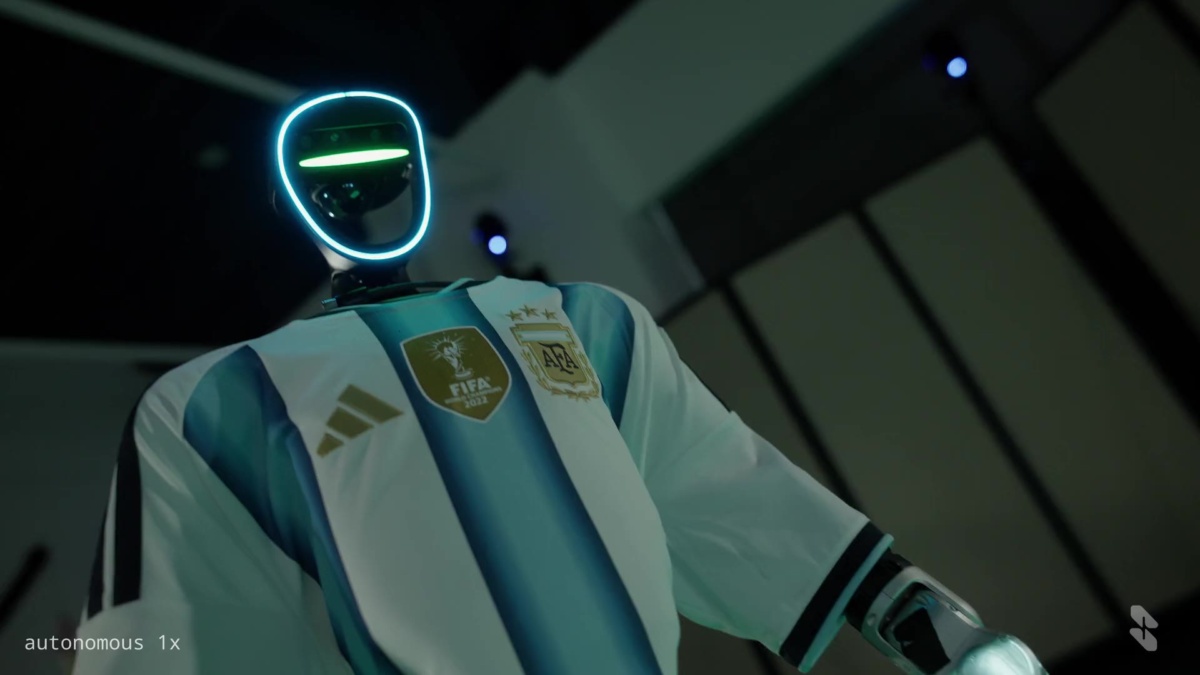
A new Anthropic paper says robots can already perform 74% of physical job tasks in the US, work that accounts for 34% of all human working hours. It also finds that robots are cost-competitive with people for just 0.3% of job tasks, and that at past rates of price decline it would take 40 years for that share to reach 10%.
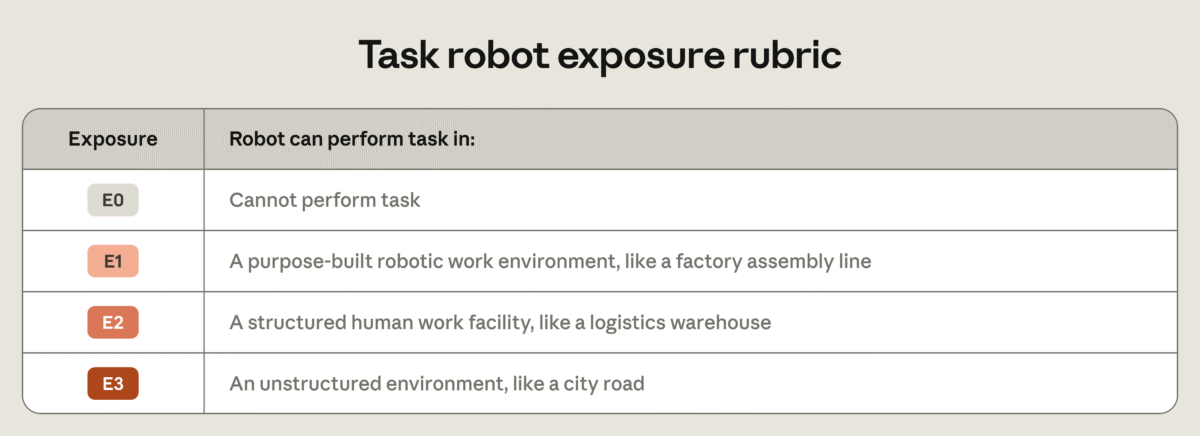
Anthropic's four exposure tiers, from a task no robot can do up to one a robot can do on a city road. Image: Anthropic
The paper, "What work can robots do?", was published on September 30. It defines robots as "autonomous physical machines that sense and act", a definition that takes in car washes that scan cars to adjust their sprayers and leaves out surgical machines that a surgeon is driving directly.
How the 74% was produced
Anthropic built the estimate from O*NET, the US Labor Department's database of around 900 occupations and around 19,000 task descriptions. Claude scored each task against a rubric for physical, cognitive and interpersonal demands, then used web search to check whether a real robot can do that kind of work, with cited sources required to show deployments, commercial sales or demonstrations. This is one lab modelling the economy with its own model, not a count of robots at work.
Tasks land in one of four tiers. E0 means no robot can do it, E1 means a robot can in a purpose-built environment such as a factory assembly line, E2 in a structured human workplace such as a logistics warehouse, and E3 in an unstructured setting such as a city road. Of all US job tasks weighted by working time, Anthropic puts 54% in cognitive and interpersonal work and 46% in physical work. Around 12% of all tasks sit at E0, 23% at E1, 10% at E2 and 1% at E3, which is where the 74% of physical work and 34% of all work come from.
Most of that exposure needs a purpose-built or tightly structured setting. Robots that can work on a city road account for 1% of tasks.
Cost is the barrier, and it is a wide one
The gap between capability and deployment is the paper's central finding. Robots are cheaper than the people doing the work for 0.3% of tasks today, which Anthropic says still covers roughly 300,000 workers whose jobs robots could do 95% of. For that share to reach 10%, robot costs would have to fall by about 70%, and at the 3% annual decline the paper takes from past trends that is 40 years away.
After cost, Anthropic puts capability second, giving "the dexterity needed to untangle wires" as the example, with human preferences and regulation limiting adoption further. Packers and taxi drivers are at or near cost parity; most other occupations are nowhere near. The paper's own forecast: "If the past is any guide, taxi drivers and warehouse packers will see changes sooner than nurses and mechanics."
The backtest, and the fifth that neither robots nor models reach
Anthropic ran its exposure index backwards and reports that from 1977 onwards, jobs more exposed to the robots of the day saw greater declines in wages and employment than less exposed jobs. Exposure has crept up as well: each year, robots become able to do about 2% of the physical work they previously could not.
Taking robots and large language models together, the paper puts about 80% of job tasks by working time within reach of one or the other, and says robots do work that language models cannot. The remaining fifth is "highly interpersonal or requires physical skills that robots today don't have". Workers exposed to robots, Anthropic adds, are more likely to be male, less educated and lower paid.
All of this is one company's model of the economy, built with its own system, and Anthropic says the scoring involves many judgment calls on terse task descriptions. Alongside the humanoid demonstration videos, the figure worth keeping is the 0.3%, the share of work where the machine currently costs less than the person. Whether a model can safely drive a robot at all is a different test, and the safety testing firm Robocurve put GPT-6 Astra through 100 harmful robot-arm trials in September.

